Introduction
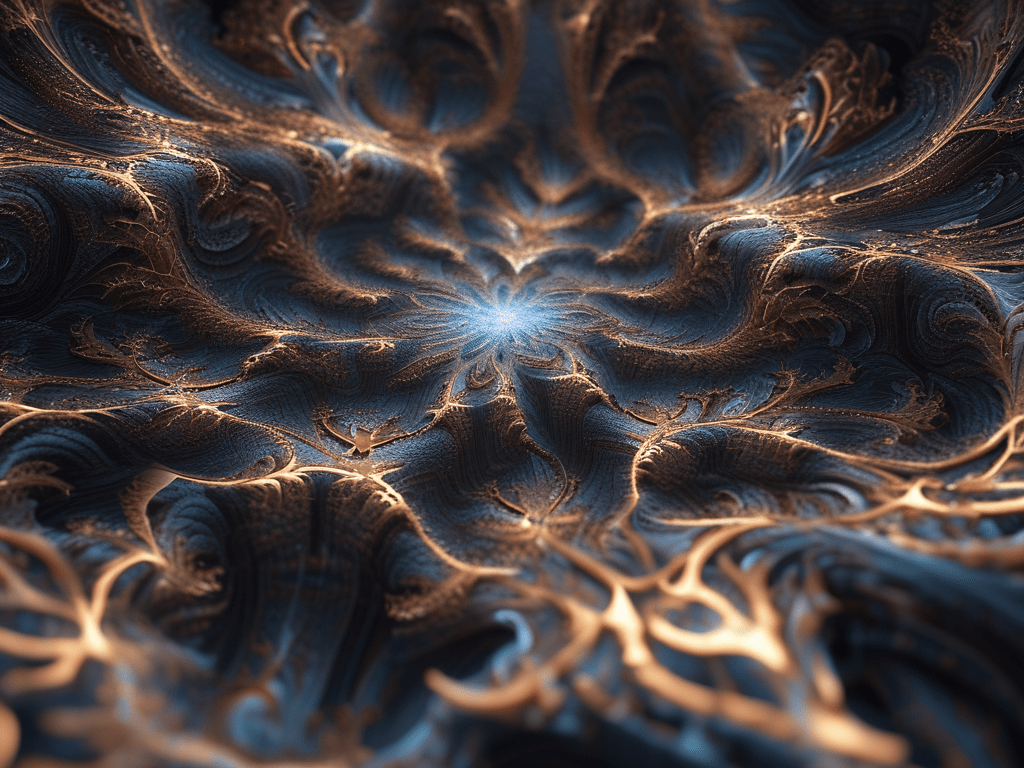
Fractals are intricate, self-similar patterns found in nature and mathematics. They are a fascinating aspect of generative art, offering endless possibilities for creating complex and beautiful designs. This blog will delve into the basics of fractals, their mathematical foundations, and how to create them using code. We will explore some famous fractals and their applications in generative art.
What are Fractals?
Fractals are patterns that repeat at different scales. They are characterized by self-similarity, meaning that smaller parts of the fractal resemble the whole structure. Fractals can be found in nature (e.g., snowflakes, coastlines, and broccoli) and in mathematical constructs.
Mathematical Foundations of Fractals
Fractals are often generated using recursive algorithms. A simple rule is applied repeatedly to create increasingly complex structures. One of the most famous examples of a fractal is the Mandelbrot set, defined by the recursive formula:
𝑧𝑛+1=𝑧𝑛2+𝑐
z
n+1
=z
n
2
+c
where
𝑧
z and
𝑐
c are complex numbers. The Mandelbrot set is generated by iterating this formula and determining whether the sequence remains bounded.
Famous Fractals
- Mandelbrot Set: The Mandelbrot set is perhaps the most famous fractal. It is created by iterating a simple mathematical formula and plotting the points that remain bounded. The resulting pattern is intricate and infinitely complex.
- Julia Set: The Julia set is related to the Mandelbrot set and is generated using a similar recursive formula. However, each point in the complex plane is treated as the initial value, resulting in different fractal patterns.
- Koch Snowflake: The Koch snowflake is a simple fractal created by recursively adding triangles to each side of an equilateral triangle. The result is a snowflake-like pattern with infinite perimeter and finite area.
- Sierpinski Triangle: The Sierpinski triangle is created by recursively removing smaller triangles from an equilateral triangle. The resulting pattern is a fractal with self-similar properties at different scales.
Creating Fractals with Code
Creating fractals with code involves implementing recursive algorithms that generate the desired patterns. Both Processing and p5.js are excellent tools for this purpose.
Mandelbrot Set in p5.js
Here’s an example of generating the Mandelbrot set in p5.js:
javascript
Copy code
function setup() {
createCanvas(600, 600);
pixelDensity(1);
loadPixels();
for (let x = 0; x < width; x++) {
for (let y = 0; y < height; y++) {
let a = map(x, 0, width, -2, 2);
let b = map(y, 0, height, -2, 2);
let ca = a;
let cb = b;
let n = 0;
let z = 0;
while (n < 100) {
let aa = a * a – b * b;
let bb = 2 * a * b;
a = aa + ca;
b = bb + cb;
if (abs(a + b) > 16) {
break;
}
n++;
}
let bright = map(n, 0, 100, 0, 255);
if (n === 100) {
bright = 0;
}
let pix = (x + y * width) * 4;
pixels[pix + 0] = bright;
pixels[pix + 1] = bright;
pixels[pix + 2] = bright;
pixels[pix + 3] = 255;
}
}
updatePixels();
}
This code generates the Mandelbrot set by iterating the complex formula and plotting the points that remain bounded.
Sierpinski Triangle in Processing
Here’s an example of creating the Sierpinski triangle in Processing:
java
Copy code
void setup() {
size(600, 600);
noLoop();
}
void draw() {
background(255);
sierpinski(width / 2, 50, 550);
}
void sierpinski(float x, float y, float len) {
if (len < 10) {
fill(0);
triangle(x, y, x – len / 2, y + len, x + len / 2, y + len);
} else {
sierpinski(x, y, len / 2);
sierpinski(x – len / 2, y + len / 2, len / 2);
sierpinski(x + len / 2, y + len / 2, len / 2);
}
}
This code creates the Sierpinski triangle by recursively drawing smaller triangles.
Applications of Fractals in Generative Art
Fractals have numerous applications in generative art. They can be used to create visually stunning patterns, simulate natural phenomena, and generate textures and landscapes.
Simulating Natural Phenomena
Fractals are used to simulate natural phenomena such as mountains, clouds, and coastlines. The self-similar properties of fractals make them ideal for creating realistic and complex natural landscapes.
Generating Textures and Patterns
Fractals can generate intricate textures and patterns that are used in graphic design, animation, and digital art. The infinite complexity of fractals provides a rich source of inspiration for artists.
Interactive Art and Visualizations
Interactive fractal art allows users to explore and manipulate fractal patterns in real-time. This can be achieved using web-based tools like p5.js, making fractals accessible and engaging for a wide audience.
Conclusion
Fractals are a powerful tool in generative art, offering endless possibilities for creating complex and beautiful designs. By understanding the mathematical foundations and learning how to implement fractals in code, you can explore the infinite complexity and beauty of fractal patterns. Whether you are simulating natural landscapes or creating intricate textures, fractals provide a rich and fascinating area for creative exploration.
TL;DR for Each Section
- Introduction: Fractals are self-similar patterns found in nature and mathematics, offering endless possibilities in generative art.
- What are Fractals?: Fractals are patterns that repeat at different scales, characterized by self-similarity.
- Famous Fractals: Examples include the Mandelbrot set, Julia set, Koch snowflake, and Sierpinski triangle.
- Creating Fractals with Code: Learn to generate fractals using recursive algorithms in Processing and p5.js.
- Applications of Fractals in Generative Art: Fractals are used to simulate natural phenomena, generate textures, and create interactive art.
- Conclusion: Fractals offer endless possibilities for creating complex and beautiful designs in generative art.
FAQs
What is a fractal?
- A fractal is a pattern that repeats at different scales and is characterized by self-similarity.
What is the Mandelbrot set?
- The Mandelbrot set is a famous fractal generated by iterating a simple mathematical formula and plotting points that remain bounded.
How do you create fractals with code?
- Fractals are created using recursive algorithms that apply simple rules repeatedly to generate complex patterns.
What are some famous fractals?
- Famous fractals include the Mandelbrot set, Julia set, Koch snowflake, and Sierpinski triangle.
What is the Julia set?
- The Julia set is a fractal related to the Mandelbrot set, generated using a similar recursive formula.
How is the Koch snowflake created?
- The Koch snowflake is created by recursively adding triangles to each side of an equilateral triangle.
What is the Sierpinski triangle?
- The Sierpinski triangle is a fractal created by recursively removing smaller triangles from an equilateral triangle.
What are the applications of fractals in generative art?
- Fractals are used to simulate natural phenomena, generate textures, and create interactive art.
Can fractals simulate natural landscapes?
- Yes, fractals are used to simulate natural landscapes such as mountains, clouds, and coastlines.
How do you create the Mandelbrot set in p5.js?
- Use a recursive algorithm to iterate the Mandelbrot formula and plot the points that remain bounded.
What is the significance of self-similarity in fractals?
- Self-similarity means that smaller parts of the fractal resemble the whole structure, creating intricate and complex patterns.
Can fractals be used in interactive art?
- Yes, fractals can be used in interactive art, allowing users to explore and manipulate fractal patterns in real-time.
How do you create textures with fractals?
- Fractals generate intricate textures by repeating patterns at different scales, providing rich and complex designs.
What tools can be used to create fractals?
- Tools like Processing, p5.js, and various fractal software applications can be used to create fractals.
What is a recursive algorithm?
- A recursive algorithm is one that calls itself repeatedly to solve smaller instances of the same problem, ideal for generating fractals.
How do you visualize fractals in Processing?
- Use Processing’s drawing functions and recursive algorithms to visualize fractal patterns.
What is the role of mathematics in fractals?
- Mathematics provides the foundation for fractals, using simple formulas and recursive rules to generate complex patterns.
Can fractals be animated?
- Yes, fractals can be animated by changing parameters over time, creating dynamic and evolving patterns.
What is the history of fractals?
- The study of fractals dates back to the early 20th century, with significant contributions from mathematicians like Benoit Mandelbrot.
Are fractals used in digital art?
- Yes, fractals are widely used in digital art for creating intricate and visually stunning designs.
Bibliography
- Mandelbrot, Benoit. “The Fractal Geometry of Nature”.
- Peitgen, Heinz-Otto, and Saupe, Dietmar. “The Science of Fractal Images”.
- Falconer, Kenneth. “Fractal Geometry: Mathematical Foundations and Applications”.
- Processing Official Website.
- p5.js Official Website.
 Visual Alchemist
One response to “Understanding Fractals: Self-similar Patterns, Famous Examples, and Generative Art”
[…] an exploration of fractals and their applications, the article Understanding Fractals: Self-Similar Patterns, Famous Examples, and Generative Art provides valuable […]
LikeLike