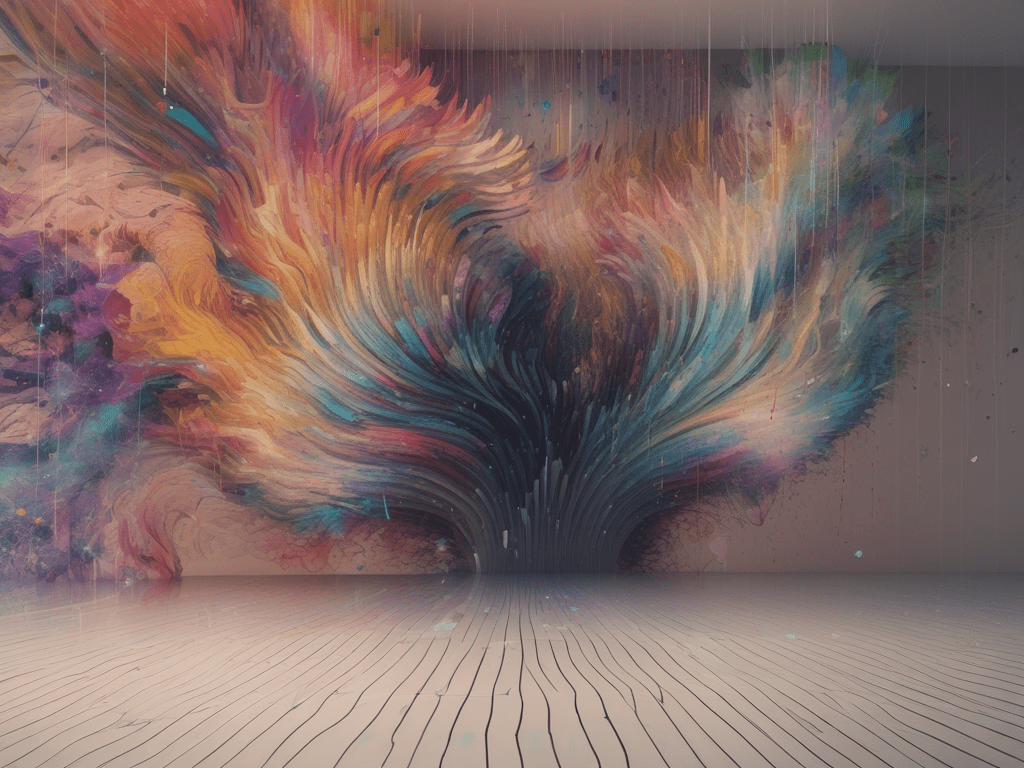
I remember the first time I stumbled upon a data-driven artwork. It was at a small gallery tucked away in a bustling urban village. I walked in, not knowing what to expect, and found myself face-to-face with a large screen displaying what looked like a living, breathing organism. Shapes and colors pulsed and flowed, responding to some unseen rhythm. I stood there, transfixed, for what felt like hours.
“What am I looking at?” I asked the gallery attendant.
“It’s a visualization of the city’s traffic patterns,” she replied with a smile.
That moment changed everything for me. I realized I was witnessing the birth of a new art form, one that merged technology, data, and creativity in ways I’d never imagined. From that day on, I dove headfirst into the world of data-driven art, exploring its depths in the vibrant cultural landscape around me.
So, what exactly is data-driven art? Well, imagine if you could take the vast sea of information that surrounds us every day – from public transportation ridership to air quality indices – and transform it into something beautiful, something that speaks to our emotions and our intellect at the same time. That’s what data-driven art does. It’s like alchemy for the digital age, turning raw data into gold.
The Complexity of Simplicity
One of the first things that fascinated me about data-driven art was its connection to complexity theory. I remember sitting in a café, scribbling furiously in my notebook as I tried to wrap my head around the concept. How could something so simple create something so intricate?
I started experimenting with simple algorithms, watching in awe as they generated patterns of astounding complexity. It reminded me of a time when I was a kid, watching a flock of birds swoop and swirl in perfect unison over a river. I later learned that this behavior, known as murmuration, emerges from a few simple rules followed by each bird. It’s the same principle at work in many data-driven artworks.
The Artist or the Algorithm?
As I delved deeper into data-driven art, I found myself grappling with some pretty heavy philosophical questions. I remember having a heated debate with a friend over dinner about the nature of creativity in this context.
“But if a computer is generating the artwork, how can you call it art?” she challenged.
I paused, fork midway to my mouth, as I considered her question. It’s something I’ve wrestled with a lot. Who’s the real artist here? The person who writes the algorithm, or the algorithm itself?
After years of creating my own data-driven artworks in my small home studio, I’ve come to see it as a collaboration between human and machine. I set the parameters, choose the data, design the system – but then I step back and let the algorithm explore the possibilities within that framework. It’s like I’m creating a digital artist, in a way. I never know exactly what it’s going to produce, and that element of surprise is part of what makes it so exciting.
Data as My Palette
One of the most thrilling aspects of working in this field is using data as my artistic medium. It’s opened up a whole new world of creative possibilities for me. I’ve created soundscapes from stock market data, visual landscapes from social media feeds about local politics, and interactive installations that respond to weather patterns.
I’ll never forget the time I created a piece based on my own health data. For a month, I tracked everything – my steps, my heart rate, my sleep patterns, even my mood. Then I fed all that data into an algorithm I’d designed. The resulting artwork was like looking at my life through a kaleidoscope. It was deeply personal yet somehow universal. When I exhibited it, people would stand in front of it for ages, seeing their own lives reflected in the patterns of my data.
Making the Invisible Visible
One of the aspects of data-driven art that I find most powerful is its ability to make visible things that are usually hidden from view. I’ve created visualizations that reveal patterns in everything from public transportation usage to migration patterns within urban areas.
There was one project that really brought this home for me. I was commissioned to create a piece about wealth inequality in a major city. I spent months collecting and analyzing data, trying to figure out how to represent it visually. The final piece was an interactive map where the height of each building corresponded to the average income of its residents.
When it was installed in a public space, the response was overwhelming. People would stand in front of it, finding their own neighborhoods, discussing what they saw. It sparked conversations about policy, about society, about the very shape of our cities. That’s when I realized the true potential of this art form – not just to create something beautiful, but to change the way people see the world around them.
Interactive Experiences
One of the most exciting developments I’ve seen in data-driven art is the rise of interactive installations. I love creating pieces that invite the audience to become part of the artwork, to shape it with their presence and actions.
I once created an installation for a science museum where visitors could interact with a visualization of air quality data. As they moved through the space, their movements would trigger different data points, changing the colors and patterns on a large projection.
Watching people interact with the piece was fascinating. Children would run back and forth, laughing as they saw the changes they were causing. Adults would move more slowly, often stopping to read the information about each area’s air quality. Some people would work together to trigger specific combinations. It was like watching a dance between the audience and the data.
Looking to the Future
As I think about the future of data-driven art, I can’t help but feel a sense of excitement and anticipation. The field is evolving so rapidly, with new technologies opening up possibilities we couldn’t have imagined even a few years ago.
I’m particularly intrigued by the potential of artificial intelligence and machine learning in this context. I’ve been experimenting with neural networks that can generate their own artworks based on training data from various neighborhoods. It’s mind-bending to think about – a computer not just executing an algorithm, but learning and creating in ways that mimic human creativity.
As I look back on my journey through the world of data-driven art, I’m struck by how much it has changed me. It’s not just about the art I create – it’s about the way I see the world around me. I find myself constantly aware of the data flows around us, the hidden patterns in everyday life, the complex systems that shape our experiences in this diverse society.
Data-driven art has taught me to see beauty in unexpected places – in the rhythms of traffic lights, in the fluctuations of local markets, in the ebb and flow of social media conversations. It’s shown me that creativity can arise from the intersection of disciplines, that technology and art aren’t separate realms but deeply interconnected ways of exploring and expressing our world.
Most of all, it’s given me a new language to communicate ideas, to ask questions, to challenge perceptions about life in the modern world. Every time I create a new piece, I feel like I’m adding to a growing conversation about our relationship with data, with technology, with each other in this dynamic urban landscape.
So the next time you encounter a piece of data-driven art – whether it’s at a gallery, an installation at a mall, or a public display – I encourage you to spend some time with it. Look closely. Interact if you can. Think about the data behind it, the code that shaped it, the questions it’s asking about our society. You might just find, as I did, that it changes the way you see the world around you.
And who knows? Maybe you’ll be inspired to start your own journey into this fascinating field. Trust me, it’s a journey well worth taking in this world of endless possibilities.
 Visual Alchemist
2 responses to “Critical Theories in Data-Driven Art: Philosophical and Technical Perspectives”
[…] For those interested in the philosophical and technical underpinnings of these shifts, exploring Critical Theories in Data-Driven Art: Philosophical and Technical Perspectives can provide deeper […]
LikeLike
[…] Improved: “A curious Siamese cat exploring a mystical library” To specify subject matter effectively, you might gain inspiration from understanding critical theories in data-driven art. […]
LikeLike