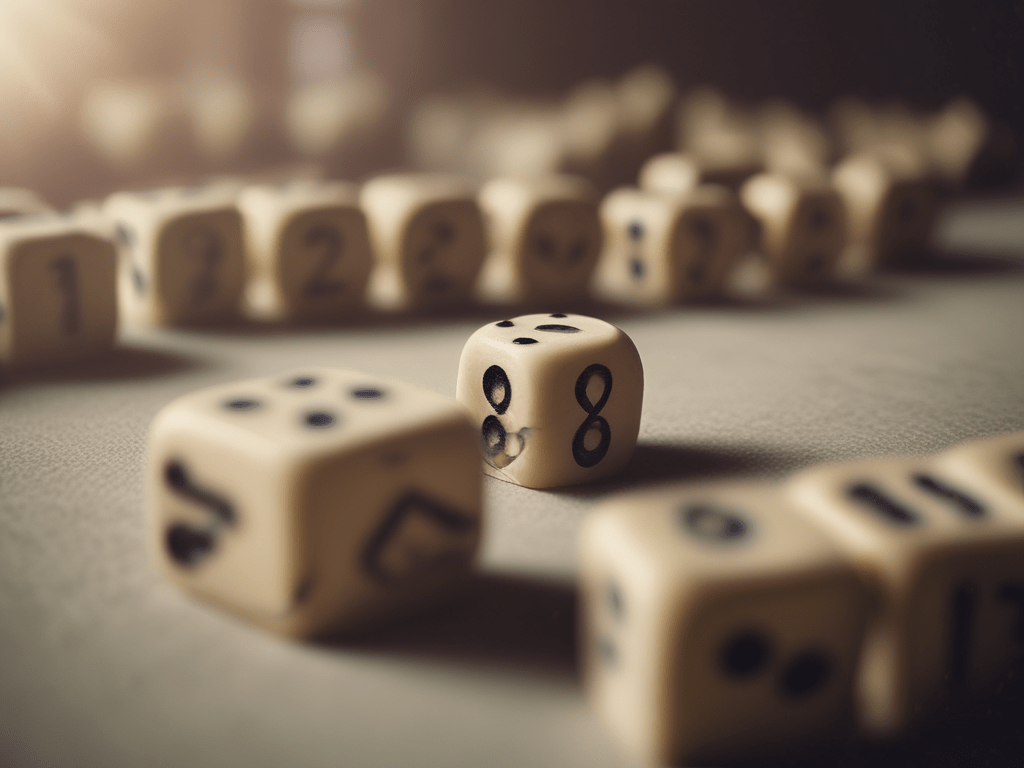
I remember the first time I stumbled upon the concept of data-driven art. It was during my college years, in a dusty corner of the university library. I had picked up an old book about experimental music composition, and there it was: Wolfgang Amadeus Mozart’s “Musikalisches Würfelspiel” (Musical Dice Game). The idea that Mozart, centuries ago, had created music using randomness from dice rolls blew my mind. Little did I know that this discovery would set me on a lifelong journey exploring the fascinating world of data-driven art.
As I delved deeper into this field, I realized that the fusion of art and data isn’t just a recent fad. It’s a rich tapestry woven through time, with each era adding its own unique threads. From those early dice games to today’s AI-generated masterpieces, the evolution of data-driven art is a story of human creativity meeting technological innovation. And it’s a story I’ve had the privilege of not just studying, but participating in.
The Dadaists: Chaos and Chance
After my encounter with Mozart’s dice game, I became obsessed with finding other early examples of data-driven art. My search led me to the Dada movement of the 1910s and 1920s. I’ll never forget the day I stood in front of Hans Arp’s “Chance Collage” at a museum in New York. The piece, created in 1920, consisted of torn pieces of paper dropped onto a surface and glued where they landed.
As I stared at the seemingly random arrangement, I couldn’t help but smile. Here was an artist, nearly a century ago, embracing chance and randomness as a creative tool. It struck me that Arp was, in a way, using gravity as his dataset and the falling papers as his algorithm. This realization opened my eyes to the fact that data-driven art isn’t just about computers and code – it’s about embracing systems and processes beyond direct human control to create something new.
Inspired by Arp’s work, I tried my hand at creating my own chance-based art. I spent weeks dropping everything from confetti to small toys onto canvases, photographing the results. While my creations were far from museum-worthy, the process taught me valuable lessons about relinquishing control and finding beauty in randomness – lessons that would serve me well as I continued to explore data-driven art.
The Post-War Revolution: Cybernetics and the Birth of Algorithmic Art
As I continued my journey through the history of data-driven art, I found myself fascinated by the post-World War II era. This period saw huge leaps in computing and cybernetics, and artists were quick to jump on board this technological revolution.
I remember attending a lecture on cybernetics during my graduate studies. The speaker talked about Norbert Wiener’s work in the 1940s, exploring the interplay between humans, machines, and systems. As I sat there, scribbling furiously in my notebook, I had an epiphany: Wiener’s ideas weren’t just about science and technology – they were laying the groundwork for a whole new approach to art.
This realization sent me on a research frenzy. I dug into the works of artists like Ben Laposky and Herbert Franke, who in the 1950s and 1960s were using analog computers and oscilloscopes to create abstract artworks. I spent hours poring over images of Laposky’s “Oscillons” and Franke’s “Oscillograms,” marveling at how they had used electronic signals to generate visual patterns.
Determined to experience this process firsthand, I managed to get my hands on an old oscilloscope. I’ll never forget the thrill of seeing my first self-generated “Oscillogram” flicker to life on the screen. It was a simple pattern, nothing compared to Laposky’s or Franke’s work, but to me, it felt like magic. I was no longer just an observer of data-driven art – I was a creator.
The Digital Revolution: My Foray into Generative Art
As my exploration continued, I found myself drawn into the digital revolution of the 1960s and 1970s. This was when computers really started to take center stage in artistic creation, and I was determined to be part of it.
I spent months learning to code, starting with basic algorithms and gradually working my way up to more complex systems. I was inspired by pioneers like Frieder Nake, Georg Nees, and Vera Molnár. Nake’s “Matrix Multiplications” and Molnár’s explorations of randomness through programmed instructions became my guiding lights.
My first successful piece of generative art was a series of digital “paintings” created using a simple algorithm that mimicked brush strokes. The results were far from perfect, but seeing my code translate into visual art was an indescribable feeling. I started to understand why organizations like ACM SIGGRAPH had become so important – they provided a crucial platform for artists and technologists to collaborate and push the boundaries of what was possible.
As I delved deeper into generative art, I began experimenting with fractals and cellular automata. I became obsessed with the idea that complex, beautiful patterns could emerge from simple rules. There were nights when I would lose track of time, tweaking parameters and watching in awe as my screen filled with intricate, ever-evolving designs.
Interactive Art: Engaging the Audience
The 1980s and 1990s brought a new dimension to data-driven art: interactivity. As I learned about works like Myron Krueger’s “Videoplace,” where participants’ movements were tracked and translated into digital interactions, I realized that the audience could become an integral part of the artwork itself.
Excited by this concept, I set out to create my own interactive installation. Using a basic motion sensor and a projector, I created a piece where viewers’ movements would trigger changes in a projected pattern. It was a simple setup, but the first time I saw someone interact with my creation – their face lighting up as they realized they were influencing the artwork – I knew I had tapped into something special.
This period also saw the rise of data visualization as an art form. I became enamored with the work of Edward Tufte, who showed that data itself could be beautiful. Inspired by Tufte and artists like John Maeda, I started to explore ways to turn datasets into visually appealing designs. One of my proudest achievements was a piece that translated local weather data into abstract patterns, changing in real-time with the temperature and wind speed.
The New Millennium: Big Data and Networked Art
As we entered the 21st century, the explosion of big data and networked systems opened up entirely new possibilities for data-driven art. I found myself in awe of artists like Aaron Koblin and Jer Thorp, who were using vast amounts of data to create intricate visualizations.
Koblin’s “Flight Patterns,” which visualized air traffic data, inspired me to look for hidden patterns in everyday data. I created a piece that visualized the rhythm of my city’s public transportation system, turning bus and train schedules into a mesmerizing dance of lines and colors.
The rise of social media also caught my attention. Inspired by projects like “We Feel Fine” by Jonathan Harris and Sep Kamvar, I started experimenting with using social media data in my art. One of my most successful pieces was a real-time visualization of Twitter emotions, where tweets from around the world were analyzed for emotional content and represented as a constantly shifting color field.
AI and Machine Learning: The New Frontier
In recent years, I’ve found myself captivated by the integration of artificial intelligence and machine learning in art. Artists like Mario Klingemann, with his AI-generated portraits, have pushed me to rethink my understanding of creativity and authorship.
Determined to explore this new frontier, I began studying machine learning. It was a steep learning curve, filled with frustrating dead ends and unexpected breakthroughs. My first successful AI-generated artwork was a series of abstract compositions created by a neural network trained on thousands of abstract paintings. The results were both familiar and alien, challenging my notions of artistic style and originality.
One of my most ambitious projects was inspired by Refik Anadol’s “Melting Memories.” I collaborated with a neuroscientist friend to create an installation that translated brainwave data into visual patterns. Seeing my own thoughts and emotions represented as swirling, colorful forms on a screen was a profound experience, one that made me reflect deeply on the nature of consciousness and creativity.
As I look back on my journey through the world of data-driven art, I’m struck by how far we’ve come – and how much further we have to go. From those early dice games to today’s AI-generated masterpieces, the evolution of this art form has been a testament to human creativity and technological innovation.
What excites me most about the future of data-driven art is its potential to help us understand and interpret our increasingly complex world. As we grapple with challenges like climate change, social inequality, and the ethical implications of AI, I believe data-driven art will play a crucial role in helping us visualize, understand, and engage with these issues.
I’m particularly interested in the potential of quantum computing in data-driven art. The ability to process and manipulate vast amounts of data in ways we can barely imagine today could lead to entirely new forms of artistic expression. I’ve already started sketching out ideas for quantum-based generative art, even though the technology is still in its infancy.
Another area I’m eager to explore is the intersection of data-driven art and virtual reality. Imagine being able to step inside a data visualization, to move through a three-dimensional representation of complex information. The possibilities for education, scientific understanding, and pure artistic expression are mind-boggling.
As I continue my work in this field, I’m also increasingly aware of the ethical considerations surrounding data-driven art. Questions of privacy, consent, and the potential misuse of personal data are always at the forefront of my mind. I believe it’s crucial for artists working in this medium to be thoughtful and responsible in their use of data, always considering the potential impact of their work on individuals and society.
My journey through the evolution of data-driven art has been more than just an academic pursuit or a career path – it’s been a transformative personal experience. Each new discovery, each experiment, each creation has changed the way I see the world around me.
I’ve learned to see patterns and relationships where I once saw only chaos. I’ve come to appreciate the beauty inherent in data and systems. And perhaps most importantly, I’ve gained a deeper understanding of the complex interplay between human creativity and technological innovation.
As I look to the future, I’m filled with excitement and anticipation. The field of data-driven art is evolving at a breathtaking pace, with new technologies and techniques emerging almost daily. Yet at its core, it remains what it has always been: a way to explore, understand, and represent the world around us in new and meaningful ways.
To anyone interested in exploring this field, I say: dive in. Experiment. Don’t be afraid to fail. Learn to code, but also learn to see. Look for patterns in the world around you. And above all, never stop asking questions.
The journey of data-driven art is far from over. In fact, I believe we’re still in the early stages of what this art form can become. As we move forward, I’m certain that data-driven art will continue to challenge our perceptions, expand our understanding, and reveal new ways of seeing and experiencing the world.
And who knows? Maybe years from now, someone will stumble upon one of my artworks in a dusty corner of a digital archive, and it will spark their own journey of discovery. That, to me, would be the greatest masterpiece of all.
 Visual Alchemist
One response to “From Dice Rolls to Neural Networks: My Journey Through the Evolution of Data-Driven Art”
[…] sound in UX design can thus enhance the emotional journey of users. According to a study on emotional engagement, sounds have the power to manipulate user emotions. Positive sounds, for example, can create […]
LikeLike