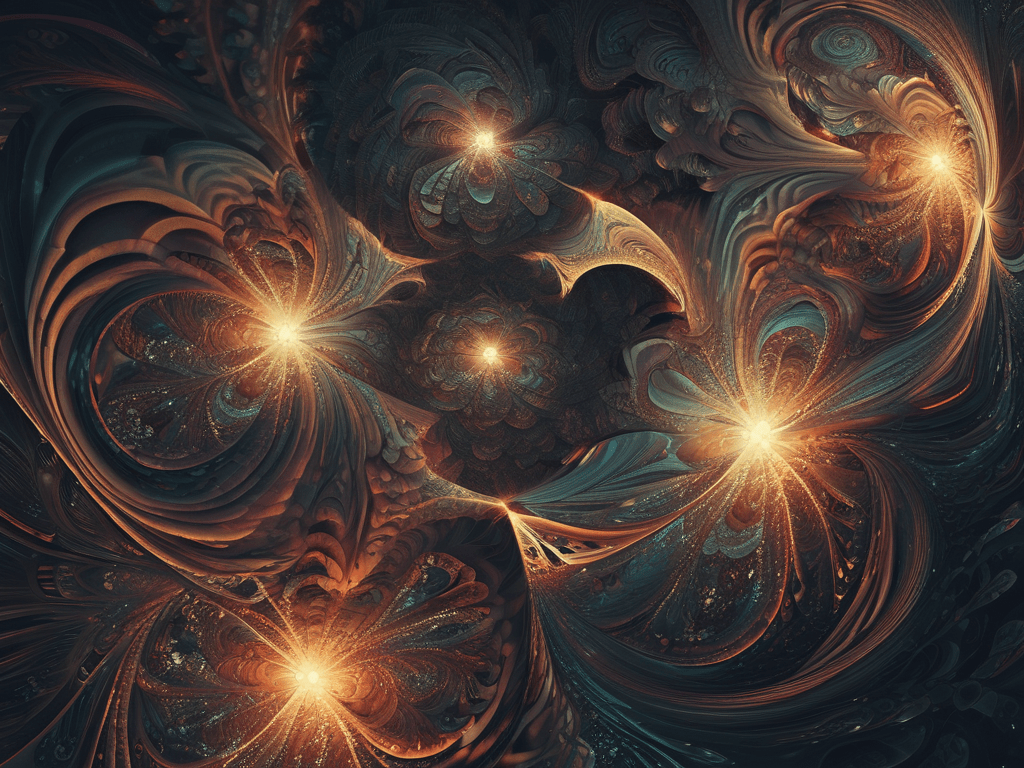
“Every act of creation is first an act of destruction”
– Pablo Picasso
His words remind me of the transformative journey of generative art. From its early beginnings to the sophisticated digital landscapes we see today, generative art has undergone a profound evolution, breaking and redefining artistic boundaries along the way.
As I delve into the history and development of generative art, I am continually amazed by how artists have harnessed the power of algorithms and systems to create works that challenge our perceptions and evoke deep emotional responses. The evolution of generative art is a testament to human ingenuity and the relentless pursuit of new forms of expression.
Early Beginnings
The roots of generative art can be traced back to the early 20th century, during the rise of modernism. Artists like Piet Mondrian and Wassily Kandinsky experimented with abstraction and systems in their work. They laid the groundwork for future explorations by embracing geometric forms and rules-based composition.
Mondrian’s use of grids and primary colors in his compositions introduced a sense of order and structure, while Kandinsky’s abstract forms and color theory explored the emotive potential of art. These early experiments set the stage for the emergence of algorithmic and systems-based art.
Algorithmic Art in the 1960s
The 1960s marked a significant turning point in the evolution of generative art with the advent of computer technology. Pioneers like Frieder Nake, Georg Nees, and Vera Molnar began using computers to create art. Their work involved writing algorithms that could generate complex patterns and forms, challenging traditional notions of authorship and creativity.
Frieder Nake’s “Matrix Multiplication” series and Vera Molnar’s “Computer Graphics” are notable examples from this period. These works demonstrated the potential of algorithms to produce intricate and aesthetically pleasing compositions, paving the way for future generations of generative artists.
The Rise of Fractals
The 1970s and 1980s saw the rise of fractal geometry, thanks to the groundbreaking work of mathematician Benoit Mandelbrot. Fractals are complex shapes that exhibit self-similarity at different scales, creating intricate patterns that are both visually stunning and mathematically significant.
Mandelbrot’s discovery of the Mandelbrot set captivated both scientists and artists. The intricate, infinitely complex shapes generated by simple iterative processes opened new avenues for exploration in generative art. Artists began incorporating fractal algorithms into their work, creating mesmerizing visuals that blurred the line between art and science.
The Digital Revolution
The digital revolution of the late 20th century brought significant advancements in computing power and software development. This period saw the emergence of tools and platforms specifically designed for generative art, such as Processing, OpenFrameworks, and Max/MSP.
Processing, developed by Casey Reas and Ben Fry, democratized access to generative art techniques by providing an easy-to-use platform for artists and designers. Its intuitive syntax and extensive library of functions enabled creators to experiment with complex algorithms and real-time interactivity without needing extensive programming knowledge.
Interactive and Real-Time Generative Art
With the rise of real-time computing and interactive technologies, generative art began to explore new dimensions. Artists like Scott Draves and Golan Levin pioneered interactive installations and software art that responded to user input, creating dynamic and immersive experiences.
Scott Draves’ “Electric Sheep” project, a distributed computing screensaver that evolves fractal animations based on user preferences, exemplifies the potential of interactive generative art. Golan Levin’s work, such as “Audiovisual Environment Suite,” allows users to manipulate visual and auditory elements in real-time, creating a participatory and collaborative artistic experience.
Generative Design in Architecture and Industrial Design
Generative techniques have also found applications in architecture and industrial design. Architects like Zaha Hadid and Patrik Schumacher have used parametric design and generative algorithms to create innovative and organic structures that push the boundaries of traditional architecture.
In industrial design, generative methods are employed to optimize forms and materials, leading to more efficient and sustainable products. The use of generative design software allows designers to explore a vast array of possibilities, resulting in unique and customized solutions.
The Influence of Machine Learning and AI
In recent years, the integration of machine learning and artificial intelligence (AI) has further expanded the possibilities of generative art. AI algorithms, such as generative adversarial networks (GANs), can learn from vast datasets to create new, unique artworks.
Artists like Mario Klingemann and Refik Anadol have leveraged AI to produce works that explore the boundaries between human and machine creativity. Mario Klingemann’s “Memories of Passersby I,” an AI-generated art installation, and Refik Anadol’s data-driven visualizations exemplify the potential of AI in generative art.
The Future of Generative Art
As we look to the future, the evolution of generative art shows no signs of slowing down. Emerging technologies like quantum computing and bioengineering are poised to open new frontiers for artistic exploration. Artists are also beginning to experiment with virtual and augmented reality, creating immersive generative experiences that engage all the senses.
The integration of generative art into everyday life is becoming more prevalent, with applications in fashion, interior design, and entertainment. Personalized generative art installations, generative fashion designs, and interactive media experiences are just a few examples of how generative art is shaping our cultural landscape.
The evolution of generative art is a journey marked by innovation, creativity, and the relentless pursuit of new forms of expression. From the early experiments of modernist painters to the sophisticated digital landscapes of today, generative art has continuously pushed the boundaries of what is possible.
As we continue to explore the intersection of art and technology, generative art will undoubtedly play a pivotal role in shaping the future of creative expression. Its ability to blend human intuition with computational logic offers endless possibilities, inviting us to imagine and create in ways we never thought possible.
 Visual Alchemist
2 responses to “Evolution of Generative Art”
[…] personality and flair. This shift mirrors the changes seen in other creative fields, such as the Evolution of Generative Art, where the integration of randomness and algorithmic techniques has opened new avenues for artistic […]
LikeLike
[…] are leveraging AI for groundbreaking visual storytelling. This transformation highlights a broader shift in generative art as a whole, where AI is becoming a cornerstone of creative […]
LikeLike