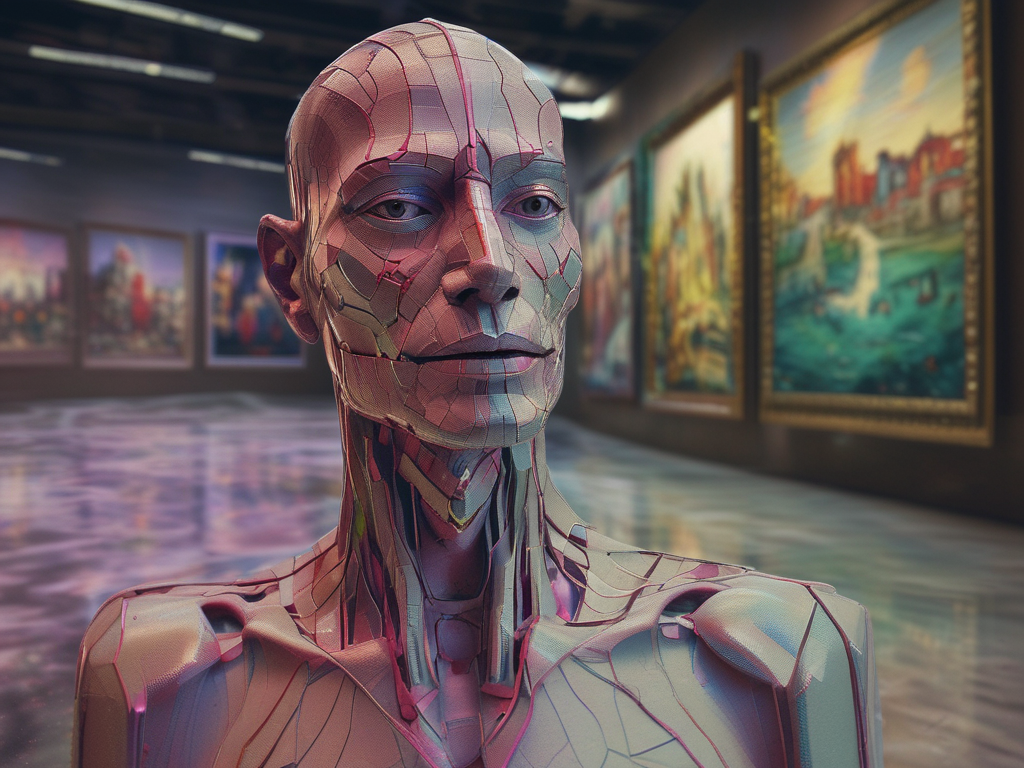
As AI-generated imagery becomes increasingly sophisticated, we find ourselves in an era where stunning visual content created by AI stands shoulder to shoulder with the masterpieces of traditional digital artists. Embracing this wave of innovation, the essence and boundaries of what we call art continue to be shaped by the human touch in creativity.
Defining Art in a Dynamic World
Art has always been a reflection of its time, mirroring shifts in society, technology, and methods of creation. From the focus on craftsmanship in ancient times to the breakaway from figurative art in the 20th century, art has continuously evolved.
The 1900s witnessed artists like Marcel Duchamp challenging traditional art definitions with his “readymades,” including a porcelain urinal signed “R. Mutt.” Through these works, he championed the idea that art is defined by the artist’s choice, presenting the artist as a ‘chooser’ rather than a ‘maker.’ Duchamp described his “readymades” as “an ordinary object elevated to the dignity of a work of art by the mere choice of an artist.”
With such a loose definition, institutions like museums and galleries have become the gatekeepers of what is recognized as art, valuing works that display visual excellence while resonating with contemporary themes and carrying historical and cultural significance.
But Really, What is Art?
In today’s landscape, where AI-generated works can be produced with simple text prompts, the focus shifts from manual technique to the artist’s conceptual choices and cultural narratives.
This evolution mirrors the journey of photography from a record-keeping tool to an art form recognized for its artistic vision. In the mid-1800s, photography was primarily seen as a means of documentation. However, as photographers began to infuse their artistic eye and carefully select or stage subject matter, photography began to be viewed as an art form. In 1905, Alfred Stieglitz opened his “291” gallery in New York, heralding photography as an avant-garde art form alongside sculpture and paintings, eventually earning recognition from other art institutions.
Today, photography is recognized as both an artistic medium and a method for precise documentation. This distinction is clear: there are fine art photographers whose work is expressive and interpretive, and those who use photography mainly to preserve moments, such as in wedding or event photography, which can also be executed with artistic finesse.
In the realm of AI-generated imagery, a similar debate unfolds. Some argue that without the depth of human experience, AI-crafted images cannot qualify as art. Conversely, others believe that certain AI-generated images deserve the ‘art’ label, crediting the creative influence of the prompt engineer or even the AI itself.
Despite varying viewpoints, the artist’s distinct vision and perspective remain irreplaceable. These elements elevate an artist to the role of a curator, infusing generated images with conceptual depth, transforming them into more than just pixels—into art.
Artistic Innovation Through AI
In the world of AI art, many artists are using unique visual inputs, developing their own algorithms, and incorporating their physical brushstrokes or other unique processes to produce their artworks. For example, Sougwen Chung uses AI models to program a painting robotic arm to create riveting patterns on canvas, while Sofia Crespo uses computer vision and machine learning to imagine new animals and marine life.
An increasing number of artists are using existing AI image generators to create artworks recognized by art institutions for their cultural and artistic merit. These works succeed because of the artistic process and careful curation, akin to Marcel Duchamp’s “choosing” from AI-generated images.
Egon Schiele’s Imaginary Paintings
OpenAI and Stefan Kutzenberger collaborated to imagine hypothetical paintings by long-deceased Austrian expressionist painter, Egon Schiele. By inputting Schiele’s existing works and lines from his poetry into DALL·E, they produced a series of paintings that exemplify the innovative potential of AI in art.
This project highlights AI’s capacity to bridge historical and contemporary art forms and raises ethical considerations about originality and authenticity in the digital age. Creating ‘new’ works in Schiele’s style underscores the complex relationship between artist, technology, and creation, prompting us to reflect on the nature of artistic expression in an AI-driven world.
Exploring “Us”: An Artistic Fusion of Human Insight and AI
In a remarkable display at the Denver Art Museum, the artwork ‘Us’ emerges as a testament to the partnership between human creativity and AI innovation. Artist Steven Yazzie, alongside poet Jennifer Elise Forster, blended traditional artistry with advanced technology.
Using Midjourney, an AI, to generate visuals based on Forster’s poetry and other artworks in the Denver Art Museum’s Near East to Far West, Fictions of French and American Colonialism exhibition, they produced forty visual options for each poetic prompt. Carefully selecting the most resonant image, they refined it with Stable Diffusion, creating a thought-provoking animation that reconstructs historical perceptions of Indigenous identities through a critical, contemporary lens.
An Uncharted Canvas: The Future of Art and AI
As we navigate the intersection of art and AI, it becomes clear that technology is both a tool and a collaborator. Artists are finding novel ways to incorporate AI into their work, guiding the process from concept to completion.
Consider projects like the hypothetical paintings of Egon Schiele or the multidimensional ‘Us’ at the Denver Art Museum. While these works showcase AI’s impressive capabilities, it’s the artists’ discernment in choosing and refining the output that infuses these pieces with meaning.
In this evolving landscape, the boundaries of art continue to stretch. Yet, amid this expansion, the artist’s vision remains at the heart of creativity. As we look to the future, artists will likely continue blending their insights with technology, prompting us to see art from fresh perspectives—connecting us to its deeply human roots in ever more accessible ways.
 Visual Alchemist
6 responses to “The Role of AI in Shaping Contemporary Art”
[…] To explore more about how AI is transforming contemporary art forms, check out The Role of AI in Shaping Contemporary Art. […]
LikeLike
[…] Peter Schaldenbrand, a Ph.D. student involved in the project, describes the experience of working with CoFRIDA: “If you start from a very simple sketch, CoFRIDA takes the artwork in vastly different directions. If you ask for six different drawings, you’ll get six very different options”. This adaptability makes CoFRIDA a valuable tool for fostering creativity, offering users the opportunity to act as art directors who guide the overall vision while the robot handles the execution of more technical details [1]. For insights into how generative art can redefine artistic possibilities, read our piece on The Role of AI in Shaping Contemporary Art. […]
LikeLike
[…] resonating with their target audiences. A similar embrace of playfulness can be seen in the Role of AI in Shaping Contemporary Art, where artificial intelligence helps generate creative outputs that challenge traditional forms of […]
LikeLike
[…] As I continue to explore these themes in the context of generative art and AI augmentation, I recognize that the ethical values guiding AI must be as dynamic and adaptable as the technology itself. Only by engaging with a broad spectrum of voices can we hope to create AI that truly reflects the diversity and richness of human values. You can follow my evolving reflections on these matters through articles like The Role of AI in Shaping Contemporary Art. […]
LikeLike
[…] it the AI itself? This blurring of lines has been debated heavily, particularly in pieces such as “The Role of AI in Shaping Contemporary Art” and “Can Autonomous Machines Truly Be […]
LikeLike
[…] Explore how AI is revolutionizing creativity in The Role of AI in Shaping Contemporary Art. […]
LikeLike