“Creativity is intelligence having fun”
– Albert Einstein, encapsulating the heart of generative art
The field of generative art is rich with diverse techniques that artists use to transform abstract concepts into tangible works of beauty and complexity. As I delve into these techniques, I am fascinated by the endless possibilities that arise from the interplay between algorithms and creativity.
Generative art leverages a variety of methods and tools to create dynamic and often unpredictable artworks. This article explores some of the key techniques used in generative art, providing insights into their applications and the unique aesthetics they produce.
Algorithmic Techniques
Fractals
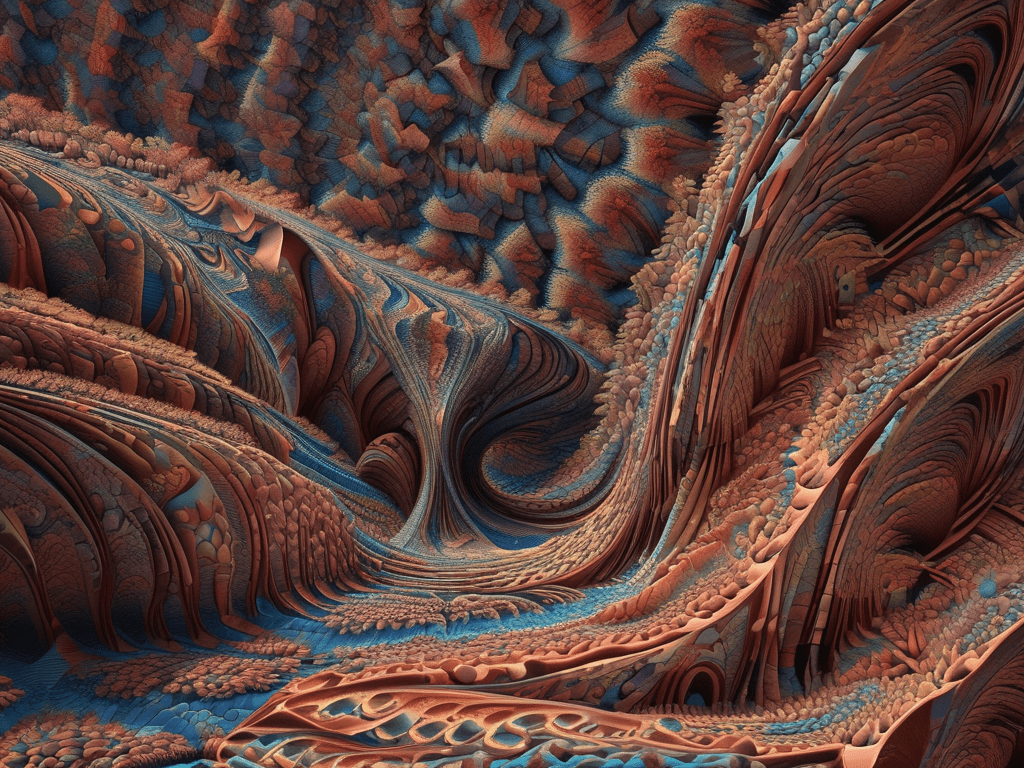
Fractals are complex geometric shapes that exhibit self-similarity at different scales. These shapes are created using recursive algorithms, where a simple process is repeated to generate intricate patterns.
Fractals are used in a variety of fields, from visual art and digital graphics to natural simulations and data visualization. Artists use fractals to create mesmerizing patterns, landscapes, and abstract compositions.
Examples:
- The Mandelbrot Set: Discovered by Benoit Mandelbrot, this set is one of the most famous examples of fractal geometry. It produces infinitely complex patterns that are visually captivating.
- Fractal Flames: Developed by Scott Draves, fractal flames are a type of fractal algorithm that generates ethereal and colorful images.
Cellular Automata
Cellular automata (CA) are grid-based systems where each cell changes state according to a set of rules and the states of neighboring cells. This technique can produce complex and dynamic patterns from simple initial conditions.
Cellular automata are used in generative art to create evolving patterns, simulate natural phenomena, and explore concepts of emergence and self-organization.
Examples:
- Conway’s Game of Life: Created by John Conway, this CA simulates the evolution of patterns based on simple rules. It has inspired countless artworks and simulations.
- Wolfram’s Rule 30: A one-dimensional cellular automaton studied by Stephen Wolfram, which produces complex, non-repeating patterns.
L-Systems
Lindenmayer systems (L-Systems) are a type of formal grammar used to model the growth processes of plants and other organisms. They use recursive rules to generate complex branching structures.
L-Systems are widely used in computer graphics, generative art, and biological modeling to create realistic representations of plants and natural forms.
Examples:
- Algorithmic Botany: Researchers use L-Systems to simulate the growth and form of plants, producing detailed and realistic models.
- Abstract Art: Artists use L-Systems to create intricate and organic-looking abstract compositions.
Perlin Noise
Perlin noise is a gradient noise function developed by Ken Perlin. It generates smooth, continuous noise patterns that are ideal for creating natural-looking textures and terrains.
Perlin noise is used in generative art, computer graphics, and procedural generation to simulate natural textures such as clouds, water, and terrain.
Examples:
- Terrain Generation: Used in video games and simulations to create realistic landscapes and environments.
- Texture Synthesis: Applied in digital art to create natural-looking textures and patterns.
Procedural Techniques
Procedural Modeling
Procedural modeling involves using algorithms to generate 3D models and structures. This technique allows for the creation of highly detailed and complex forms that can be easily modified and scaled.
Procedural modeling is widely used in architecture, game design, and visual effects to create intricate and realistic models.
Examples:
- CityEngine: A software tool that uses procedural modeling to generate detailed urban environments.
- Menger Sponge: A fractal-like 3D model created using procedural techniques, often used to explore mathematical concepts in art.
Generative Design
Generative design is a process that uses algorithms to explore a vast array of design possibilities. It allows designers to specify goals and constraints, with the algorithm generating multiple solutions to choose from.
Generative design is used in product design, architecture, and engineering to optimize forms, materials, and structures for performance and aesthetics.
Examples:
- Autodesk’s Dreamcatcher: A generative design tool that helps designers create optimized and innovative product designs.
- Generative Architecture: Used by architects like Zaha Hadid to create fluid and organic building designs.
Data-Driven Techniques
Data Visualization
Data visualization involves transforming data sets into visual representations. This technique helps to reveal patterns, trends, and insights that might be hidden in the raw data.
Data visualization is used in science, business, journalism, and art to make complex information accessible and engaging.
Examples:
- We Feel Fine: A project by Jonathan Harris and Sep Kamvar that visualizes human emotions based on data from blog posts.
- Wind Map: An interactive visualization by Fernanda Viégas and Martin Wattenberg that shows real-time wind patterns across the United States.
Generative Adversarial Networks (GANs)
Generative Adversarial Networks (GANs) are a type of machine learning model that consists of two neural networks—a generator and a discriminator—that work together to produce realistic images.
GANs are used in generative art to create new, unique artworks, often blending styles and forms in innovative ways.
Examples:
- DeepDream: Developed by Google, this GAN-based tool generates surreal and abstract images by enhancing patterns in existing images.
- Artbreeder: An online platform that uses GANs to allow users to create and blend images, producing unique and evolving artworks.
Interactive Techniques
Interactive Installations
Interactive installations are artworks that respond to user input or environmental data. These pieces create dynamic and participatory experiences, engaging audiences in new and meaningful ways.
Interactive installations are used in galleries, public spaces, and events to create immersive and engaging experiences.
Examples:
- Rain Room: Created by Random International, this installation allows visitors to walk through a room of falling water that stops wherever they move.
- Shadow Monsters: An interactive installation by Philip Worthington that transforms participants’ shadows into playful, animated creatures.
Real-Time Generative Art
Real-time generative art involves creating artworks that evolve and change in response to real-time data or user interactions. This technique allows for dynamic and fluid experiences that can continuously adapt and transform.
Real-time generative art is used in live performances, installations, and interactive media.
Examples:
- Patatap: An interactive website by Jono Brandel that generates visual and audio compositions in real-time based on user input.
- Audiovisual Performances: Artists like Ryoji Ikeda use real-time generative techniques to create immersive audiovisual experiences during live performances.
Generative art techniques encompass a wide range of methods and tools, each offering unique possibilities for creative expression. From algorithmic processes like fractals and cellular automata to procedural modeling and interactive installations, these techniques push the boundaries of what art can be. By exploring and mastering these techniques, artists can unlock new dimensions of creativity, producing works that are dynamic, engaging, and endlessly fascinating.
 Visual Alchemist