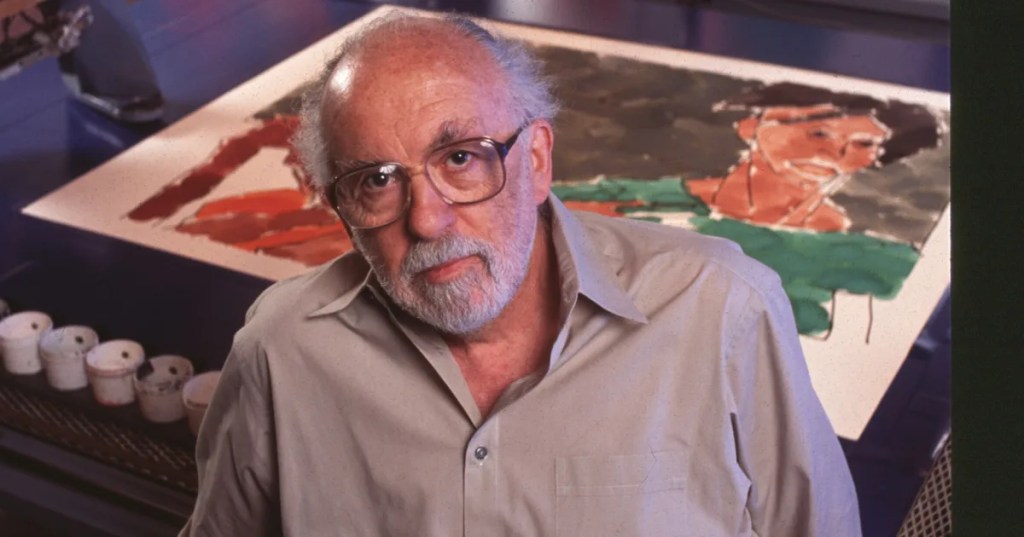
“Art is not about mastering a brush, but about mastering a process.” This quote, attributed to Harold Cohen, encapsulates his groundbreaking approach to creativity, an approach that bridged the seemingly disparate worlds of art and artificial intelligence. For Cohen, the canvas was no longer confined to the human hand but was extended by the potential of machines.
Purpose of the Article:
This article explores the life, work, and enduring legacy of Harold Cohen, one of the most innovative figures in the world of generative art. We will delve into his pioneering role in using artificial intelligence (AI) as a creative tool, specifically his work with AARON, the program he developed to create art autonomously. Through this journey, we’ll explore the significance of Cohen’s work in both art and computer science and examine how he reshaped the boundaries of what defines an “artist.”
Overview of Featured Artist:
Harold Cohen (1928-2016) was a British-born artist and professor who became a leading figure in the intersection of art and artificial intelligence. His transition from abstract painter to digital artist, along with his creation of AARON, a computer program that autonomously generates artworks, positioned him as a pioneer in generative art. Cohen’s work challenged traditional notions of authorship and creativity, igniting discussions about the role of technology in artistic practice.
Born in London in 1928, Harold Cohen was raised in an artistic environment and pursued his studies at the prestigious Slade School of Fine Art, University College London, in the late 1940s. During the early part of his career, Cohen was known primarily as a painter, working in the abstract style that was popular in post-war Britain. His works from this period were vibrant, gestural pieces that reflected the influence of European modernism and American abstract expressionism.

In the 1960s, Cohen began to grow increasingly dissatisfied with the limits of traditional painting. Always a thinker ahead of his time, he became interested in the role of systems and processes in artistic creation. After a trip to the U.S. in 1968, where he encountered the burgeoning fields of computer science and AI, Cohen saw an opportunity to merge his artistic inclinations with his fascination for technology. He eventually moved to California, where he took up a position at the University of California, San Diego (UCSD). This move marked the beginning of his transition from traditional painter to digital artist.
By the early 1970s, Cohen began experimenting with early computer programs and created AARON, a system designed to produce drawings autonomously. Over the next several decades, Cohen would dedicate his career to refining AARON, turning it into a sophisticated, semi-autonomous creative system capable of generating complex artworks.
Artistic Style and Medium:
Harold Cohen’s early artistic style was rooted in abstraction, but his foray into the digital realm revolutionized his medium and technique. With AARON, Cohen moved from the brush and canvas to the computer screen, coding a series of algorithms that allowed the machine to create art based on specific rules and procedures.
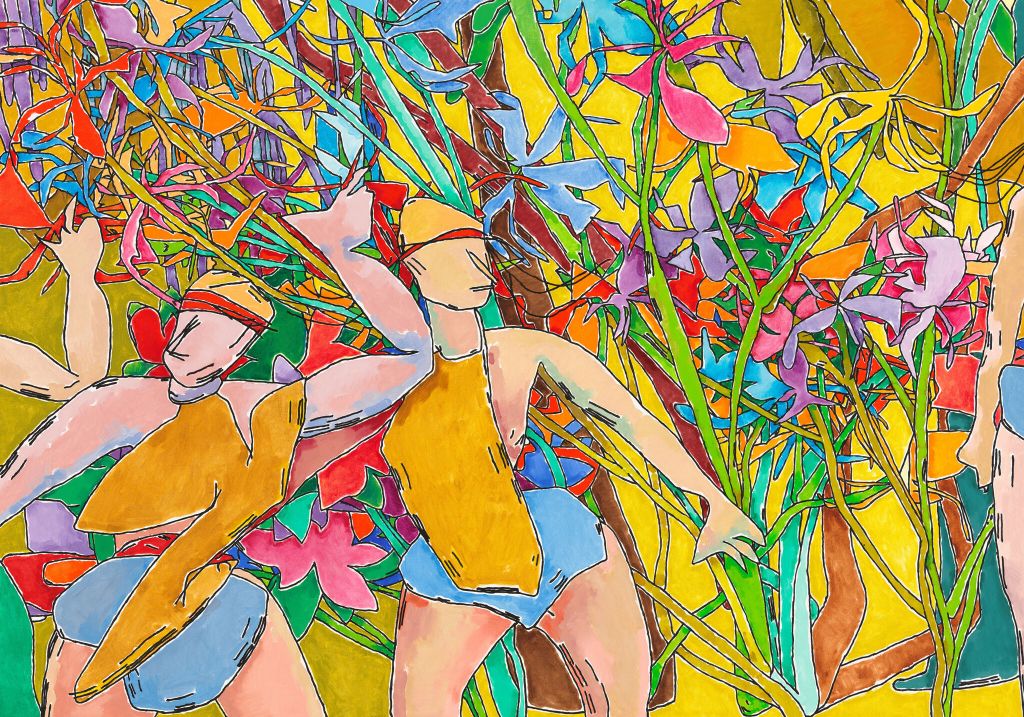
AARON was built to mimic certain aspects of the artistic process. It began by producing simple line drawings but eventually evolved to generate complex forms, including figures, plants, and abstract compositions. Cohen programmed the system to make decisions about line, shape, and composition autonomously, although the artist himself would sometimes intervene in the coloring process. As AARON evolved, it began to produce fully colored artworks, pushing the boundaries of generative art further.
Themes and Messages:
One of the most compelling themes in Harold Cohen’s work is the exploration of what it means to create. His work interrogated the concept of authorship, asking whether a machine can be considered an artist in its own right. Cohen’s artistic journey was a philosophical one, as he questioned the essence of creativity. Is art a purely human endeavor, or can machines possess a kind of creative agency?
By developing AARON, Cohen also explored the intersection between human knowledge and artificial intelligence. The machine’s “decisions” were, of course, based on the artist’s programming, but as AARON became more complex, Cohen allowed it to function with greater autonomy. His works ultimately challenged the viewer to consider the role of human intention in the artistic process—where does human creativity end, and where does machine generation begin?
Notable Works:
Several milestones in Cohen’s career stand out, marking his significant contributions to both the art and AI communities.
- Early AARON Drawings (1970s): The first versions of AARON were relatively simple, producing monochromatic line drawings. These early works resemble abstract forms that echo Cohen’s background in abstract painting. However, even at this stage, AARON’s creations demonstrated a sophistication in composition and form that was impressive for the time.
- AARON’s Color Works (1980s): As Cohen continued to refine AARON, he introduced more complexity into the system, including the ability to color its creations. One significant work from this period is “Untitled 1984”, in which AARON generated a full, multicolored abstract figure. This work showed that the program could autonomously generate both the form and the coloration of its compositions.
- “Cognitive Archaeology” (2004): This later work marked a shift in Cohen’s career, where he delved deeper into the philosophical implications of his project. AARON produced increasingly complex, painterly pieces, combining abstract shapes with vibrant colors. “Cognitive Archaeology” stands as a testament to the evolution of both Cohen’s ideas and his digital medium.
Personal Insights:
Cohen often remarked on his relationship with AARON, describing it not as a tool, but as a collaborator. “AARON doesn’t make art,” he would say, “but it draws—and that’s where all artists start.” This view emphasizes that while the machine could create images, Cohen believed the artistic spark remained human. His view of AARON as a partner rather than a mere tool highlights the evolving relationship between humans and technology in creative fields.
Common Threads:
Harold Cohen’s work is often compared to that of other generative and computational artists, such as Vera Molnar and Frieder Nake. All three share an interest in systems-based art and in exploring the aesthetic possibilities of algorithmic processes. Like Molnar, Cohen employed rule-based systems in the creation of his works, but Cohen pushed the concept further by making AARON increasingly autonomous.
Both Cohen and Nake were interested in how machines could engage with aesthetic creation, but while Nake focused on the mathematical beauty of algorithms, Cohen was more concerned with the philosophical implications of creativity itself. Cohen’s work specifically asked the question: What happens when we allow machines to move beyond being mere tools to become independent creators?
Diverse Perspectives:
Cohen’s journey from painter to computer artist sets him apart from many of his contemporaries. While other generative artists began with a focus on digital processes from the outset, Cohen’s background as a painter lent his work a different kind of nuance. His deep understanding of traditional art practices allowed him to translate concepts of form, color, and composition into digital code with a degree of sensitivity that many other generative artists may not have possessed.
Another critical distinction is that Cohen’s work with AARON was not about creating random generative art but about instilling a sense of human intention into a machine. This collaboration between artist and machine is central to understanding the impact of his work.
Impact on the Art World
Cultural Significance:
Harold Cohen’s work has had a profound impact on both the art world and the field of artificial intelligence. In a time when computers were seen primarily as tools for calculation, Cohen saw them as collaborators in creative practice. His work broke down the barriers between human and machine creativity, foreshadowing the rise of AI in many creative industries today.
AARON’s autonomous creations prompted philosophical discussions about the nature of art and authorship that remain relevant in contemporary discourse. With the advent of machine learning models like OpenAI’s DALL-E and Google’s DeepDream, Cohen’s early explorations of algorithmic art seem prophetic, anticipating the current wave of interest in AI-generated art.
Reception and Recognition:
During his lifetime, Cohen’s work was met with both fascination and skepticism. While some critics lauded his pioneering work in AI and art, others were more critical of the notion that a machine could truly be considered an artist. Nevertheless, as technology has advanced and AI has become more integrated into creative processes, Cohen’s work is increasingly recognized for its forward-thinking approach.
Cohen’s work with AARON has been exhibited in major museums around the world, including the Tate Gallery in London and the San Francisco Museum of Modern Art. His contributions to both the fields of art and computer science have also been acknowledged through numerous awards and accolades.
Future Directions:
Harold Cohen’s legacy continues to influence both artists and technologists today. As AI-generated art becomes more commonplace, Cohen’s early explorations remain a critical reference point. His work encourages a continued examination of the relationship between human and machine creativity, challenging contemporary artists to reconsider what it means to create in a world increasingly shaped by technology.
As AI systems become more advanced, capable of mimicking human creativity in increasingly sophisticated ways, Cohen’s work will undoubtedly continue to be studied as a foundational exploration of these themes. AARON, though it may be one of the earliest examples, remains an enduring symbol of the potential for collaboration between artists and machines.
Recap Key Points:
Harold Cohen’s career was a remarkable journey from traditional abstract painter to digital art pioneer. Through his creation of AARON, Cohen challenged long-standing assumptions about the role of the artist, asking whether creativity can exist in machines. His work not only pushed the boundaries of what was possible in the realm of generative art but also contributed to broader conversations about the nature of creativity and authorship in an age of rapidly advancing technology.
To truly appreciate the complexity and beauty of Harold Cohen’s work, explore AARON’s creations through online archives, museum collections, and exhibitions. Engaging directly with his works offers an opportunity to reflect on the intersections of art and technology in today’s world.
Harold Cohen’s artistic philosophy invites us to ask fundamental questions about creativity. In an era where machines are increasingly capable of artistic production, his work reminds us that the role of the artist is not just to create, but to question and redefine the very act of creation itself.
 Visual Alchemist
One response to “Artist Profile: Harold Cohen”
[…] the works of pioneers such as Harold Cohen, who used the AI system AARON to create generative paintings. Cohen’s works, alongside those of […]
LikeLike