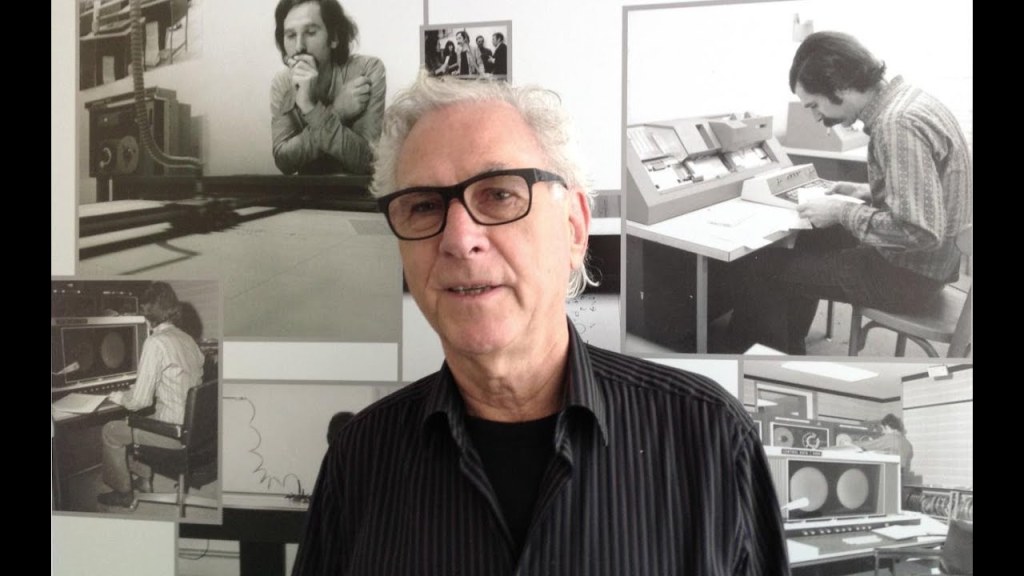
“Art is no longer a means of expressing the world but a means of constructing it.” This idea, central to the work of Manfred Mohr, a pioneer in generative art, encapsulates his belief that mathematics and algorithms are not just tools for creation but essential elements of the artistic process itself. Mohr’s artistic journey is one of evolving technology and deep philosophical questions about how we perceive, create, and experience art in a world increasingly dominated by systems and data.
In this article, we will explore the life, work, and legacy of Manfred Mohr, an artist whose generative art fundamentally altered the relationship between aesthetics and computation. We will examine his background in traditional painting, his transition to using computers as a central medium, and how his exploration of higher-dimensional spaces and algorithmic processes positioned him as one of the key figures in digital art. We will also consider his cultural significance and his ongoing influence on contemporary artists and technologists alike.
Manfred Mohr (b. 1938) is a German-born artist who is widely regarded as a key figure in generative and algorithmic art. Known for his exploration of the relationship between art, logic, and mathematics, Mohr was one of the first artists to use computers as a creative tool, leveraging algorithms to generate visual forms. His work, often based on complex geometric structures and high-dimensional spaces, has been pivotal in advancing the use of technology in the art world.
Background:
Manfred Mohr was born in 1938 in Pforzheim, Germany. His early years as an artist were spent exploring traditional forms of painting, jazz music, and abstract expressionism, which dominated the post-war art scene in Europe. However, Mohr’s interests soon shifted toward a more intellectual exploration of art, specifically focusing on how logical structures and systems could serve as a foundation for creative work.

Mohr studied fine art in France in the early 1960s, where he was heavily influenced by Abstract Expressionism. His exposure to the works of Jackson Pollock and Willem de Kooning spurred him to explore abstract forms, but it was his growing interest in mathematics and logic that would lead him to experiment with systematic and algorithmic processes. His discovery of Max Bense’s writing on information aesthetics in the late 1960s and the intellectual debates surrounding concrete art and formal systems greatly impacted his artistic trajectory.
In the late 1960s, Mohr’s encounter with the early use of computers for visual generation was a turning point in his career. He recognized the potential for computers to go beyond their functional role in science and mathematics and began to see them as collaborators in the creative process. This led to his groundbreaking shift from traditional painting to creating art entirely through computer algorithms.
Artistic Style and Medium:
Manfred Mohr’s artistic style is defined by his use of algorithms, mathematics, and geometric abstraction to generate complex visual forms. His early works, such as “P-100” and “P-121” from the early 1970s, were produced using FORTRAN programming on early computer systems. Mohr’s visual language relies on basic geometric shapes—lines, cubes, and grids—that are algorithmically manipulated to create intricate and often mesmerizing compositions.
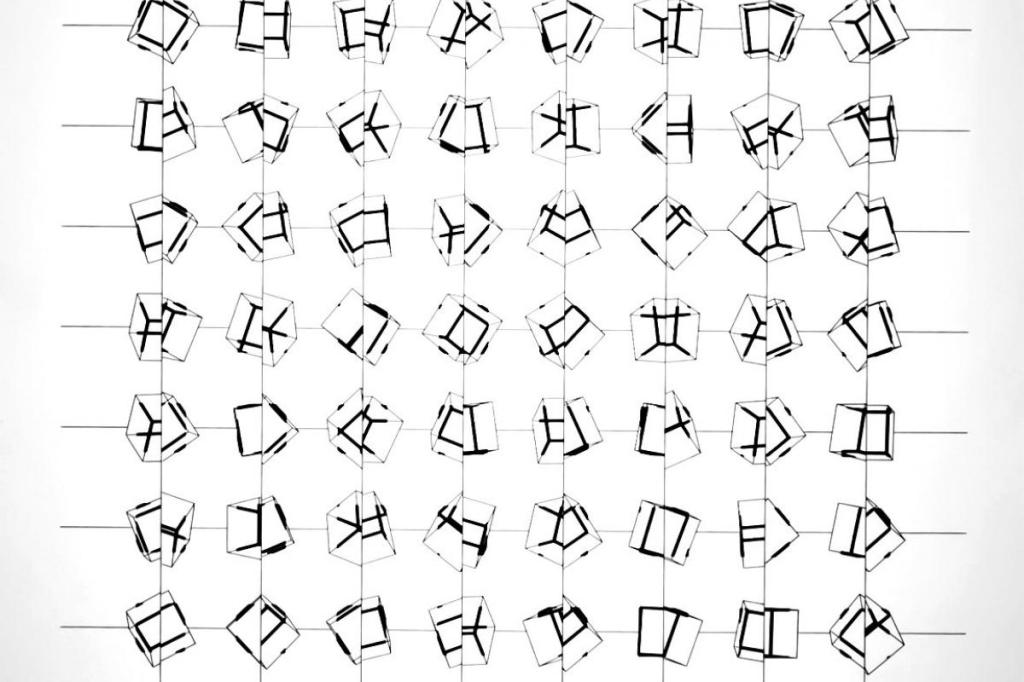
Mohr’s exploration of high-dimensional spaces, particularly the 4D hypercube (or tesseract), is a hallmark of his work. His pieces are often the result of systematic transformations of geometric shapes, rendered into two-dimensional visual forms through algorithms. These works challenge traditional notions of perspective, symmetry, and dimensionality, offering viewers a glimpse into complex, unseen mathematical worlds.

Another distinctive aspect of Mohr’s medium is his use of plotter machines to physically render his digital creations. These early plotters, which used pens to draw on paper, allowed Mohr to bring his algorithmic designs into the physical world. Over the decades, his use of technology has evolved alongside advancements in digital tools, but the core of his practice remains rooted in the use of systems and logic to guide artistic expression.
Themes and Messages:
The central theme of Manfred Mohr’s work is the relationship between mathematics and aesthetics. His art explores the tension between order and complexity, between rigid logical structures and the often unpredictable visual outcomes that result from algorithmic processes. Mohr’s work is deeply tied to the idea that art is a construction, not merely a representation of the world but a means of generating new worlds through logic and computation.
Mohr’s use of the hypercube is particularly significant in his exploration of higher-dimensional spaces. By translating the mathematical concept of the 4D cube into 2D visual forms, Mohr invites viewers to reflect on the limitations of human perception and the ways in which art can transcend those limitations through abstraction.
Another key theme in Mohr’s work is the role of randomness and variation within structured systems. While his algorithms are tightly controlled, the visual outcomes often have a sense of organic variation, reflecting Mohr’s belief that even within rigid systems, there is room for aesthetic freedom and interpretation.
Notable Works:
Several works stand out as milestones in Mohr’s career, each showcasing his innovative use of algorithmic processes and geometric abstraction.
- “P-100” (1973): One of Mohr’s early generative works, this piece was produced using FORTRAN programming and an early plotter machine. “P-100” is a series of intersecting lines and shapes, created by manipulating a simple algorithm that gradually increases the complexity of the forms. The piece exemplifies Mohr’s approach to exploring the tension between simplicity and complexity through mathematical rules.
- “P-511c” (1991): This work is part of Mohr’s exploration of the hypercube, where he systematically transforms the geometric structure of the 4D cube into various two-dimensional projections. The result is a mesmerizing series of abstract forms that shift and evolve, challenging the viewer’s sense of dimensionality.
- “Cubic Limit” (1980): One of Mohr’s most iconic series, “Cubic Limit” is based on the systematic manipulation of the three-dimensional cube. Through the application of various algorithms, Mohr creates a dynamic interplay of lines and planes, resulting in intricate, evolving visual patterns. This series represents Mohr’s continued fascination with geometric abstraction and the potential for algorithmic art to explore infinite visual possibilities.
Personal Insights:
Mohr often speaks about his art in terms of systems, algorithms, and logic, describing the process of creating art as a form of constructing worlds. “Art is about finding the simplest possible structure and developing it as far as it can go,” he has said. His works are a reflection of his belief that creativity is not inherently chaotic or emotional but can emerge from the application of clear rules and systems.
Mohr’s focus on the hypercube—a structure beyond human perception—reflects his desire to push the boundaries of how we think about space, form, and visual experience. By using mathematical models, he seeks to transcend the limitations of the human eye, offering a vision of reality that is both abstract and rooted in the logic of the universe.
Common Threads:
Manfred Mohr is often compared to other pioneers in the field of generative art, including Vera Molnar and Harold Cohen. Like Molnar, Mohr’s work is rooted in the systematic exploration of geometry and logic. Both artists utilize algorithms to generate visual outcomes, but where Molnar often introduces elements of randomness and human error, Mohr’s work is more strictly governed by mathematical rules.
Compared to Harold Cohen, whose focus was on using machines to mimic human drawing, Mohr’s work leans more heavily into abstraction and the exploration of high-dimensional forms. While Cohen’s AARON was designed to imitate human creativity, Mohr’s approach positions the machine as a collaborator in exploring spaces beyond human perception.
Diverse Perspectives:
Mohr’s background in traditional painting sets him apart from many other generative artists. While he eventually moved fully into digital art, his early works were deeply influenced by the gestural and expressive qualities of abstract painting. This influence is still visible in the way his algorithmic creations evoke a sense of movement and dynamism, even within their strict geometric constraints.
Another key difference is Mohr’s focus on higher-dimensional geometry, particularly his long-term exploration of the hypercube. While many generative artists work with simple 2D or 3D forms, Mohr’s commitment to visualizing 4D spaces adds a layer of intellectual depth to his work, positioning him as a unique figure in both the art world and the realm of mathematics.
Impact on the Art World
Cultural Significance:
Manfred Mohr’s work is a significant contribution to the ongoing conversation about the role of technology in art. As one of the earliest artists to use computers as a central creative tool, Mohr helped pave the way for the digital art movement, which has since become a dominant force in contemporary art. His work challenged traditional notions of what it means to be an artist, suggesting that creativity is not solely a human endeavor but something that can be shared with, and enhanced by, machines.
Mohr’s exploration of higher-dimensional spaces also intersects with broader cultural and philosophical questions about perception, reality, and the limits of human understanding. His work invites viewers to consider how technology can expand our horizons, allowing us to see and understand aspects of the world that are otherwise beyond our reach.
Reception and Recognition:
Mohr’s work has been exhibited in major galleries and museums around the world, including the Centre Pompidou in Paris and the Museum of Modern
Art in New York. Critics have praised his ability to merge art and mathematics in a way that is both intellectually rigorous and visually compelling. His work has been influential not only in the field of generative art but also in the broader context of digital and conceptual art.
As the use of algorithms and artificial intelligence in art continues to grow, Manfred Mohr’s legacy remains foundational. His systematic approach to generative art continues to influence contemporary artists who are exploring the possibilities of machine learning, AI, and algorithmic processes. As these technologies evolve, Mohr’s work serves as a reminder that art and logic are not mutually exclusive but can come together to create new and exciting forms of expression.
Mohr’s ongoing exploration of higher-dimensional spaces also points to future possibilities in virtual and augmented reality, where artists can create immersive environments that push the boundaries of how we experience space and form.
Recap Key Points:
Manfred Mohr’s artistic career is a testament to the power of combining art with mathematics and technology. From his early days as an abstract painter to his groundbreaking use of algorithms and computers, Mohr has consistently pushed the boundaries of what art can be. His exploration of geometric structures, particularly the hypercube, offers viewers a glimpse into higher-dimensional spaces, challenging our understanding of form and perception.
To fully appreciate the complexity and beauty of Manfred Mohr’s work, explore his digital archives, visit exhibitions featuring his works, or engage with contemporary generative artists who continue to build on his legacy. Mohr’s art encourages us to think critically about the role of technology in shaping how we see and create the world.
Manfred Mohr’s work is more than just an exploration of form—it is an intellectual and philosophical journey into the nature of creativity itself. In a world increasingly driven by algorithms and data, his art reminds us that even within the most rigid systems, there is room for beauty, variation, and discovery.
 Visual Alchemist