
“Art and mathematics share a common goal: they seek patterns, harmony, and an understanding of the world. But what happens when one merges the two? For Vera Molnar, it becomes an exploration of the digital and human, of the chaos and order that coexists in all creative endeavors.”
This article delves into the life and work of Vera Molnar, a pioneering figure in the intersection of art and computation. It aims to showcase her journey as an early adopter of digital tools in art, examine her contributions to contemporary art, and highlight her unique style that blends algorithmic logic with aesthetic beauty.
Vera Molnar is often regarded as one of the forerunners of generative and algorithmic art. A trailblazer in the digital art movement, she was among the first to incorporate computer algorithms into her creative process, long before the digital revolution became mainstream. Her works challenge the boundaries between human intuition and machine logic, offering a profound commentary on the possibilities and limits of creativity in the age of computation.
Background:
Vera Molnar was born in Budapest, Hungary, in 1924, a time when the world of art was heavily influenced by the classical traditions of painting and sculpture. However, her upbringing and early exposure to modernist movements played a crucial role in shaping her artistic vision. She initially studied art history and aesthetics at the Budapest College of Fine Arts, focusing on traditional methods of artistic creation. Yet, even in her early years, Molnar’s interests gravitated toward abstraction and geometry, inspired by the works of Piet Mondrian, Kazimir Malevich, and the De Stijl movement.

It wasn’t long before her curiosity led her to explore the connections between art and mathematics, leading to a seismic shift in her approach to creative work. In 1947, she moved to Paris, where she began to investigate the use of mathematical formulas in the generation of art, an interest that would eventually lead her to computational tools. By the late 1960s, Molnar was one of the first artists to experiment with computers, using them to explore the possibilities of algorithmic creation.
Artistic Style and Medium:
Vera Molnar’s artistic style is a blend of geometric abstraction and algorithmic precision. Her early works were created manually, with her employing a series of self-imposed rules to explore different visual possibilities. These “systematic drawings” laid the groundwork for her later computational works. When Molnar first encountered computers, she quickly realized their potential to generate art based on algorithms, which aligned with her interest in the logical, mathematical foundations of creativity.
Molnar’s most famous technique involves the gradual transformation of simple geometric shapes, like squares or lines, through a series of algorithmic steps. This allows her to produce variations that remain anchored in order but gradually introduce an element of visual “disorder.” Through this method, she explores the tension between control and chaos, precision and randomness. Molnar has primarily worked with digital mediums, employing early plotter machines (computer printers that draw with pens) to create intricate designs that would be nearly impossible to replicate by hand.

Themes and Messages:
At the core of Vera Molnar’s work is the exploration of systematic creativity—can machines, bound by rigid logic, produce art that evokes human emotions? Her art challenges the notion that artistic creation is solely reliant on human intuition and emotion. Instead, she suggests that algorithms and rules, often seen as cold and mechanical, can generate profound aesthetic experiences.

The duality of order and chaos, precision and randomness, is another recurring theme in her work. Molnar’s gradual introduction of “disturbances” or “errors” into the otherwise orderly sequences of shapes mimics the imperfections inherent in human creation, bridging the gap between machine-generated and handmade art. This tension between order and disorder mirrors broader existential questions about the nature of control, the limitations of human understanding, and the beauty found in imperfection.
Notable Works:
Several pieces stand out in Vera Molnar’s long career, each illustrating her fascination with geometry, repetition, and algorithmic distortion.
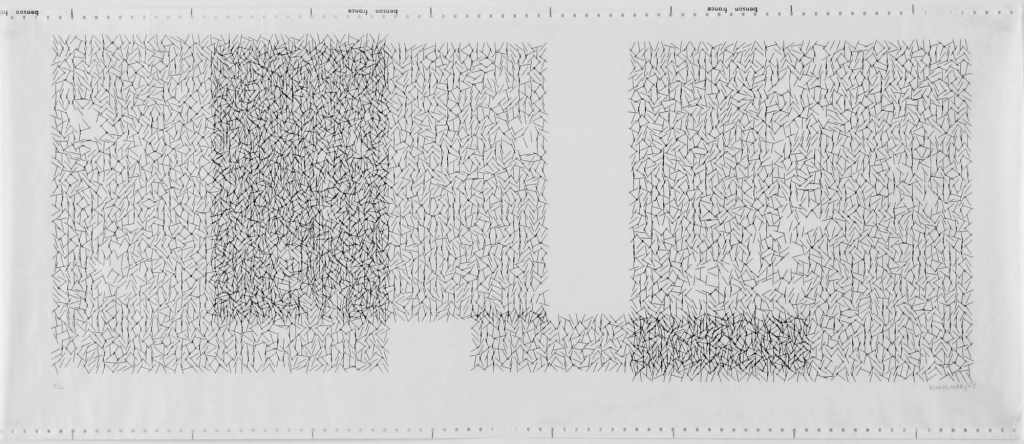
- “Interruptions” (1968): This series demonstrates her approach of introducing systematic disruptions to ordered sequences. In these works, Molnar begins with a regular grid of squares or lines, which are then gradually “interrupted” by small changes to position, size, or orientation. These deviations create an intriguing visual rhythm, one that evokes both the predictability of a machine and the unpredictability of human error.

- “À la recherche de Paul Klee” (1970): A tribute to the Swiss-German artist Paul Klee, Molnar’s work takes inspiration from his experimental approach to color and form. In this series, Molnar uses algorithms to recreate the whimsical spirit of Klee’s compositions, but with a computational twist—each piece is generated through a systematic process, reflecting her belief in the power of rules to produce beauty.

- “Transformation of a Square” (1974): This iconic piece exemplifies Molnar’s exploration of minimal shapes. The work begins with a perfect square, which is then subjected to a series of algorithmic transformations, gradually distorting and fragmenting it. The result is a visual metaphor for change, illustrating how even the simplest forms can be infinitely manipulated while retaining their fundamental essence.
Personal Insights:
Vera Molnar has often spoken about the concept of “planned accidents” in her work—small, deliberate deviations from a prescribed system that introduce an element of surprise. “I love disorder, but I want to master it,” she once remarked, summarizing her desire to create art that walks the fine line between chaos and control. Her work reflects this philosophy, as each algorithmic rule she employs is balanced by moments of unpredictability that make her pieces uniquely captivating.
Comparative Analysis
Common Threads:
Vera Molnar is often compared to other generative artists such as Manfred Mohr, who also explored the relationship between art and algorithm. Both artists were pioneers in their fields, pushing the boundaries of how technology can be used as a tool for creative expression. However, while Mohr focused more on the rigid, formal structures of computer-generated lines and shapes, Molnar embraced a more organic process, allowing for subtle disruptions and variations that evoke the imperfections of human creation.
Another shared theme between Molnar and her contemporaries is the blending of art and mathematics. Like Bridget Riley, a British artist known for her op-art, Molnar’s work creates optical effects that play with perception and form. Both artists explore how simple geometric shapes, when repeated and transformed, can evoke complex visual experiences.
Diverse Perspectives:
Where Molnar’s work diverges from other artists in the field is in her deliberate introduction of “errors” or “interruptions.” While many generative artists focus on the precision and exactness of algorithmic art, Molnar’s approach embraces the imperfections of both machines and humans. This focus on imperfection and unpredictability brings a distinct warmth to her work, setting it apart from the often cold, calculated precision of her peers.
Impact on the Art World
Cultural Significance:
Vera Molnar’s work is a vital contribution to the conversation about the relationship between humans and technology. Long before digital art became mainstream, Molnar recognized the potential of computers to push the boundaries of artistic creation. Her pioneering efforts in algorithmic and generative art laid the groundwork for subsequent generations of digital artists. In an age where artificial intelligence is increasingly being used in creative fields, Molnar’s work feels more relevant than ever, raising important questions about the nature of creativity, authorship, and the role of machines in art.
Reception and Recognition:
While her early work was somewhat niche and overlooked by mainstream art critics, Molnar has gained recognition in recent years as a significant figure in both the digital art movement and the broader history of modern art. Her works have been exhibited in major institutions such as the Centre Pompidou in Paris and the Tate Modern in London. Critics have praised her ability to combine logic with aesthetics, describing her pieces as “deeply human” despite their algorithmic origins.
As the field of generative art continues to evolve with advancements in AI and machine learning, Molnar’s legacy remains foundational. Artists today are building upon the systems she pioneered, using more advanced algorithms to create increasingly complex and lifelike digital works. Molnar’s emphasis on the interplay between control and chaos will likely continue to influence future generations of artists who seek to blur the lines between human and machine creativity.
Recap Key Points:
Vera Molnar’s life and work are a testament to the power of blending art with logic, emotion with computation. From her early studies in traditional art to her groundbreaking use of algorithms, Molnar has carved out a unique place in the history of modern art. Her ability to introduce human “error” into the rigid world of computer-generated art makes her work both thought-provoking and emotionally resonant.
To truly appreciate the nuances of Vera Molnar’s work, one must engage with her art directly. Whether through online galleries, visiting exhibitions, or exploring her work in the context of the digital art movement, Molnar’s pieces invite viewers to reconsider their assumptions about the role of machines in creativity.
As the art world continues to grapple with the rise of artificial intelligence, Vera Molnar’s work poses a critical question: Can a machine ever truly create? In her art, the answer seems to be yes, but only when the machine is guided by a human hand, willing to embrace the imperfections that define both art and life.
 Visual Alchemist
One response to “Artist Profile: Vera Molnar”
[…] creativity and AI can collaborate to produce compelling pieces. The transition from artists like Vera Molnar who utilized early computer systems to today’s AI-driven systems reflects the broader evolution […]
LikeLike