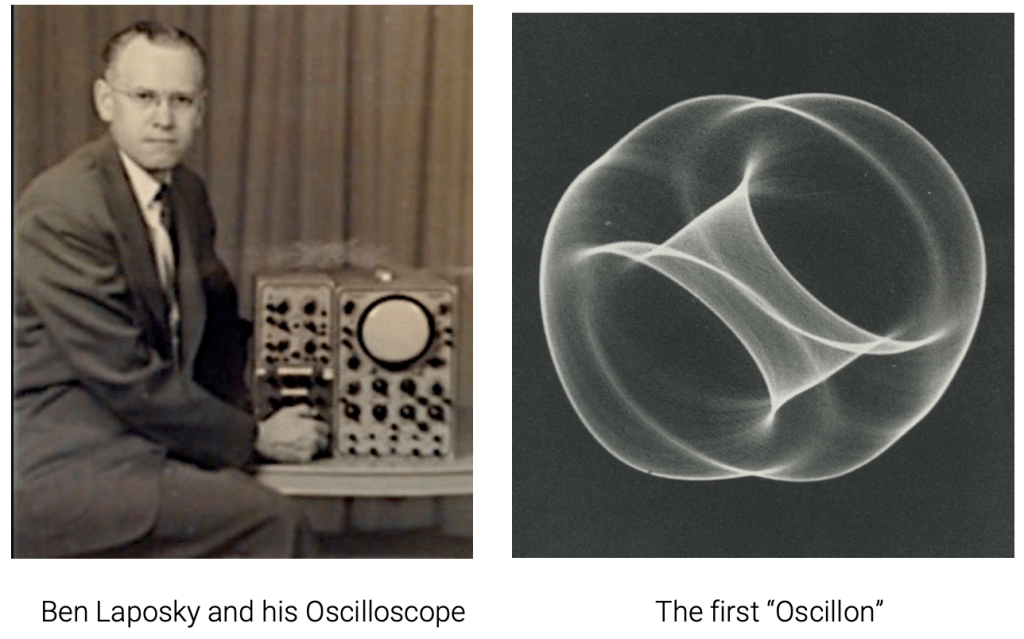
Ben Laposky, born in 1914 in Cherokee, Iowa, is widely regarded as one of the first pioneers in electronic art, having created some of the earliest examples of what we now call computer graphics. His groundbreaking work in the 1950s with oscilloscopes and electronic equipment helped pave the way for digital art and computer-generated imagery. Laposky’s artistic career is marked by his innovative use of technology to generate abstract and mesmerizing visual patterns, which he referred to as “oscillons” or “electronic abstractions.”
Originally trained as a mathematician and draftsman, Laposky’s interest in geometry and design led him to explore the intersection of mathematics, technology, and visual art. His experiments with electronic equipment, in particular, the oscilloscope, transformed him into a key figure in the development of algorithmic and generative art. Laposky’s work, largely produced in the 1950s and 1960s, predated the rise of computer art but laid the groundwork for future artists working with digital tools and computational processes.
Artistic Style and Medium:
Ben Laposky’s artistic style is defined by his use of electronic signals to create abstract, curvilinear designs. His works, known as oscillons, are generated using an oscilloscope, a piece of equipment typically used for measuring electrical waves. By manipulating these waves, Laposky created intricate, fluid patterns that were visually akin to abstract expressionism or modernist abstraction, yet entirely produced through electronic means. His art bridges the gap between mathematics and aesthetic beauty, creating harmonious forms out of pure electronic signals.
Laposky’s medium was primarily the oscilloscope, combined with various other electronic instruments, including sine wave generators and analog computers. He would adjust the input of these machines to control the shapes and patterns displayed on the screen, photographing the results to preserve the ephemeral visual effects. Laposky’s works were thus a combination of technology and photography, with the final product being a static photographic image of the dynamic oscillations generated by the electronic equipment.
In terms of color, Laposky’s early works were monochromatic due to the limitations of the oscilloscope technology, which only displayed green or white lines on a black background. However, the shapes and patterns Laposky created were fluid, continuous, and seemingly organic, often resembling forms found in nature. His works are recognized for their mathematical precision as well as their surreal, almost otherworldly appearance.
Themes and Messages:
A central theme in Ben Laposky’s work is the intersection of mathematics and aesthetic beauty. His oscillons reflect the idea that mathematical forms, when visualized through electronic means, can produce abstract art that is both scientifically rigorous and artistically captivating. Laposky’s work embodies the idea that art and science are deeply interconnected, with mathematical equations serving as the foundation for visual beauty.
Another key theme in Laposky’s work is the notion of ephemerality in art. The oscilloscope-generated patterns that Laposky created were fleeting, existing only as electrical waves on a screen. By photographing these images, he captured a moment in time, preserving the ephemeral beauty of the oscillations. His work raises questions about the nature of art and whether it needs to be permanent to be considered significant.
Laposky was also deeply interested in the concept of automation and generative processes. His work prefigured the algorithmic art movement, where artists use computer algorithms to generate visual patterns. Although Laposky did not use computers in the modern sense, his work with oscilloscopes and sine wave generators can be seen as an early form of generative art, in which mathematical processes dictate the visual outcome.
Notable Works:
- Oscillon No. 1 (1950s): This is one of Laposky’s earliest and most iconic pieces, marking the beginning of his exploration into electronic art. Created using an oscilloscope and photographed to capture the fleeting electronic patterns, Oscillon No. 1 features curvilinear shapes that flow and intersect, creating a visual rhythm reminiscent of natural forms.
- Electronic Abstractions Series (1950s-1960s): This series of works represents Laposky’s most extensive contribution to the field of electronic art. Using oscilloscopes and sine wave generators, Laposky produced hundreds of abstract photographs that showcase the limitless potential of electronic signals to generate intricate designs. The Electronic Abstractions series was exhibited internationally and introduced the public to the concept of machine-generated art.
- Mathematical Curves (1955): In this work, Laposky explored the use of mathematical formulas to create specific curves and geometric shapes on the oscilloscope screen. By adjusting the sine wave generators with mathematical precision, Laposky was able to generate harmonic patterns that were both mathematically accurate and visually stunning. Mathematical Curves helped to establish Laposky as a key figure in the emerging field of art and mathematics.
- Cumulative Oscillon (1960): This piece is one of Laposky’s more complex designs, featuring multiple overlapping waveforms that generate a dynamic, multi-layered composition. The result is a hypnotic interplay of light and dark, suggesting movement and fluidity even in its static, photographic form. Cumulative Oscillon was part of Laposky’s later work, where he pushed the boundaries of the technology available to him to create more intricate compositions.
- Dynamic Harmonics (1960s): In this series of works, Laposky focused on creating visual representations of harmonic motion using sine waves and oscilloscopes. The pieces are notable for their use of symmetry and repetition, with Laposky carefully controlling the electronic input to create rhythmic patterns that appear almost musical in their repetition of forms. Dynamic Harmonics reflects Laposky’s deep interest in the relationship between sound, mathematics, and visual art.
Personal Insights:
Ben Laposky often spoke about his work as being a combination of art and science. He viewed his electronic abstractions as a form of mathematical art, where the beauty of the forms was derived from the underlying equations that produced them. Laposky saw the oscilloscope not just as a tool for scientific measurement, but as an artistic medium that could reveal the inherent beauty of mathematical structures.
Laposky also believed that technology could be a creative force in its own right. His use of machines to generate art was revolutionary for its time, and he frequently expressed his belief that machines could assist artists in creating new forms that were beyond the scope of traditional media. He once stated, “The machine can create beauty in ways we’ve never imagined. It’s up to us to harness that potential.”
Comparative Analysis
Common Threads:
Ben Laposky’s work shares key conceptual elements with other pioneers of electronic and computer art, such as Herbert W. Franke and John Whitney, both of whom explored the use of technology to generate abstract, mathematically based art. Like Laposky, these artists believed in the power of machines to expand the possibilities of artistic creation, and they used early computing technologies to create art that was driven by mathematical principles.
Where Laposky stands out is in his use of oscilloscope technology, which predated the widespread use of digital computers. His focus on pure electronic signals as a source of artistic inspiration set him apart from later artists who worked primarily with digital systems. In this sense, Laposky’s work can be seen as a precursor to the digital art movement, laying the groundwork for artists who would later explore algorithmic processes and digital imagery.
Diverse Perspectives:
While many electronic and digital artists focused on the aesthetic possibilities of technology, Laposky’s work was deeply rooted in mathematical precision. His background in mathematics and geometry informed his approach to electronic art, making his work more systematically driven than some of his contemporaries. His emphasis on the mathematical foundations of art aligns him more closely with the constructivist and geometric abstraction movements.
Laposky’s work is also distinctive in its focus on ephemeral art. Unlike many digital artists, whose works could be printed or displayed on screens, Laposky’s oscilloscope-generated images existed only briefly, captured through photography. This fleeting nature gives his work a unique sense of impermanence, contrasting with the more permanent forms of digital art that would come later.
Impact on the Art World
Cultural Significance:
Ben Laposky’s contributions to electronic art have had a lasting impact on the development of computer graphics and digital art. His work with oscilloscopes and electronic signals predated the rise of digital computers and introduced the idea that machines could be used to generate abstract art. Laposky’s work laid the foundation for the algorithmic art movement and opened the door for future artists to explore the creative potential of electronic and digital technologies.
Laposky’s work also had a significant influence on the field of visual mathematics, demonstrating how mathematical equations could be used to generate visually compelling forms. His emphasis on the aesthetic beauty of mathematical structures has inspired both artists and mathematicians to explore the
intersections between these two fields.
Reception and Recognition:
Ben Laposky’s work was widely recognized during his lifetime, with his Electronic Abstractions series being exhibited internationally in the 1950s and 1960s. His work was featured in scientific journals, art exhibitions, and technology showcases, where it was celebrated as a revolutionary approach to art-making. Laposky’s contributions were particularly important in bridging the gap between art and science, and he is often cited as one of the earliest figures in the development of computer-generated art.
Despite the technical nature of his work, Laposky’s art has continued to resonate with audiences and has been preserved in various collections that focus on the history of digital and electronic art.
Future Directions:
As digital technologies continue to evolve, Ben Laposky’s legacy remains relevant, particularly in the fields of algorithmic art and digital aesthetics. His work with generative processes and mathematical art provides a framework for understanding how machines and computers can be used to create art that is both aesthetically beautiful and scientifically grounded. Laposky’s pioneering use of oscilloscopes continues to inspire contemporary artists who work with real-time data visualization and interactive installations.
Recap Key Points:
Ben Laposky was a pioneering figure in electronic art, whose innovative use of oscilloscopes and electronic equipment to generate abstract patterns laid the groundwork for the later development of computer-generated art. His oscillons and electronic abstractions demonstrated the potential for mathematics and technology to serve as creative tools, and his work has had a lasting impact on the fields of generative art, algorithmic art, and digital graphics.
For those interested in exploring Laposky’s groundbreaking work, many of his oscillons and electronic abstractions can be found in collections dedicated to the history of digital art and computer graphics. His work serves as a reminder of the early intersections between art and technology, and his legacy continues to inspire artists working with electronic media today.
Ben Laposky’s contribution to the world of art demonstrates that the fusion of mathematics, technology, and creativity can produce forms of beauty that transcend traditional media. His pioneering experiments with electronic signals have forever changed the landscape of digital art, proving that machines can be powerful partners in the creation of visual and conceptual art. As technology continues to evolve, Laposky’s legacy as a trailblazer in electronic abstraction will remain a crucial chapter in the history of art and science.
 Visual Alchemist