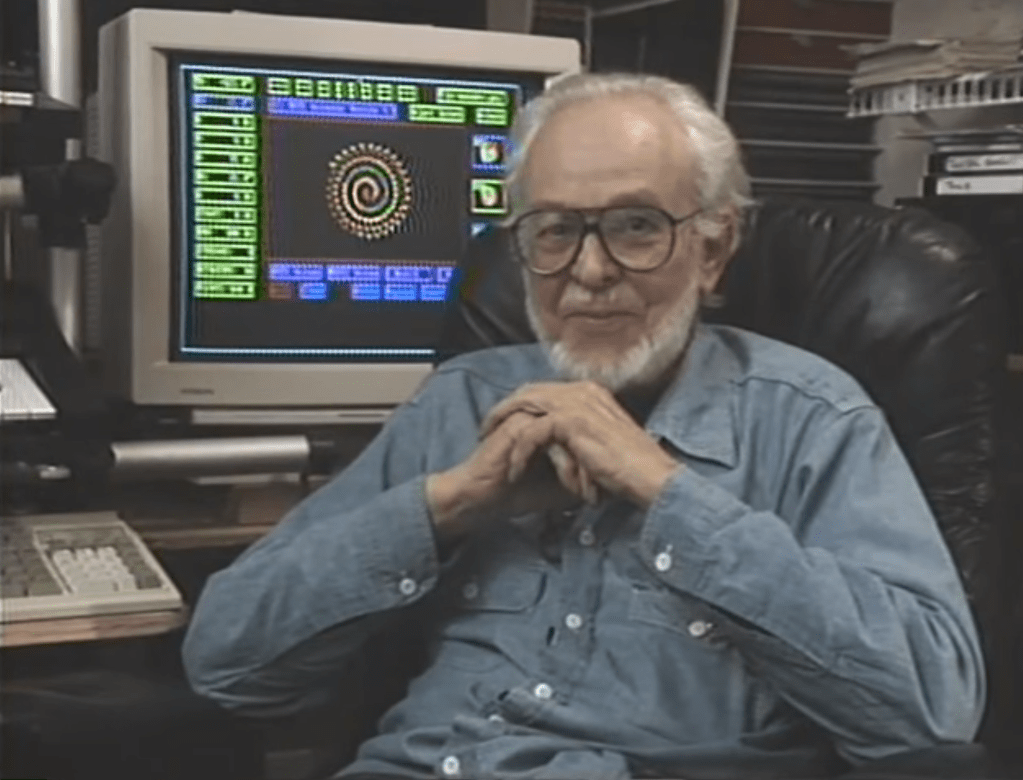
John Whitney, often hailed as the “father of computer graphics,” was born on April 8, 1917, in Pasadena, California. His artistic journey began with music, studying composition at Pomona College. His early exposure to both the mathematics of music and visual art helped shape his later career in computer art. Whitney’s fascination with technology was sparked during World War II, where he worked on designing mechanical instruments for military purposes. This experience with machines led him to experiment with film and animation, eventually blending his love for music and visual art into a unique form of expression: computer-generated art.
In the 1950s, he became an early pioneer in motion graphics, creating experimental films that combined art and science. His career took a significant turn in the early 1960s when Whitney obtained an IBM computer, marking the beginning of his groundbreaking work in digital art. By the 1970s, he had become a leading figure in the emerging field of computer animation, using mathematical algorithms to create abstract visual compositions synchronized with music.
Artistic Style and Medium:
John Whitney’s artistic style is deeply rooted in his understanding of music, mathematics, and visual motion. His early works were crafted using analog devices like the cam machine, a modified World War II anti-aircraft targeting device, which he adapted to create intricate animations. He was constantly pushing the boundaries of what was technically possible, merging the mathematical precision of algorithms with the fluidity and emotion of music.
Whitney is most recognized for his work in generative art, where he used mathematical formulas to create visual patterns that evolve over time. His medium evolved from hand-crafted mechanical devices to digital computer systems, allowing him to produce intricate animations where the visual and auditory components were perfectly synchronized. His work focused on abstract forms, often resembling geometric shapes or organic patterns that morphed and transformed on screen.
Whitney’s compositions were highly mathematical in nature. He developed techniques that involved sine wave forms and harmonic motion, both borrowed from his background in music composition. His goal was to create visual symphonies, where shapes and forms would move harmoniously, much like the way notes in a musical score interact to create a melody. Over time, Whitney transitioned to working with more sophisticated computer systems, eventually creating some of the first-ever 3D animations using early digital technologies.
Themes and Messages:
A key theme in Whitney’s work is the relationship between motion, form, and music. He believed that the principles of harmony found in musical compositions could be applied visually, creating a bridge between sound and sight. His works often explore how abstract forms can evoke emotional responses similar to music, using repetition, rhythm, and progression to mirror musical compositions.
Another major theme in Whitney’s work is the use of technology as a creative tool. He was fascinated by the potential of machines to expand the possibilities of human expression, and he believed that computers could be a new artistic medium. Whitney’s work challenges the traditional boundaries of art, suggesting that the artist’s role can evolve alongside technology. By using computers to generate complex visual patterns, Whitney redefined what it meant to be an artist in the modern world, positioning technology as an integral part of the creative process.
Whitney’s work also reflects a deep interest in cosmic order and universal patterns. Much like the natural world operates on mathematical principles, Whitney sought to create visual representations of these underlying structures. His animations often evoke a sense of cosmic flow, as shapes morph and evolve in ways that seem both organic and mathematical, reflecting the interconnectedness of all things.
Notable Works:
- Catalog (1961): Catalog is one of Whitney’s most famous early works, a short film created using an analog computer to produce geometric patterns synchronized to music. The film was commissioned as a demonstration reel for potential commercial clients, but it stands as a landmark in the history of computer graphics, showcasing Whitney’s ability to blend music and visual art using mechanical means.
- Permutations (1968): This film is one of Whitney’s explorations into cybernetic art, using algorithms to create complex visual patterns that evolve over time. The visuals, which consist of morphing geometric shapes, are accompanied by electronic music, creating a mesmerizing interplay between sound and image.
- Arabesque (1975): In Arabesque, Whitney explores the use of harmonic motion to generate fluid, intricate visual patterns that are reminiscent of Islamic art. The film is notable for its smooth transitions and flowing movement, which Whitney achieved by refining his use of sine waves and mathematical algorithms. The work is often considered one of the most elegant examples of his pursuit of visual music.
- Matrix III (1972): This groundbreaking work was among the first to utilize a digital computer for generating 3D graphics. In Matrix III, Whitney creates a dynamic, evolving environment of geometric forms, exploring the possibilities of depth and perspective in the digital realm. The work marked a significant moment in the history of computer animation and set the stage for future developments in 3D rendering.
- Celestial Navigations (1980): In this later work, Whitney continues to explore the relationship between cosmic order and abstract forms. Using more advanced computer systems, Whitney creates visuals that evoke the movement of celestial bodies, emphasizing the connection between his artistic vision and the larger universe.
Personal Insights:
John Whitney was deeply philosophical about his work and the role of technology in art. He once said, “The goal of computer art is to find out what new things the machine will allow an artist to do that could not have been done before.” This sentiment reflects his belief that computers were not merely tools for efficiency, but powerful instruments for exploring new dimensions of creativity. He saw the computer as a means of expanding human potential, a way to express ideas that were previously unimaginable.
Whitney also emphasized the importance of collaboration between art and science. He believed that artists should embrace technology and work alongside engineers and scientists to push the boundaries of what’s possible in creative expression. His work was driven by a deep curiosity about the world, and he viewed technology as a way to better understand and articulate the complexity of the universe.
Comparative Analysis
Common Threads:
John Whitney shares common ground with several other pioneers of generative and digital art, such as László Moholy-Nagy and Manfred Mohr. All of these artists were deeply interested in the intersection between technology and art, and they saw mathematical systems as a means of creating complex, abstract visual compositions.
Like Moholy-Nagy, Whitney was interested in the idea of art as a process rather than a static object. Both artists explored how machines could be used to generate art, believing that the role of the artist was to design the system rather than execute the final product. Whitney’s work, however, was more focused on the integration of sound and motion, whereas Moholy-Nagy’s experiments were more rooted in light and photography.
Diverse Perspectives:
Where Whitney diverges from many of his peers is in his focus on visual music. His background in musical composition allowed him to think about visual art in terms of harmony, rhythm, and progression, creating a unique fusion of auditory and visual elements. This approach sets Whitney apart from other digital artists who were primarily focused on exploring the possibilities of form, space, and color. Whitney’s work was deeply concerned with the relationship between time-based media (both sound and visuals), positioning him as a pioneer in the field of motion graphics.
Impact on the Art World
Cultural Significance:
John Whitney’s contributions to the art world cannot be overstated. He was instrumental in the development of computer graphics, laying the groundwork for modern motion design, digital animation, and even visual effects in film. His explorations of how mathematical systems could be used to create art were revolutionary, influencing not just visual artists, but also computer scientists, animators, and filmmakers.
Whitney’s work helped to bridge the gap between art and technology, showing that computers could be powerful tools for artistic expression. His influence can be seen in a wide range of disciplines today, from the animated sequences in movies to the generative art used in digital installations.
Throughout his life, Whitney received widespread recognition for his pioneering work. His films were featured in museums and galleries around the world, including the Museum of Modern Art in New York. He also lectured at various institutions, sharing his vision of computer-generated art with both artists and engineers.
His work was especially influential in the early development of motion graphics and visual effects, fields that have since become central to the entertainment and media industries. Whitney’s films, especially Catalog and Arabesque, are now considered classics in the history of computer art.
John Whitney’s legacy continues to inspire contemporary artists working in the fields of generative art, digital animation, and interactive installations. As technology advances, the principles Whitney pioneered—using algorithms to create visual music and synchronizing sound with motion—remain central to how digital artists think about time-based media.
With the rise of artificial intelligence and machine learning, artists today are exploring new ways to generate complex, evolving visuals, much like Whitney did with his sine wave compositions. Whitney’s work will likely continue to serve as a foundation for future innovations in both art and technology.
Recap Key Points:
John Whitney was a visionary artist whose work redefined the relationship between art, music, and technology. His pioneering efforts in computer-generated art and motion graphics laid the groundwork for many of the digital innovations we see today. By blending mathematical precision with musical harmony, Whitney created a new form of artistic expression that continues to influence generations of artists, animators, and designers.
For those interested in exploring Whitney’s work further, many of his films, including Catalog and Arabesque, are available to view online or at major art institutions. His works remain a valuable resource for understanding the origins of digital art and the role of technology in shaping the future of creative expression.
As the digital age progresses, John Whitney’s vision of computers as artistic collaborators feels more relevant than ever. His work challenges us to think about the ways in which technology can expand our creative horizons and offers a glimpse into the future of art, where machines and humans work together to create something truly new. Whitney’s legacy is a testament to the endless possibilities that arise when art and technology converge.
 Visual Alchemist
One response to “Artist Profile: John Whitney”
[…] of human creativity and AI is expected to lead to even more complex generative pieces. Artists like John Whitney and Roman Verostko laid the foundation for this evolution by experimenting with the concept of […]
LikeLike