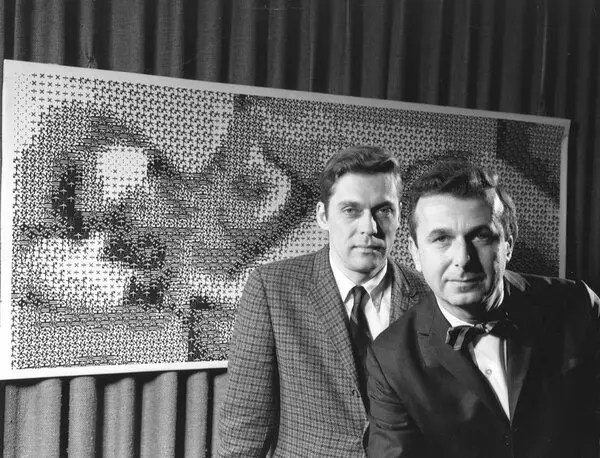
Kenneth Knowlton, born in 1931 in Springville, New York, is a pioneering figure in the fields of computer art and visual programming. Known for his work at Bell Labs in the 1960s, Knowlton was a key contributor to the early development of computer-generated imagery (CGI) and the intersection of art and technology. He earned his Ph.D. in Electrical Engineering from the Massachusetts Institute of Technology (MIT) in 1962, a background that equipped him with a deep understanding of both the technical and creative potential of computers.
Knowlton’s innovative work began during a time when computers were still largely considered tools for scientific calculation and data processing. At Bell Labs, he worked alongside leading artists, engineers, and scientists to explore the possibilities of using computers as creative tools. His collaboration with artists such as Stan VanDerBeek and Leon Harmon positioned him at the forefront of the computer art movement, where he contributed to the invention of new techniques and technologies for creating digital images and animations.
Artistic Style and Medium:
Kenneth Knowlton’s artistic style is deeply rooted in his dual expertise in art and computer science. He is best known for creating computer-generated images using mosaics and ASCII art, an innovative technique where images are formed using text characters or simple shapes. Knowlton’s work focuses on the pixel-like construction of images, long before modern digital art tools like Photoshop and Illustrator existed. His approach involved breaking down images into smaller units, which were then reconstructed using symbols, patterns, or mathematical rules.
Knowlton’s preferred medium was computers, and he developed programming languages specifically designed to create digital art. His most famous invention, BEFLIX (short for Bell Flicks), was one of the first programming languages designed for creating digital movies. BEFLIX allowed Knowlton to generate images and animations by manipulating pixels and lines of code, creating abstract forms, photorealistic images, and animations with an unprecedented level of precision.
Knowlton’s work frequently explored the use of binary and low-resolution graphics, often employing grid-based systems where each square, or “cell,” could be filled with a distinct symbol or character. His technique anticipated the modern digital raster graphics system, which organizes images as a collection of pixels. By using characters like letters, numbers, or geometric shapes to represent parts of an image, Knowlton was able to create visually complex compositions with simple tools, long before high-resolution graphics and advanced computing systems were available.
Themes and Messages:
A central theme in Knowlton’s work is the relationship between technology and human perception. His pixelated images challenge the viewer to reconsider how images are constructed and understood. In his famous piece Studies in Perception I (1966), created in collaboration with Leon Harmon, Knowlton used a low-resolution grid of symbols to form a recognizable portrait of a nude woman. The work demonstrated how the human brain can interpret complex images from minimal visual information, a concept that would later influence the development of computer vision and image processing technologies.
Another major theme in Knowlton’s work is the convergence of art and science. Knowlton viewed programming as both a scientific and artistic process, where creativity and logic intersected. His experiments in digital art were part of a broader philosophical exploration of how computers, traditionally seen as tools of precision and calculation, could be used for aesthetic expression. His work challenges the traditional boundaries between artistic intuition and machine-generated form, suggesting that computers can not only replicate human creativity but also extend its possibilities.
Knowlton was also deeply interested in communication and visual language. Much of his work centers around the idea that images, like language, can be broken down into smaller units—whether pixels or letters—and reconstructed into something meaningful. His use of ASCII and mosaic art is a visual analogy for the way language is formed, with each symbol contributing to the overall structure of meaning. In this sense, Knowlton’s work often bridges the gap between visual representation and coded systems, highlighting the deep connections between visual art, programming, and communication.
Notable Works:
- Studies in Perception I (1966): One of Knowlton’s most iconic works, created in collaboration with Leon Harmon, Studies in Perception I is a low-resolution image of a reclining nude woman. The image was constructed using a grid of small symbols, which, when viewed from a distance, form a recognizable image. This piece became famous after it was published in The New York Times and is regarded as one of the earliest examples of computer-generated art. It demonstrates how the brain can interpret complex images from simple, minimal data.
- BEFLIX (1960s): Knowlton’s development of the BEFLIX programming language was revolutionary for its time. BEFLIX allowed artists and engineers to create digital movies and animations using sequences of binary code. Knowlton used this tool to create some of the earliest examples of computer-generated films, combining artistic creativity with the technical precision of programming.
- Nude with Lines (1967): In this work, Knowlton created a stylized image of a reclining nude using a grid system where the image was built from geometric lines and shapes. The piece represents Knowlton’s early exploration of how abstract forms could still convey recognizable figures, using low-resolution graphics and pattern-based construction to achieve his desired visual effect.
- Leonardo (1970s): Named after Leonardo da Vinci, this series explored the intersection of art and technology through computer-aided design. In this work, Knowlton applied advanced algorithms to generate abstract images that echoed the architectural sketches and mechanical designs of the Renaissance master. By using computers to replicate the geometric rigor of da Vinci’s work, Knowlton showcased how modern technology could extend classical ideas of proportion and symmetry.
- ASCII Art (1960s–1980s): Knowlton was an early adopter and practitioner of ASCII art, a technique in which images are generated using the characters available in the ASCII (American Standard Code for Information Interchange) set. His ASCII artworks pushed the limits of what could be achieved with such a simple medium, creating intricate and detailed images that demonstrated the potential of computer-based creativity.
Personal Insights:
Kenneth Knowlton has often described programming as a form of artistic expression. He believed that the process of writing code—choosing the structure, rules, and variables—was akin to the creative decisions an artist makes with a canvas. In an interview, Knowlton said, “The computer is a tool that can extend the artist’s reach, helping to create things that are both unexpected and unimaginable without its assistance.” This sentiment reflects his philosophy that technology, far from limiting creativity, opens new doors for artistic experimentation and innovation.
Knowlton also emphasized the importance of collaboration between art and science. His work with other artists, such as Stan VanDerBeek, and his technical expertise at Bell Labs, allowed him to push the boundaries of what computers could do in the service of art. He once remarked, “The artist and the scientist are both explorers—one through imagination, the other through experimentation—and computers bring those worlds closer together.”
Comparative Analysis
Common Threads:
Kenneth Knowlton’s work shares many conceptual elements with other pioneers of computer art like Frieder Nake, Georg Nees, and Vera Molnár. All of these artists were early adopters of computers as artistic tools and explored how algorithms and programming could generate new forms of visual expression. Like Nees and Molnár, Knowlton was deeply engaged with the mathematical and logical foundations of art, creating works that explored the relationship between structure, pattern, and visual perception.
What distinguishes Knowlton, however, is his focus on low-resolution graphics and his pioneering development of programming languages for creating art. While many early computer artists worked with complex patterns or three-dimensional forms, Knowlton’s art often revolved around the simplicity and minimalism of grid-based systems, exploring how much visual information could be conveyed with the fewest possible elements.
Diverse Perspectives:
Knowlton’s collaborative approach with both artists and engineers also set him apart. His work with Stan VanDerBeek, for example, led to the creation of Movie-Drome, an immersive visual environment that blended computer-generated imagery with experimental film techniques. This interdisciplinary approach helped to expand the boundaries of both film and computer art, merging these fields in a way that few other artists of his time were exploring.
Knowlton’s background in engineering and his technical expertise also gave him a unique perspective on the possibilities of computers. While many artists approached technology from a creative or aesthetic angle, Knowlton’s deep understanding of programming and image processing allowed him to innovate from within the technical systems themselves, developing tools that other artists could use to create new forms of digital art.
Impact on the Art World
Cultural Significance:
Kenneth Knowlton’s contributions to the field of computer-generated imagery have had a lasting impact on both the art world and the technology sector. His work at Bell Labs, particularly his development of the BEFLIX programming language, helped lay the foundation for modern CGI and digital animation. Knowlton’s explorations of low-resolution graphics, ASCII art, and pixel-based images also anticipated many of the developments in pixel art and data visualization that would emerge in later decades.
His early experiments with visual perception and image construction also influenced the fields of computer vision and **image
recognition**, areas that are now critical in modern technology applications ranging from facial recognition to artificial intelligence. Knowlton’s work demonstrated how computers could be used to process and interpret images in ways that mimic human perception, laying the groundwork for these later innovations.
Reception and Recognition:
Knowlton’s work was highly influential in both academic and artistic circles. His images, particularly Studies in Perception I, were widely exhibited and discussed, and his programming languages have been used by both artists and engineers for decades. His work has been shown in galleries and museums, including the Whitney Museum of American Art and the Museum of Modern Art.
Knowlton has received numerous awards for his contributions to both the arts and computer science, including recognition from ACM SIGGRAPH, the leading organization for computer graphics. His impact has been profound not only in the realm of digital art but also in educational tools, where his work has influenced generations of programmers and designers.
Future Directions:
As technology continues to evolve, Knowlton’s legacy remains relevant, particularly in the realms of data visualization, digital art, and human-computer interaction. His emphasis on the role of computers as creative partners in the artistic process will continue to inspire future generations of artists and technologists exploring the boundaries of artificial intelligence, interactive art, and generative design.
Recap Key Points:
Kenneth Knowlton is a pioneering figure in the fields of computer-generated art and digital imagery, best known for his development of the BEFLIX programming language and his innovative use of mosaics, ASCII art, and low-resolution graphics. His work bridges the gap between art and science, demonstrating the creative potential of computers and challenging traditional ideas about the relationship between technology and art.
For those interested in exploring Knowlton’s work further, many of his images, films, and programming experiments are available for viewing online and in archives. His influence on computer graphics and digital art continues to resonate, offering a fascinating insight into the early days of the digital art movement.
Kenneth Knowlton’s groundbreaking work reminds us of the profound ways in which technology can extend human creativity. His pioneering efforts in the field of computer art laid the foundation for many of the innovations we see today in digital media, computer graphics, and artificial intelligence. As the boundaries between art and technology continue to blur, Knowlton’s work remains a powerful reminder of the creative potential of machines and the ever-expanding possibilities of human-computer collaboration.
 Visual Alchemist