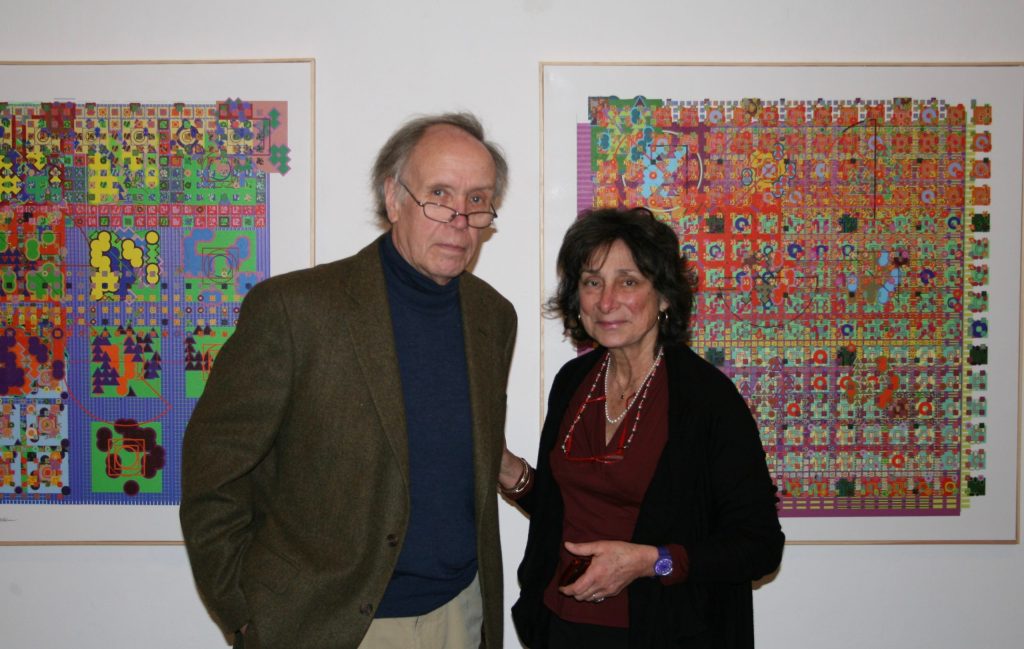
Mark Wilson, a pioneering figure in the realm of digital art, was born in 1943 and raised in the United States. He began his career in traditional art, exploring painting and printmaking during his academic years, earning degrees from Duke University and Yale University in the 1960s. His artistic journey took a transformative turn in the early 1980s when he discovered the potential of computer technology to push the boundaries of his work.
Although Wilson started with a background in abstract painting, his curiosity about new forms of expression led him to experiment with early digital tools, long before computers became ubiquitous in the art world. In the decades that followed, Wilson would become a trailblazer in the field of algorithmic art, leveraging the growing power of digital systems to create vibrant, highly detailed works that seamlessly combined geometry, color, and form.
Artistic Style and Medium:
Mark Wilson’s artistic style is a compelling blend of geometric abstraction and digital precision. His early works, influenced by the Op Art and minimalist movements, were centered around careful arrangements of color, pattern, and form. However, with the introduction of digital tools, Wilson’s work evolved into something more dynamic. He began to incorporate complex algorithmic structures into his art, creating visually captivating compositions that explore the relationships between geometry, symmetry, and color theory.
Wilson’s preferred medium has been the computer, specifically the early IBM PCs and later more advanced digital tools. He was one of the first artists to recognize the computer not just as a tool for efficiency, but as a medium that could enable entirely new forms of visual expression. He utilized software to generate intricate, highly complex patterns that would be nearly impossible to replicate by hand, pushing the limits of mathematical precision and digital rendering. Wilson’s process often involved writing his own code or adapting software to achieve the desired results, making him a true pioneer in programmatic art.
His work is characterized by an emphasis on precision, detail, and depth, often featuring grid-like structures, interlocking geometric shapes, and optical illusions that create a sense of movement and three-dimensionality. The influence of fractals, chaos theory, and mathematical algorithms is evident in his work, reflecting his deep interest in the interplay between mathematics and visual art.
Themes and Messages:
A central theme in Mark Wilson’s work is the exploration of mathematical beauty. By using algorithms and digital processes, Wilson creates intricate patterns that mimic the underlying order of the universe, from the geometry of natural forms to the symmetry found in architectural structures. His work challenges viewers to engage with the invisible patterns that shape our world, presenting them in a form that is both abstract and aesthetically engaging.
Another recurring theme in Wilson’s art is the intersection between technology and creativity. His work addresses the idea that technology is not just a tool for replicating existing forms, but a creative medium in its own right. Wilson uses computers not just to assist in the creation of art, but as a core part of the artistic process, emphasizing how technology can augment and enhance human creativity.
Wilson’s art also explores the concept of infinity. Many of his works feature repetitive patterns that suggest endless movement or boundless space, evoking a sense of continuity and expansion. This concept is closely tied to the idea of fractals, where small patterns repeat at infinitely smaller or larger scales. Wilson’s use of digital technology allows him to push this theme further, creating pieces that feel simultaneously finite and infinite, as though they could continue to evolve endlessly within the parameters of their design.
Notable Works:
- Zygo IV (1994): One of Wilson’s most iconic pieces, Zygo IV is a stunning exploration of symmetry and color theory. Created using custom software, the work features interlocking geometric shapes arranged in complex, almost hypnotic patterns. The composition is both visually dynamic and mathematically precise, reflecting Wilson’s deep interest in combining digital algorithms with artistic intuition.
- Mandala Series (1980s-1990s): Inspired by both Eastern philosophy and mathematical theory, Wilson’s Mandala Series is a collection of digital prints that evoke the traditional designs of mandalas, but with a modern, digital twist. Each piece in the series is created using complex algorithms that produce intricate, symmetrical patterns. The Mandala Series reflects Wilson’s interest in combining spiritual symbolism with digital precision.
- Quasi-Crystal Variations (1996): This work draws inspiration from quasi-crystals, a form of matter with a unique, non-repeating structure. Wilson used digital algorithms to create a series of visual interpretations of quasi-crystals, exploring the relationship between order and randomness. The work’s intricate, almost otherworldly forms reflect the delicate balance between chaos and structure in both nature and art.
- Tessellation Series (2000s): In this series, Wilson explores the concept of tessellation, where shapes are arranged in a repeating pattern without gaps or overlaps. Each piece in the series uses digital algorithms to generate intricate, often hypnotic patterns that draw the viewer into the visual rhythm of the design. This series highlights Wilson’s fascination with the mathematical underpinnings of art and the ability of computers to push the boundaries of visual complexity.
- Lattice Dynamics (2010): This later work marks a return to Wilson’s interest in creating digital art that evokes three-dimensional movement. Lattice Dynamics features interlocking shapes and grid structures that appear to move in and out of the picture plane, creating a sense of depth and motion. The work showcases Wilson’s continued exploration of how digital tools can be used to create visual effects that challenge our perception of space and form.
Personal Insights:
Mark Wilson often speaks about the importance of technology in expanding the boundaries of artistic creation. He views the computer not as a replacement for traditional methods but as a tool that offers new possibilities for exploration. In interviews, Wilson has noted, “The computer doesn’t make the art; it provides the framework for the ideas.” This perspective highlights his belief that the artist’s vision is always at the center of the creative process, regardless of the tools used.
Wilson also speaks passionately about his love for mathematics and geometry, subjects that have been central to his artistic exploration. He once remarked, “Geometry is the skeleton of all beauty.” For Wilson, mathematical structures offer a sense of harmony and order that resonates deeply with his approach to digital art.
Comparative Analysis
Common Threads:
Mark Wilson’s work is often compared to that of other digital art pioneers such as Harold Cohen and Manfred Mohr, who were also early adopters of computer technology in their artistic practice. Like Wilson, these artists use algorithms and digital tools to generate art, focusing on the intersection of art and mathematics. All three artists are fascinated by the ways in which computers can create new possibilities for artistic expression, blurring the line between human creativity and machine logic.
One of the key commonalities between Wilson and other digital artists is their emphasis on abstraction and the use of geometric forms. However, Wilson’s work is particularly distinguished by its focus on color theory and his use of digital tools to explore optical effects, where geometry, color, and depth interact in dynamic ways.
Diverse Perspectives:
While many digital artists focus exclusively on digital forms, Wilson’s work often integrates elements of traditional art, such as color theory and visual composition, into his digital creations. His background in painting and printmaking gives him a unique perspective on how digital technology can enhance rather than replace traditional artistic practices. This combination of digital precision with a painterly understanding of color and form sets Wilson apart from many of his peers in the digital art world.
Another unique aspect of Wilson’s work is his interest in infinite structures and repetitive patterns, which often evoke ideas related to fractal geometry and chaos theory. These themes are less common in other digital artists’ work, making Wilson’s exploration of mathematical concepts particularly distinctive.
Impact on the Art World
Cultural Significance:
Mark Wilson is considered one of the early pioneers of computer-generated art, and his influence has been profound in shaping how artists and designers think about the role of technology in creative expression. His work has helped legitimize the use of digital tools in the fine art world, breaking down the barriers between traditional art forms and digital innovation. Wilson’s emphasis on the computer as a creative medium has inspired generations of digital artists, programmers, and designers to explore new ways of combining art with technology.
Wilson’s exploration of geometric abstraction and color theory has also influenced fields beyond the visual arts, including graphic design and architecture, where mathematical precision and visual harmony are central concerns. His use of algorithms to generate complex patterns has also found resonance in the world of data visualization, where artists and scientists alike are using digital tools to create visual representations of information.
Reception and Recognition:
Wilson’s work has been widely exhibited in both traditional art galleries and digital media exhibitions, including prominent venues such as the Museum of Computer Art and the New York Digital Salon. His work has also been featured in various academic journals and publications focused on the intersection of art, science, and technology.
Critics have praised Wilson’s work for its sophistication and technical mastery, noting his ability to use digital tools to create art that is both conceptually rich and visually stunning. His early adoption of computer technology in the 1980s has earned him a place as one of the pioneers of digital art, and his continued innovation has kept him relevant in the ever-evolving digital art landscape.
Future Directions:
As technology continues to advance, Wilson’s work remains relevant, particularly in the context of AI-driven art and machine learning. As artists increasingly experiment with new forms of algorithmic and generative art, Wilson’s emphasis on the artist’s role in guiding technology offers a blueprint for how human creativity can work in tandem with machine logic. His exploration of mathematics, geometry, and pattern generation also continues to inspire contemporary digital artists exploring similar themes.
Recap Key Points:
Mark Wilson is a pioneering figure in digital and algorithmic art, known for his masterful use of computers to create intricate, highly detailed works that blend mathematical precision with artistic creativity. His focus on geometric abstraction, color theory, and repetitive patterns has had a lasting influence on both the visual arts and digital design fields.
For those interested in exploring Wilson’s work further, many of his digital prints and algorithmic art pieces are available for viewing online, and exhibitions featuring his work are often hosted by museums and galleries focused on the intersection of art and technology. Wilson’s work offers a fascinating insight into the possibilities of computer-generated art, where human creativity and machine precision intersect to create something entirely new.
Mark Wilson’s legacy as a digital artist reminds us of the endless possibilities that technology offers to the creative process. His work challenges us to reconsider the role of machines in art-making, showing that computers, when guided by human creativity, can expand the boundaries of visual expression. As digital art continues to evolve, Wilson’s pioneering approach will remain a touchstone for artists seeking to explore the fusion of mathematics, art, and technology.
 Visual Alchemist