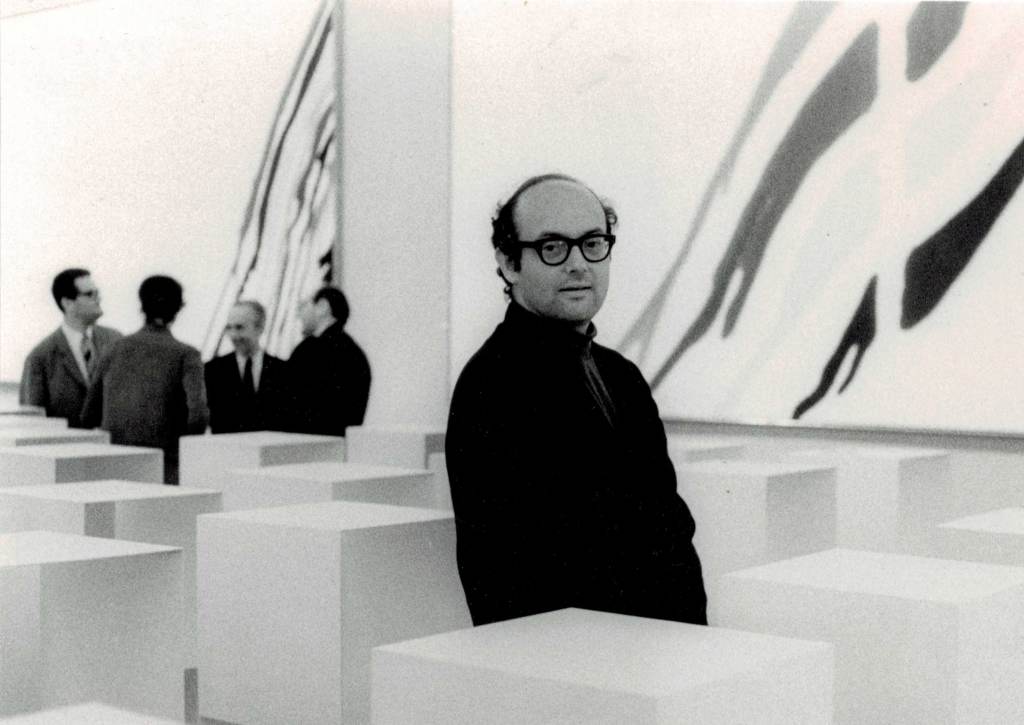
Sol LeWitt was born on September 9, 1928, in Hartford, Connecticut, into a Jewish immigrant family. His early exposure to art came through his mother, who encouraged his creative pursuits. After earning a Bachelor of Fine Arts from Syracuse University in 1949, LeWitt served in the Korean War and later moved to New York City in the early 1950s. There, he studied at the School of Visual Arts and worked various jobs, including a role at the Museum of Modern Art (MoMA), where he met key figures of the New York art scene, such as Robert Rauschenberg and Jasper Johns.
These formative experiences, combined with his interest in minimalism, geometry, and systematic processes, shaped LeWitt’s unique approach to art. He became a key figure in the Conceptual Art movement, which emphasized the importance of ideas over traditional aesthetics and the physical making of objects. LeWitt’s art pushed boundaries, exploring how the role of the artist could be defined, where the act of creation was more important than the final product.
Artistic Style and Medium:
Sol LeWitt is renowned for his work in Conceptual Art and Minimalism, often described as a “systems artist.” He believed that the idea behind a work of art was more important than its execution. This philosophy is central to his wall drawings and structures, two of his most famous artistic outputs. LeWitt’s work frequently took the form of simple geometric shapes, like squares, cubes, and grids, and he would devise elaborate instructions for their creation, leaving the actual execution to assistants or even viewers. His art defied the traditional notion that the artist must physically create the work for it to be considered authentic.
LeWitt’s medium varied throughout his career, ranging from pencil and ink to three-dimensional structures. His most celebrated medium was his wall drawings, which consisted of carefully plotted lines and geometric shapes drawn directly onto gallery walls. These drawings were often created by assistants following precise instructions from the artist, emphasizing the process over the final product. Additionally, LeWitt’s modular structures—minimalist sculptures constructed from cubes and grids—highlighted his interest in mathematical precision and seriality, where simple forms were repeated in complex variations.
Themes and Messages:
LeWitt’s work is deeply rooted in the idea that art can be reduced to its most basic forms and that the process of making art is a conceptual journey. One of his key beliefs was that the idea itself is the artwork, a principle that resonates throughout the Conceptual Art movement. His systematic approach often explored the relationship between order and chaos, as rigid geometric systems would produce unexpected results depending on how they were executed.
Another central theme in LeWitt’s work is the rejection of the artist’s hand in the final creation. By outsourcing the physical execution of his pieces to others, LeWitt challenged the traditional role of the artist and placed greater emphasis on collaboration and the democratic nature of art. His art also explored repetition and variation, where slight changes in a pattern could produce vastly different results, encouraging the viewer to focus on the subtle shifts in structure and form.
LeWitt also saw his art as temporary in nature, especially in the case of his wall drawings. Once the exhibit ended, the drawings would often be erased, underscoring the ephemeral nature of art and the importance of the process over the physical object.
Notable Works:
- Wall Drawing #1 (1968): This was the first of LeWitt’s famed wall drawings, and it laid the groundwork for the rest of his career. Created using simple graphite lines drawn directly on the wall, the piece marked a significant shift in his approach to art-making. It demonstrated his belief that the instructions or concept behind the work were just as valuable as the work itself.
- Incomplete Open Cubes (1974): This series of sculptures exemplifies LeWitt’s interest in modularity and geometric form. He took a simple cube and, through a systematic process, created various configurations in which parts of the cube were missing. The result was a series of sculptures that alluded to the idea of presence through absence.
- Serial Project No. 1 (1966): This work consists of a series of modular structures that explore the repetition of simple forms in complex arrangements. Through a mathematical process, LeWitt developed numerous variations of a cube, demonstrating the concept of seriality—a method of repeating elements with small variations that produce intricate results.
- Four-Sided Pyramid (1997): One of LeWitt’s iconic outdoor sculptures, this pyramid-like structure is made up of stacked open cubes, reflecting his fascination with geometry and scale. The sculpture’s repetitive form and architectural quality evoke a sense of both simplicity and monumentality.
- Wall Drawing #260 (1975): Created for the exhibition at the Whitney Museum of American Art, this piece features arcs and lines that connect different points on the wall, resulting in a visually complex but orderly arrangement. This work exemplifies LeWitt’s commitment to the idea of “system as art.”
Personal Insights:
LeWitt was a private and introspective artist, often letting his work speak for itself. However, in his famous 1967 essay, Paragraphs on Conceptual Art, he articulated his philosophy: “The idea becomes a machine that makes the art.” This statement encapsulates his belief that the concept behind an artwork is its most important element and that the execution, often performed by others, was secondary.
In interviews, LeWitt emphasized the importance of viewer interpretation in completing the artwork. He once remarked, “The artist’s will is secondary to the process he initiates from idea to completion. His willfulness may only be ego.” This humility and deference to the process have made his work accessible and resonant with a wide audience.
Common Threads:
Sol LeWitt shares key conceptual and stylistic elements with many of his contemporaries, including Donald Judd and Carl Andre. Like them, he was deeply involved in the Minimalist movement and was interested in reducing art to its basic forms. The use of repetition, geometry, and modular systems is central to all of their works.
What distinguishes LeWitt is his embrace of Conceptual Art, where the idea takes precedence over the object itself. While Minimalism often focuses on the purity of form, LeWitt’s approach leans heavily on the conceptual framework, making him a pivotal figure in both Minimalism and Conceptual Art.
Diverse Perspectives:
While many artists of the time adhered to rigid formalism, LeWitt’s work introduced a playful, participatory element by allowing others to execute his pieces. This focus on collaboration and process sets him apart from many of his peers. LeWitt’s work also engages in a conversation about temporality, as many of his wall drawings were never meant to be permanent, but were intended to be drawn, experienced, and then erased.
His deep interest in mathematical systems and seriality aligns him with artists like Agnes Martin, though his use of assistants to execute his work breaks from the traditional “artist’s touch,” making him a radical innovator of his time.
Impact on the Art World
Cultural Significance:
Sol LeWitt has had an enduring impact on contemporary art, particularly in how art is conceptualized and produced. His belief that the idea is the artwork influenced generations of artists working in diverse mediums, from sculpture to digital art. LeWitt’s influence can be seen in contemporary installation art, where the experience of the viewer often completes the piece.
LeWitt was also instrumental in breaking down the hierarchy of the art world, championing the notion that art could be executed by anyone, provided the instructions or concept were sound. This democratization of art-making has had far-reaching effects, inspiring artists to think beyond the traditional boundaries of craft and production.
LeWitt’s work has been widely celebrated in both academic and popular circles. He exhibited at major institutions like the Museum of Modern Art (MoMA), the Whitney Museum, and Tate Modern. His pieces have been collected by prestigious institutions, cementing his place in art history. His wall drawings, in particular, have been seen as groundbreaking, with critics lauding their simplicity, elegance, and conceptual depth.
LeWitt received several awards throughout his career, including the National Medal of Arts in 2004, a testament to his contributions to contemporary art. His work continues to be revisited and reinterpreted in exhibitions worldwide, a reflection of its timeless relevance.
LeWitt’s influence continues to ripple through the art world, particularly in the realms of installation art, digital art, and conceptual practices. As more artists explore the intersections between technology and art, LeWitt’s approach to instructions and process-based art remains highly relevant. His works, especially the wall drawings, are constantly reinterpreted by new generations of artists, ensuring that his conceptual legacy will endure.
Recap Key Points:
Sol LeWitt redefined the role of the artist in the 20th century, emphasizing the power of ideas over execution. His conceptual approach to art-making, grounded in mathematical systems and minimalist aesthetics, paved the way for future generations to explore the boundaries between idea and object, artist and audience. His legacy as a pioneer of Conceptual Art and Minimalism remains a vital influence on contemporary practices.
To fully appreciate LeWitt’s impact, readers are encouraged to explore his works in person. Many of his wall drawings are exhibited in major museums, where the viewer can experience the unique relationship between concept, process, and space. His modular structures and public sculptures can also be found in various cities worldwide, continuing to provoke thought and inspire new ways of seeing.
Sol LeWitt’s art invites us to reconsider the boundaries of artistic creation. As we move into an era where technology and collaborative processes become more central to artistic production, his pioneering efforts to decouple the artist’s hand from the final work feel more relevant than ever. The question that lingers is: How will future generations reinterpret the role of the artist in an increasingly conceptual, process-driven world?
 Visual Alchemist