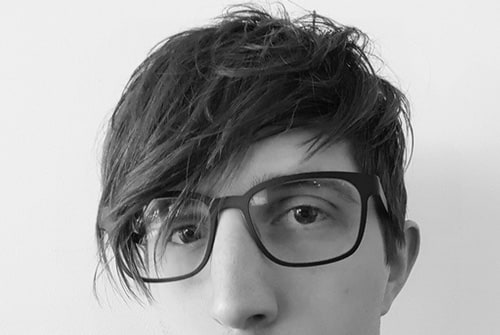
Anders Hoff, in my personal opinion, has a very distinctive voice in his work. Known for his intricate and mesmerizing computational artworks, Hoff delves deep into the mathematical foundations of art, creating pieces that are both visually stunning and intellectually engaging. His work not only captivates the eye but also invites viewers to contemplate the underlying systems that govern natural phenomena. By bridging the gap between art and mathematics, Hoff pushes the boundaries of digital creativity, solidifying his place as a pioneering figure in the generative art movement.
Biography
Anders Hoff, hailing from Norway, has always been fascinated by the intersection of art, science, and technology. With a background in engineering, he earned his degree from the Norwegian University of Science and Technology (NTNU), where he specialized in fields that honed his analytical and computational skills. Early in his career, Hoff worked in the engineering sector, focusing on complex systems and simulations. However, his inherent passion for visual expression led him to explore the artistic potentials of the algorithms he was developing.
Influenced by the works of pioneers like Casey Reas and Ben Fry, as well as the natural patterns found in landscapes and biological forms, Hoff began experimenting with code as a medium for artistic creation. Adopting the moniker “Inconvergent,” he started sharing his explorations online, gradually gaining recognition within the digital art community. His early works, while simple in their execution, hinted at the profound complexity achievable through computational methods.
Over the years, Hoff’s career trajectory shifted from engineering towards full-time artistic practice. His dedication to exploring generative systems and their aesthetic potentials has led to collaborations, exhibitions, and a growing influence on contemporary digital art.
Artistic Practice
At the heart of Hoff’s artistic endeavor is the exploration of mathematical algorithms to generate complex, organic visuals. He operates on the principle that simple rules can lead to intricate and unexpected outcomes—a concept rooted in chaos theory and emergent systems. By meticulously crafting algorithms, he allows patterns to evolve naturally, resulting in artworks that mirror the complexities of the natural world.
Hoff’s approach is deeply process-oriented. He primarily utilizes programming languages like Processing and Python, employing techniques such as flow fields, particle systems, and noise functions. These tools enable him to simulate phenomena like fluid dynamics, growth patterns, and other natural processes. His work often involves:
- Iterative Development: Continuously refining algorithms to enhance visual outcomes.
- Parameter Exploration: Adjusting variables to observe how small changes impact the overall composition.
- Visualization of Data: Translating mathematical concepts into tangible visual forms.
The philosophy behind his work emphasizes the beauty of emergent complexity. Hoff believes in “designing systems rather than images,” allowing the inherent properties of the algorithms to dictate the final form. This method results in pieces that are not just aesthetically pleasing but also rich with conceptual depth.
Technologically, Hoff is adept at combining traditional coding with modern computational techniques. He occasionally integrates machine learning and artificial intelligence to introduce new layers of complexity. The final artworks are often presented as high-resolution digital prints, though he has also ventured into animations and interactive installations.
Notable Works
“Flow Fields”
One of Hoff’s most acclaimed series, “Flow Fields,” visualizes the paths of particles moving through vector fields. By defining mathematical functions that govern the flow, he creates images reminiscent of swirling currents, wind patterns, or even cosmic phenomena. The delicate lines and gradients capture a sense of movement and fluidity, inviting viewers to get lost in the intricate details.
Themes and Concepts: This series explores the idea of unseen forces shaping visible outcomes. It reflects on how complex behaviors emerge from simple rules, mirroring patterns found in nature like the formation of clouds or the meandering of rivers.
“Noise Weaver”
In “Noise Weaver,” Hoff delves into the realm of pseudo-randomness using algorithms like Perlin noise. The artworks in this series resemble woven fabrics or organic meshes, blurring the line between digital precision and handcrafted textures. The interplay of order and randomness results in compositions that are both structured and chaotic.
Themes and Concepts: “Noise Weaver” examines the balance between predictability and randomness. It highlights how controlled randomness can produce harmonious results, echoing patterns observed in natural formations like wood grains or leaf veins.
“Chaotic Attractors”
Exploring the depths of chaos theory, “Chaotic Attractors” visualizes the behavior of dynamical systems sensitive to initial conditions. The series showcases complex, fractal-like structures that emerge from iterative mathematical processes. The mesmerizing patterns invite contemplation on the nature of chaos and order.
Themes and Concepts: This work delves into the idea that within apparent randomness lies an underlying order. It reflects on how minute variations can lead to vastly different outcomes, a concept applicable in fields ranging from meteorology to economics.
Exhibitions and Recognition
While much of Anders Hoff’s recognition comes from his substantial online presence, his work has also been featured in various exhibitions and platforms:
- “Generative Art Conference,” Rome: Hoff presented his work at this international event dedicated to the exploration of generative art, sharing insights into his methodologies and creative philosophy.
- “Digital Arts Festival,” Oslo: Showcased alongside other contemporary digital artists, his pieces received acclaim for their complexity and aesthetic appeal.
- Online Galleries: Platforms like Tumblr, Behance, and Instagram have been instrumental in bringing Hoff’s work to a global audience. His projects have garnered thousands of followers and have been featured in digital art publications and blogs.
Though he may not have an extensive list of traditional art awards, Hoff’s influence is evident through his impact on the generative art community. His willingness to share his processes and engage with other artists has solidified his reputation as both a creator and educator.
Impact on the Art Community
Anders Hoff has significantly contributed to advancing the dialogue around art and technology. By openly sharing his code, processes, and insights on his website and social media, he has made available the complexities of generative art, making it more accessible to aspiring artists and enthusiasts.
His work challenges traditional perceptions of art-making by emphasizing the role of algorithms and computational systems. Hoff encourages a collaborative relationship between the artist and the machine, where unpredictability is embraced rather than controlled. This perspective has inspired a new generation of artists to explore the potentials of coding as a creative tool.
Moreover, his explorations have sparked discussions on the nature of creativity in the digital age. Hoff’s emphasis on process over product invites contemplation on the evolving definitions of authorship and originality in art.
Anders Hoff stands as a compelling figure in the world of generative art, seamlessly blending mathematical rigor with creative exploration. His artworks serve as a testament to the profound beauty that can emerge from algorithmic processes. By pushing the boundaries of what’s possible through code, Hoff not only creates visually arresting pieces but also contributes to a broader understanding of the interplay between art and technology.
His journey from engineer to artist exemplifies the transformative power of embracing interdisciplinary approaches. As he continues to innovate and inspire, Anders Hoff leaves an indelible mark on the generative art movement, reminding us of the endless possibilities that arise when we merge analytical precision with boundless creativity.
 Visual Alchemist
Leave a comment