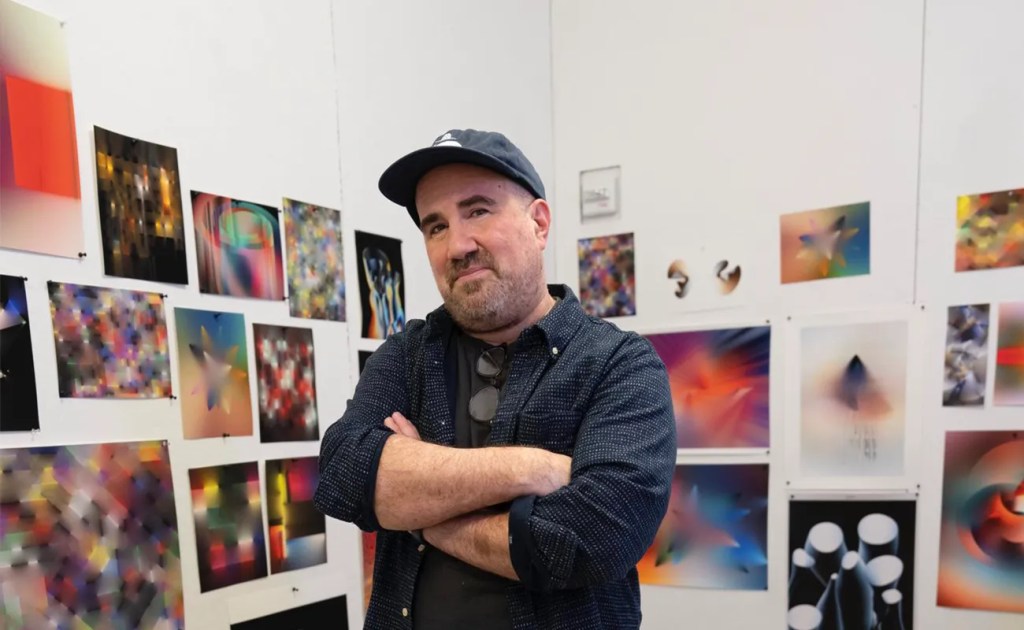
Zach Lieberman is a pioneering artist, educator, and programmer whose innovative work sits at the intersection of art and technology. Renowned for his contributions to generative art, interactive installations, and creative coding, Lieberman has been instrumental in redefining how we perceive and interact with digital media. His art transcends traditional boundaries, inviting viewers to become participants in immersive experiences that blend the physical and digital realms.
Lieberman’s significance in the field of generative art is profound. By harnessing computational systems to create dynamic, algorithm-driven visuals, he has expanded the possibilities of artistic expression. His work challenges conventional notions of authorship and creativity, emphasizing the role of code as both a tool and a medium. Through his explorations, Lieberman has not only pushed the boundaries of digital art but also inspired a new generation of artists and technologists to explore the poetic potential of code.
Biography
Born in 1977 in New York City, Zach Lieberman grew up during a time when personal computers were becoming increasingly accessible. This environment fostered his dual interests in art and technology from a young age. His early experiences with computers ignited a fascination with programming, while his exposure to the vibrant art scene of New York cultivated his appreciation for visual expression.
Lieberman pursued his undergraduate studies at Hunter College, where he earned a Bachelor’s degree in Fine Arts. His work during this period was characterized by traditional mediums, but he remained intrigued by the potential of technology in art-making. Seeking to merge his passions, he enrolled in the Design and Technology Master’s program at the Parsons School of Design. Here, he studied under influential figures like John Maeda and Casey Reas, who were exploring computational design and generative art.
During his time at Parsons, Lieberman began experimenting with software as an artistic medium. He was particularly interested in how code could generate visuals and respond to human input in real-time. His thesis project explored interactive installations that responded to audience movements, laying the groundwork for his future endeavors.
Lieberman’s career trajectory accelerated when he co-founded openFrameworks in 2005 with Theodore Watson and Arturo Castro. This open-source C++ toolkit democratized creative coding by making it more accessible to artists and designers without extensive programming backgrounds. OpenFrameworks became a cornerstone for many in the creative coding community, facilitating the development of interactive installations, generative art, and experimental interfaces.
Throughout his career, Lieberman has engaged in numerous collaborations that span art, education, and social activism. Notably, his work with the Graffiti Research Lab and the development of the EyeWriter project exemplify his commitment to using technology for social impact. He has also been a visiting professor and lecturer at esteemed institutions, further influencing the field through education.
Artistic Practice
Approach to Generative Art
Zach Lieberman’s artistic practice is a fusion of art, technology, and human interaction. He approaches code as a raw material, akin to paint or clay, that can be shaped to create evocative experiences. His philosophy centers on the idea that technology, when used creatively, can reveal new ways of seeing and understanding the world.
Lieberman’s work is characterized by:
- Interactivity: He designs systems that respond to human input, making the audience an integral part of the artwork.
- Generativity: His art often involves algorithms that generate visuals in real-time, ensuring that each experience is unique.
- Accessibility: By using open-source tools and sharing his processes, he promotes inclusivity in digital art.
Philosophy Behind His Artworks
At the heart of Lieberman’s philosophy is the belief that technology should augment human creativity, not replace it. He sees the computer as a collaborator—a tool that can extend the artist’s reach and open up new creative possibilities. His artworks often explore themes of perception, communication, and the unseen connections between people and technology.
Lieberman is also deeply committed to the idea of poetic computation—using code to create moments of wonder and reflection. He aims to humanize technology, making it more approachable and expressive. This philosophy is evident in his projects that transform mundane interactions into magical experiences, such as turning gestures into visual poetry or translating eye movements into drawings.
Creative Process
Lieberman’s creative process is iterative and exploratory. It often begins with a question or a curiosity about how a particular computational process can manifest artistically. He engages in sketching with code, rapidly prototyping ideas to see how they behave in real-time. This process allows him to experiment with different inputs, algorithms, and outputs.
He leverages various technologies and techniques, including:
- Computer Vision: Using cameras and sensors to capture and interpret human movements.
- Machine Learning: Employing algorithms that can learn patterns and generate outputs based on data.
- Projection Mapping: Transforming physical spaces by projecting visuals onto surfaces in dynamic ways.
- Sound Synthesis: Integrating audio elements that respond to or enhance the visual components.
Lieberman’s commitment to openness is a hallmark of his practice. He frequently shares his code and techniques with the community, believing that collective knowledge drives innovation. This approach not only demystifies the technology behind his art but also encourages others to experiment and contribute.
Notable Works
EyeWriter
The EyeWriter project is one of Zach Lieberman’s most acclaimed works. Developed in collaboration with artists and technologists from the Graffiti Research Lab, Free Art and Technology (FAT), and OpenFrameworks, EyeWriter is a low-cost, open-source eye-tracking system. It was initially created to help Tony Quan, a graffiti artist known as TEMPT1, who was paralyzed by ALS, regain the ability to draw using only his eye movements.
Impact and Significance
EyeWriter stands as a powerful example of how technology can be harnessed for social good. By enabling individuals with severe physical limitations to create art, the project has had a profound impact on both the art and medical communities. It has:
- Inspired advancements in assistive technologies.
- Highlighted the importance of accessibility in design.
- Demonstrated the potential of collaborative, open-source projects.
The project received numerous awards, including the Designs of the Year from the Design Museum in London and was listed in TIME Magazine‘s “Top 50 Inventions.”
Daily Sketches
Lieberman’s commitment to exploration is epitomized in his Daily Sketches project. Since 2016, he has been creating and sharing a new piece of coded artwork every day. These sketches are experiments in generative visuals, interactive graphics, and novel algorithms.
Purpose and Influence
The Daily Sketches serve multiple purposes:
- Creative Discipline: The daily practice keeps his skills sharp and fosters continuous learning.
- Community Engagement: Sharing his work openly inspires others and invites feedback.
- Resource Sharing: Many sketches come with code snippets, providing learning materials for aspiring artists.
This project underscores Lieberman’s belief in the value of process over product, emphasizing growth and exploration over polished outcomes.
Reflection Studies
In the Reflection Studies series, Lieberman delves into the interplay of light, shadow, and form. Using custom software, he simulates optical phenomena to create visuals that challenge perceptions of space and reality.
Themes and Exploration
The series explores:
- Perception: How light and reflection shape our understanding of form.
- Physical-Digital Boundary: Blurring the lines between simulated and real environments.
- Aesthetics of Code: Showcasing the beauty inherent in mathematical and algorithmic processes.
These works have been exhibited internationally, captivating audiences with their mesmerizing visuals.
Manual Input Sessions
A collaboration with artist Golan Levin, Manual Input Sessions is a performance piece that transforms hand gestures into real-time projected graphics and sound. Using a combination of custom software and cameras, the artists create an interactive canvas where gestures generate abstract animations and audio responses.
Significance
The project:
- Explores the expressiveness of human gestures.
- Highlights the potential of technology to amplify human creativity.
- Challenges traditional performance art by incorporating audience interaction.
Manual Input Sessions have been performed at various venues, showcasing the synergy between art, technology, and live performance.
Exhibitions and Recognition
Major Exhibitions
Zach Lieberman’s work has been featured in prominent exhibitions and festivals worldwide:
- Ars Electronica Festival (Austria): A hub for electronic art, where Lieberman’s projects have received critical acclaim.
- Japan Media Arts Festival: Showcasing cutting-edge media art, where his work has been highlighted for innovation.
- Centre Pompidou (France): Exhibited as part of collections exploring the intersection of art and technology.
- Museum of Modern Art (MoMA) (New York): Featured in exhibitions that examine contemporary digital art practices.
Awards and Honors
Lieberman’s contributions have been recognized with several prestigious awards:
- Golden Nica at Ars Electronica for Interactive Art.
- Designs of the Year by the Design Museum in London for EyeWriter.
- Apple Design Award for his contributions to innovative software tools.
These accolades underscore the impact and relevance of his work in both artistic and technological contexts.
Educational Influence
As an educator, Lieberman has:
- Served as a professor at the Parsons School of Design.
- Been a visiting artist and lecturer at the MIT Media Lab.
- Co-founded the School for Poetic Computation (SFPC), an artist-run school that emphasizes creative coding and critical thinking.
Through these roles, he has mentored countless students, influencing the next generation of artists and technologists.
Impact on the Art Community
OpenFrameworks and Community Building
The creation of openFrameworks has been pivotal in democratizing creative coding. By providing an accessible toolkit, Lieberman has:
- Lowered barriers to entry for artists and designers new to programming.
- Fostered a global community of users who contribute to and expand the platform.
- Enabled the development of countless projects in interactive art, installation, and design.
The open-source nature of openFrameworks aligns with Lieberman’s ethos of collaboration and shared knowledge.
School for Poetic Computation (SFPC)
Through SFPC, Lieberman has created a space where art and technology converge in education. The school focuses on:
- Interdisciplinary Learning: Combining coding with art, design, and critical theory.
- Community Engagement: Hosting workshops, lectures, and exhibitions open to the public.
- Inclusivity: Striving to make technology education accessible to underrepresented groups.
SFPC embodies Lieberman’s vision of education as a catalyst for innovation and social change.
Influence on Contemporary Art
Lieberman’s work has inspired numerous artists to explore the possibilities of generative art and creative coding. His emphasis on process, experimentation, and openness has:
- Encouraged artists to embrace technology as a medium.
- Expanded the dialogue around the role of algorithms in creativity.
- Highlighted the importance of ethical considerations in tech-based art.
By bridging gaps between disciplines, Lieberman has enriched the contemporary art landscape.
Zach Lieberman’s contributions to art and technology are both profound and far-reaching. His innovative works have expanded the boundaries of generative and interactive art, demonstrating the expressive potential of code. Through projects like EyeWriter and openFrameworks, he has shown how technology can be a force for empowerment and social good.
Lieberman’s legacy is characterized by his commitment to openness, education, and community building. By sharing his knowledge and tools, he has democratized access to creative technology, enabling a diverse range of voices to contribute to the field. His influence as an educator and mentor ensures that his impact will continue to resonate with future generations.
Looking ahead, Lieberman’s work remains highly relevant as emerging technologies like artificial intelligence, augmented reality, and machine learning become increasingly prominent in art. His approach serves as a model for integrating these technologies thoughtfully and ethically, emphasizing human connection and creativity.
In a world where technology often feels impersonal or alienating, Zach Lieberman’s art reminds us of its potential to inspire wonder, foster communication, and enhance our shared experiences. His ongoing explorations promise to continue shaping the dialogue around art and technology, making him a central figure in the narrative of contemporary digital art.
 Visual Alchemist
Leave a comment