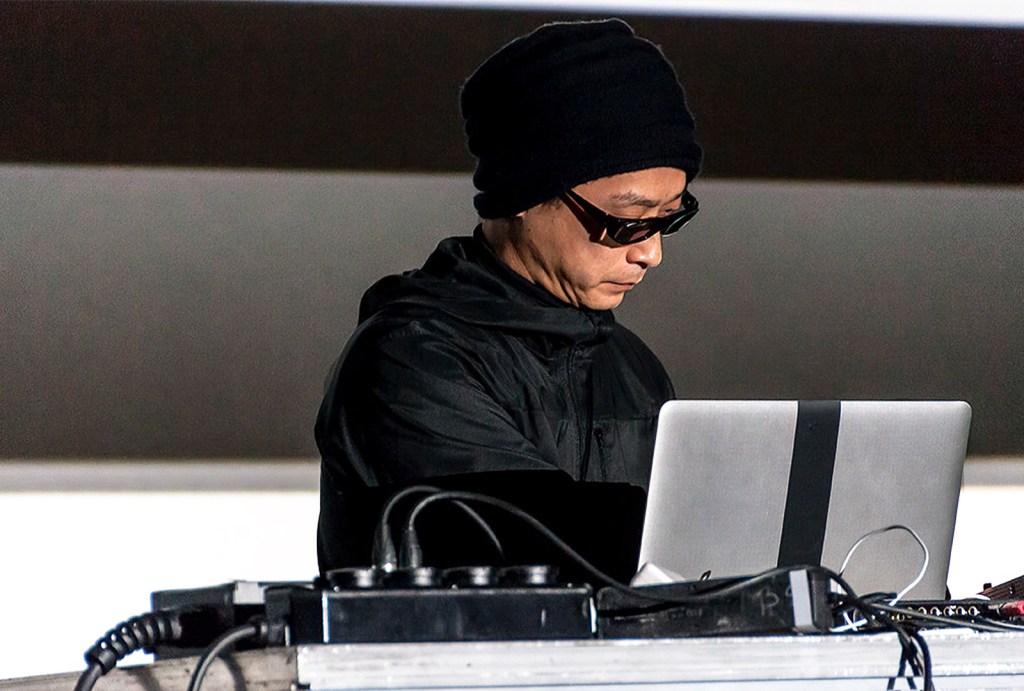
Ryoji Ikeda is a Japanese artist and composer renowned for his groundbreaking work in the realms of sound and visual art. Recognized as one of the leading figures in the field of minimalist electronic music and generative art, Ikeda’s work explores the essential characteristics of sound itself and transforms data into immersive sensory experiences. His installations and performances have captivated audiences worldwide, pushing the boundaries of art and technology by blending mathematical precision with aesthetic beauty.
Ikeda’s significance in generative art lies in his unique ability to translate complex data sets into audio-visual compositions. By harnessing the power of mathematics, physics, and computer programming, he creates works that challenge perceptions and invite viewers to contemplate the fundamental principles of the universe. His art is a fusion of sound and light, precision and randomness, simplicity and complexity—offering a profound exploration of the relationship between data and human experience.
Biography
Born in 1966 in Gifu, Japan, Ryoji Ikeda’s early life was steeped in the cultural richness of his homeland. While specific details about his childhood remain private, it is known that Ikeda developed an interest in music and science at a young age. He was particularly drawn to the minimalist compositions of artists like Steve Reich and Philip Glass, as well as the experimental works of John Cage. These influences would later inform his own minimalist approach to sound and composition.
Ikeda’s formal education did not follow a traditional path in the arts or sciences. Instead, he began his career in the early 1990s as a DJ and sound artist in the Japanese electronic music scene. His experimentation with electronic sounds and interest in the digital realm led him to explore the intersections of sound, time, and space. In 1995, he joined the influential Japanese art collective Dumb Type, which was known for its interdisciplinary performances that combined visual arts, theater, dance, and technology.
Working with Dumb Type allowed Ikeda to collaborate with artists from various disciplines, enriching his understanding of multimedia art forms. His contributions to the collective’s projects helped solidify his reputation as an innovative sound artist. Throughout the late 1990s and early 2000s, Ikeda began to gain international recognition for his solo work, which delved deeper into the concepts of data visualization and the aesthetics of minimalism.
Key milestones in his career include the release of influential albums such as +/- (1996), Matrix (2000), and Dataplex (2005). These works showcased his distinctive style and commitment to exploring the potentials of digital sound. Over the years, Ikeda has continued to evolve his practice, incorporating large-scale installations and performances that have been exhibited in some of the world’s most prestigious museums and galleries.
Artistic Practice
Ryoji Ikeda’s artistic practice is characterized by a rigorous exploration of the physical properties of sound and light, often using mathematical and scientific principles as foundational elements. His approach to generative art involves the transformation of raw data into sensory experiences, challenging audiences to engage with the imperceptible aspects of reality.
Philosophy Behind His Artworks
Ikeda’s philosophy centers on the idea of reducing art to its most fundamental components. He is fascinated by the invisible world of data, frequencies, and numerical sequences that underpin the observable universe. By translating these abstract concepts into audible and visual forms, he seeks to reveal the hidden structures that govern our reality. His work often questions the limits of human perception, pushing the boundaries of what can be experienced and understood.
Process of Creating the Artwork
Ikeda’s creative process begins with the collection and analysis of data. This data can range from mathematical constants like pi and prime numbers to astronomical measurements and quantum physics equations. He uses custom software and programming languages to process this information, converting numerical values into sound frequencies and visual patterns.
In his audio compositions, Ikeda employs sine waves, white noise, and ultra-high or low frequencies to create minimalist soundscapes. These sounds are meticulously arranged to produce rhythmic patterns and textures that are both precise and immersive. For his visual installations, he often uses synchronized projections of stark black-and-white imagery, geometric shapes, and binary code that pulse in harmony with the audio components.
Discussion of Techniques and Technologies Used
Ikeda utilizes a range of advanced technologies in his work, including:
- Digital Signal Processing (DSP): To manipulate sound waves and create complex auditory experiences.
- Data Sonification and Visualization: Transforming data sets into audio and visual formats.
- Programming Languages: Such as Max/MSP, Pure Data, and custom software to generate real-time audio-visual outputs.
- High-Resolution Projection Systems: For large-scale installations that envelop the viewer in immersive environments.
- Laser Technology: To create precise visual elements that interact with architectural spaces.
His mastery of these technologies allows him to craft works that are both technically sophisticated and artistically profound.
Insights into His Creative Process
Ikeda’s creative process is deeply analytical and methodical. He often begins with a conceptual framework based on a scientific or mathematical theme. From there, he experiments with ways to represent these concepts sensorially. This involves extensive research, programming, and testing to achieve the desired synchronization between audio and visual elements.
Despite the technical complexity, Ikeda maintains a focus on the experiential aspect of his work. He aims to create installations that are not only intellectually stimulating but also viscerally affecting. His pieces often evoke a sense of awe and contemplation, encouraging viewers to consider the vastness of the data-driven world we inhabit.
Notable Works
1. Datamatics (2006-Present)
Datamatics is one of Ikeda’s most renowned projects, encompassing a series of concerts, installations, publications, and CDs. The work explores the potential to perceive the invisible multi-substance of data that permeates our world. By using pure data as both a material and a subject, Datamatics transforms sequences of data—from text files to DNA sequences—into sound and visuals.
The installation features rapid-fire projections of data onto screens, synchronized with an intense electronic soundtrack. The visuals include complex grids, numerical sequences, and geometric patterns that create a high-intensity sensory experience. Datamatics challenges viewers to consider the overwhelming amount of data in the digital age and our ability to process it.
2. Test Pattern (2008-Present)
Test Pattern is an audiovisual installation that converts audio signals into tightly synchronized barcode-like patterns. The project examines the relationship between the auditory and the visual, exploring how data can be perceived through different senses.
In a darkened space, large screens display rapidly flickering black-and-white patterns that correspond to a pulsating soundtrack. The sheer speed and precision of the visuals create a disorienting effect, immersing the audience in a world of binary information. The work comments on the accelerating pace of data transmission in modern society.
3. Superposition (2012-Present)
Superposition is a performance piece that delves into quantum physics and the concept of multiple states existing simultaneously. Combining synchronized video screens, live performers, and a complex soundscape, the work presents a multilayered exploration of reality at the subatomic level.
The piece features two performers who manipulate an array of electronic devices, contributing to the audio and visual output. The synchronized elements represent the duality and uncertainty inherent in quantum mechanics. Superposition pushes the boundaries of performance art by integrating scientific theory into an immersive artistic experience.
4. The Planck Universe Micro and Macro
Commissioned for the Sharjah Biennial, this installation visualizes the vast scales of the universe, from the smallest known measurements (Planck length) to the largest (the observable universe). Through a series of projected images and sounds, Ikeda invites viewers to traverse these scales, contemplating the limits of human perception.
The work uses high-resolution projections and a minimalistic soundscape to create a contemplative environment. It reflects Ikeda’s ongoing interest in the intersection of art and science, offering a meditative exploration of space and scale.
Analysis of Themes and Concepts
Across his body of work, Ikeda consistently explores themes such as:
- Data and Information Overload: Commenting on the overwhelming amount of data in contemporary life.
- Perception and Reality: Investigating how we perceive and interpret sensory information.
- Mathematics and Science: Utilizing mathematical principles as artistic material.
- Minimalism and Precision: Emphasizing simplicity and exactness in composition.
- The Invisible Made Visible: Revealing hidden structures and patterns that govern existence.
Exhibitions and Recognition
Ryoji Ikeda’s work has been exhibited extensively around the world in solo and group exhibitions, as well as in international festivals. Notable exhibitions include:
- “The Transfinite” at Park Avenue Armory, New York (2011): An immersive installation where visitors could walk on a vast floor projection of data and sound.
- “Spectra” in London (2014): A temporary installation featuring a tower of light beams projected into the sky, commemorating the centenary of World War I.
- Exhibitions at Centre Pompidou, Paris; Museum of Contemporary Art, Tokyo; and the Barbican Centre, London.
Ikeda has received numerous awards and recognitions, including:
- Golden Nica Award at Ars Electronica (2001): For his album Matrix.
- Prix Ars Electronica Collide@CERN (2014): A prestigious residency award allowing him to work with scientists at CERN.
- Best Digital Work, Prix Ars Electronica (2015): For Supercodex, an album exploring the transformation of raw data into music.
Impact on the Art Community
Ryoji Ikeda has had a significant influence on both the generative art movement and the broader field of contemporary art. His work has inspired a generation of artists who explore the intersections of art, science, and technology. By demonstrating how data and algorithms can be harnessed creatively, he has expanded the possibilities of artistic expression.
Ikeda’s role in advancing the dialogue around art and technology is multifaceted:
- Pioneering Data-Driven Art: His innovative use of data as both subject and medium has opened new avenues for artistic exploration.
- Interdisciplinary Collaboration: His work often involves collaboration with scientists, mathematicians, and technologists, fostering a cross-pollination of ideas.
- Educational Influence: Through lectures, workshops, and residencies, Ikeda has shared his expertise, influencing emerging artists and students.
- Challenging Perceptions: His installations encourage audiences to engage with complex concepts in accessible ways, bridging the gap between abstract theory and sensory experience.
Ryoji Ikeda’s contributions to art are profound and far-reaching. His exploration of the fundamental elements of sound and light, combined with his innovative use of data and technology, has redefined the boundaries of generative art. By transforming invisible data into immersive experiences, he invites audiences to contemplate the complexities of the universe and our place within it.
Ikeda’s legacy is one of bridging disciplines—art, science, and technology—creating works that are intellectually stimulating and aesthetically compelling. As technology continues to evolve, his approach serves as a blueprint for future artists seeking to navigate the digital landscape. Ryoji Ikeda stands as a testament to the power of art to illuminate the unseen and to provoke thought through sensory exploration.
 Visual Alchemist
Leave a comment