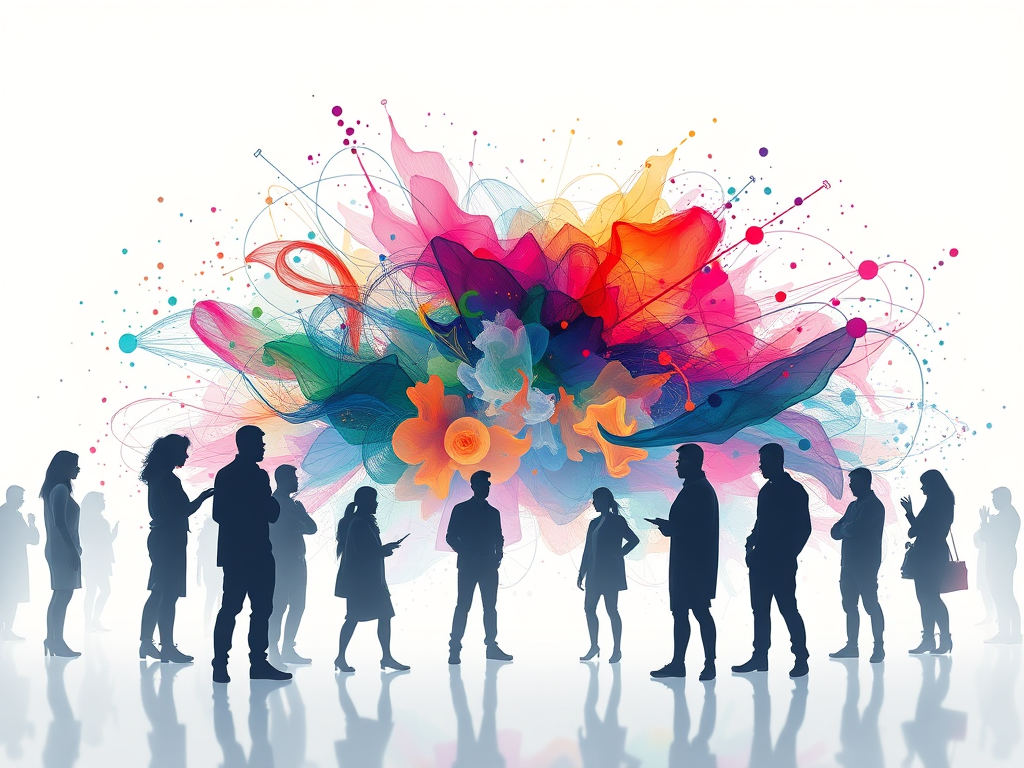
Does the use of generative systems redefine the roles of creator and observer, blurring the lines between active participation and passive appreciation?
Imagine a future setting in which art does not remain fixed on a gallery wall. Instead, it exists within complex computational frameworks that respond to input from those who engage with it. In this scenario, art is never entirely complete. Each viewer becomes part of a dynamic process, interacting with underlying rules and parameters, influencing patterns, colors, textures, sounds, or forms. The artist, having initiated a system that can vary and shift, steps aside as the observer steps forward. This thought experiment explores a landscape in which the distinction between artist and audience is continually negotiated. The generative system, defined by algorithms, rules, and structures, facilitates exchanges of roles and responsibilities.
In traditional art contexts, a painting, sculpture, or photograph is presented as a finished piece. The audience receives it as is. Appreciation generally involves observing, interpreting, and understanding the artist’s intention. Interaction remains limited to contemplation and internal reflection. Generative art, however, adds complexity. The audience can influence certain parameters, perhaps by adjusting a data input or interacting through a computational interface. The resulting work then transforms, responding to these inputs. Over time, this participation changes the trajectory of the artwork’s evolution. Multiple viewers can engage at different moments, each adding an element that shifts the output’s direction. The boundaries of creation begin to blur. The system itself contributes autonomy, making decisions based on code, probability, or external data. The presence of a system that can adapt and evolve highlights a fundamental shift: the concept of authorship no longer resides solely with a single creator. Instead, it disperses among participants, including non-human elements.
This reconfiguration of roles is not only conceptual. It has pragmatic implications that filter into how art is valued, exhibited, distributed, and archived. The changing relationship between artist and audience challenges long-held assumptions about what it means to create and appreciate art. It affects the ways museums, galleries, and collectors perceive authenticity. It alters the viewer’s expectations about what it means to “see” an artwork. All of these issues become more pronounced as generative systems become more accessible, embedded within digital platforms and accessible devices, where spectators can easily become co-creators.
Traditionally, art appreciation involved a relatively passive interaction
In a typical museum or gallery setting, a painting or sculpture sits in a controlled environment. The audience observes from a designated viewing distance. Interaction often involves reading explanatory text, absorbing the piece visually, and drawing conclusions. The work’s narrative, meaning, and emotional resonance reside in the audience’s internal engagement. The artist’s voice comes through the static artifact. Although different viewers bring distinct backgrounds, the object itself remains unchanged. The roles are clearly defined: the artist created the piece, and the audience receives it.
Over centuries, this pattern established stable expectations. The viewer seldom expected to alter the artwork itself. While interpretations differed, the object’s form and content remained constant. In some cases, conceptual art introduced the idea that the audience’s mental engagement completed the piece. But even then, the physical artifact or instruction set remained static. The audience’s role was still mostly interpretative rather than generative.
This longstanding model forms the background against which generative art stands out. The new possibilities raise questions: Is the artwork complete before the viewer arrives? Or does its final form come into being only when the viewer interacts with it? If the latter is true, then traditional notions of a completed masterpiece no longer apply. Instead, the work becomes a process, and the audience’s contribution becomes integral.
Interactive Systems
Generative artworks often incorporate interactive components. This may take the form of a digital installation that tracks the movements of individuals in a gallery, altering visuals on a screen or generating sound in response. Another example might be an online artwork that changes its patterns based on data input from remote users. Such systems shift focus away from a single-point experience and toward a continuous interaction between the system and multiple participants.
The audience member, once a passive observer, becomes a catalyst for aesthetic change. By moving, clicking, or speaking, the viewer can cause the artwork to morph into something new. The observer’s presence, movement, or input is crucial to the piece’s ongoing evolution. The conditions that the artist sets—comprising software code, mathematical models, or logical instructions—constitute only a starting framework. The viewers’ engagement drives the generative process forward, resulting in unique iterations. The art object, rather than existing as a final statement, operates as a field of potential outcomes.
This approach suggests that the identity of the artwork cannot be pinned down to a single form. Instead, it exists as a set of probabilities and conditional states. The generative system reveals how the aesthetic outcome emerges not from a single creator’s vision alone, but from the interplay of defined rules and audience interactions. Over time, this can produce a large range of distinct outcomes—none of which can claim to be the definitive version. Every iteration is valid as an expression of the underlying system.
Dynamic and Evolving Outputs
Unlike static artworks, generative pieces may change continually, even without direct human intervention. They might rely on environmental inputs such as temperature readings, random number generators, sensor data, or online information streams. The viewer’s role may be just one among many influences. Even so, when a viewer does engage, the piece’s trajectory might shift in a direction determined by that moment of interaction.
Consider a generative light installation that varies its patterns according to the number of people in the room. At certain intervals, the system draws on random algorithms to select new patterns. An observer might enter, notice a pattern, interact physically, and prompt a change. If they return later, the output may differ entirely. The audience member’s expectation of finding the “same” artwork no longer holds. The piece maintains a state of ongoing flux. Its identity becomes a concept linked to its generative rule set rather than any single manifestation.
This continuous evolution encourages repeated engagement. An observer might visit multiple times to discover new possibilities. The work’s meaning does not reside in a single interpretation but rather in the cumulative experience and the observer’s evolving understanding of the generative principles that guide it. The audience develops familiarity with the system’s rules, perhaps even predicting certain outcomes or influencing them more skillfully over repeated visits. The relationship between audience and artwork grows deeper and more involved.
Blurring of Authorship
The concept of authorship in generative art becomes complex. Traditionally, the artist’s name carries significant weight. It signifies origin, intention, and authority. In generative art, authorship disperses. The artist initiates the system, writing code, setting parameters, and defining constraints. But as soon as the system runs and the audience interacts, multiple agents contribute to the final output.
The system’s autonomy also plays a role. Code and algorithms can produce unexpected results, even surprising the artist. If randomization or adaptive machine learning is involved, the system might evolve in ways not entirely foreseen. Where does authorship reside in such situations? Is it in the artist who created the initial code? In the audience whose input guides the transformations? In the machine’s logic and processes?
This question disrupts the traditional artist-viewer hierarchy. Authorship no longer implies singular control. Instead, it suggests a network of influences, including human creativity, computational processes, environmental data, and audience engagement. The viewer, by participating, becomes a co-author. The original artist sets the stage, but the performance’s final form results from a co-creative act.
In this thought experiment, consider a scenario in which a generative music installation is open to public interaction. People enter, make vocal sounds, and the system processes these inputs to shape the music. Over time, the composition drifts from the artist’s initial sonic palette. The output might incorporate layers the artist never anticipated. The “author” of this ever-changing composition is not singular. It is a collective entity involving everyone who has interacted and the system itself.
Enhanced Engagement
Deeper engagement emerges when viewers participate actively. Traditional artworks often prompt questions, emotions, and interpretations. Generative systems add another dimension. Now viewers might consider not only what the artwork means but how it is formed. Observers may try adjusting parameters, testing the system’s boundaries, and learning its logic to influence the outcome deliberately. This creates a cycle of discovery and learning.
In many generative artworks, the audience can see their influence immediately. The responsiveness encourages a feedback loop: the viewer makes a change, sees a result, and modifies their approach. Over time, they might develop strategies for producing certain aesthetic outcomes. This process fosters a more profound understanding of the art’s underlying concepts and the intricacies of its generative rules.
Through hands-on interaction, viewers may feel a sense of agency. Instead of viewing a finished painting and experiencing it passively, they now have an active role. This shift can lead to a more invested audience. As participants begin to think of themselves as partial creators, their personal connection to the artwork intensifies. They are no longer external observers. They are essential contributors, influencing form, movement, and structure.
Personalized Experience
Each viewer’s interaction with a generative system can produce unique results. Two participants might approach the system differently, receiving outputs that vary widely. This personalization introduces a novel dynamic in the artist-audience relationship. Instead of a single, uniform viewing experience, there are as many variants as there are participants and engagement moments.
This uniqueness can lead to a form of individualized meaning-making. Each participant’s journey through the generative process differs. They might remember specific patterns they influenced, certain sounds they triggered, or particular visual configurations they caused. Over time, the audience collectively generates a wide array of outcomes. The artwork, rather than being one object, becomes a fluid set of experiences. Documenting all these iterations might be impossible, yet each participant carries a personal memory of their contribution. In this sense, the artwork expands beyond what is visible at any single moment and persists as a dispersed network of experiences and recollections.
Personalization also challenges conventional notions of evaluation and criticism. How do critics discuss a generative artwork that never repeats the same form twice? Traditional criteria may not apply. Instead, the focus might shift to the generative logic itself, the elegance of the system’s rules, the meaningfulness of the interactions it facilitates, and the depth of audience engagement. The evaluative conversation changes. It no longer revolves solely around the artist’s intent or the final visual product. Instead, it acknowledges a multiplicity of valid experiences and outcomes.
Shifting Focus from Product to Process
Generative art places heavy emphasis on process. The code, algorithms, and logical structures become central. Understanding how the artwork functions can be as important as observing its current manifestation. The audience may become curious about the underlying rules and even learn about the generative techniques involved.
Instead of treating the output as a static artifact, participants begin to appreciate the generative engine. This might involve understanding algorithmic principles, probability distributions, data streams, or machine learning models. In doing so, the audience not only consumes the art but also learns from it. They reflect on how small changes in input yield large shifts in output. They consider the role of randomness or constraints. They see how complexity emerges from simple rules.
This focus on process can reshape what it means to be an artist or a viewer. The artist becomes someone who designs systems rather than producing single artworks. The viewer becomes an explorer, navigating the complexity of the generative environment. Both roles emphasize exploration, experimentation, and adaptation. The aesthetic value emerges from the interplay of rules and variations rather than a final polished image.
Democratizing the Artistic Experience
Generative systems often rely on accessible interfaces. They can be presented on websites, mobile devices, interactive installations, or public screens. This accessibility can broaden the art world’s audience. People who might never visit a traditional gallery might engage online. They might shape the artwork from their own devices, contributing from anywhere in the world.
As participation becomes simpler, the line between artist and audience fades even more. The system allows widespread involvement, making creativity a collective enterprise. The gatekeeping mechanisms of traditional art spaces—geographic distance, exclusivity, limited gallery hours—diminish. Anyone with an internet connection or access to a public installation can become part of the generative artwork’s unfolding narrative.
This democratization encourages a re-examination of what makes someone an artist. If the audience participates in creation, do large numbers of people become artists? Does the artwork belong to the collective community of participants? The hierarchical distinction, once based on specialized skill or recognition, may lose some of its power. The artistic experience becomes a shared territory, dissolving barriers that previously existed between creator and observer.
Thought Experiment: The Generative Art Gallery of the Future
To illustrate these concepts, imagine a large-scale generative art gallery set in a future city. Instead of static paintings, the gallery is filled with screens, projections, holograms, and soundscapes. Each exhibit is a generative system that responds to visitor inputs. Some artworks might rely on environmental data—perhaps a piece that visualizes local weather patterns in abstract forms. Others might respond to wearable devices that measure visitors’ heart rates, transforming these biometric signals into evolving shapes and colors.
In this gallery, the audience has the option to interact through digital panels, voice commands, or gestures. Each input nudges the artworks into new states. Visitors return multiple times, noticing that the pieces never look the same twice. One sculpture-like projection shifts patterns based on how many people have recently passed through a space. Another transforms spoken words into generative poetry displayed on walls. The audience’s presence and actions continually alter the aesthetic environment.
Over time, the community of visitors learns how to influence certain installations. Some individuals develop reputations for creating remarkable visual sequences by understanding how to manipulate parameters. Others cooperate, coordinating their actions to produce collective experiences. The gallery’s artworks are co-authored by thousands of participants and the systems the original artists designed.
Critics face a challenge. Instead of reviewing a single completed artwork, they must discuss evolving processes. They comment on the elegance of the code, the quality of interactions, and the range of meaningful experiences that arise. The visitors, too, reflect on their involvement. They do not simply consume art; they shape it. The gallery becomes a living ecosystem of creativity.
Implications for Understanding and Valuing Art
In this thought experiment, value judgments shift. Collectors used to acquiring singular pieces might wonder how to “own” a generative artwork that continuously changes. They might purchase the underlying code or the platform on which the system runs. They might commission unique parameters that produce certain styles of output. Yet the collective influence of countless participants defies simple notions of possession.
Museums and archives face challenges in preservation. Preserving a generative artwork is not about storing a static image. Instead, it might involve maintaining the code, documenting user interactions, and preserving the environment it requires. Future viewers and scholars may attempt to recreate the conditions under which the artwork once generated its outputs.
Philosophically, generative art prompts reconsideration of creativity itself. Creativity has often been associated with individual genius. Generative systems illustrate how creativity can emerge from collaboration between humans and machines. The artist sets the stage, the audience participates, and the system autonomously generates forms. Authorship, meaning, and value emerge from these interconnections.
Bridging Disciplines
Generative art draws on fields beyond traditional fine arts. It involves computer science, mathematics, data science, and interaction design. Understanding a piece might require familiarity with code, machine learning, or network theory. The viewer who wishes to fully appreciate the work might study these fields, bridging the gap between aesthetics and technology.
This interdisciplinary nature further alters the artist-audience relationship. The audience may not only bring their aesthetic tastes but also their technical expertise, becoming co-creators who guide the artwork’s algorithmic evolution. The dialogue extends beyond visual elements to include discussions about data sets, algorithmic bias, or computational complexity. The artwork can thus become a platform for broader intellectual engagement.
As audiences grow more literate in these domains, their expectations change. They might demand transparency in how algorithms function or expect certain ethical standards in how data is used. This introduces a new dimension of responsibility for artists who design generative systems. The audience, now partly co-creating, also contributes to this ethical discourse.
Evolution Over Time
As technology advances, generative art will become more sophisticated. Future systems might incorporate advanced artificial intelligence, sophisticated sensors, and vast data streams. They might run continuously, never displaying the same pattern twice. They could learn from audience interactions, refining their aesthetics over months or years.
In such a future, the boundary between artist and audience might become even more fluid. An artist might design a seed—a set of rules and initial conditions—and then release it into the world. Thousands of people interact with it, guiding it through countless transformations. After a decade, the artwork’s form might bear little resemblance to its initial state. Who, then, is the creator?
This scenario underscores the idea that the artist-audience relationship will continue to evolve. It suggests that future art forms will be less about static objects and more about ongoing processes. The traditional model of an artist completing a work and an audience passively appreciating it may become a historical footnote.
Societal and Cultural Impact
Generative art could shift cultural attitudes toward creativity. As more people participate in the creation process, art could become viewed as a communal endeavor rather than the product of singular authors. This might align with a world increasingly defined by networks, platforms, and collective intelligence. The boundary between professional and amateur, creator and consumer, might become less relevant.
In societies that encourage participation, generative art can become a channel for expression at scale. During important events, people might collectively shape artworks that reflect shared experiences, data, or sentiments. Public art installations could evolve with the contributions of passersby, turning cityscapes into ever-changing visual narratives. The cultural role of art could expand from reflective object to dynamic forum.
Over time, these shifts could influence education. Students might learn about art by engaging with generative systems, understanding not just aesthetics but the logic behind them. They might experiment with creating their own generative pieces, blurring the line between learning about art and making it. This can nurture a generation of individuals who see themselves as co-creators in many domains, not just art.
Challenges and Limitations
The evolving artist-audience relationship in generative art also presents challenges. Not everyone will feel comfortable or interested in interacting. Some may long for the traditional experience of quiet contemplation before a stable image. Generative systems can be complex, and understanding their logic might be difficult. The learning curve might deter some viewers.
There is also the risk that increased interactivity turns art into a novelty or a game-like experience rather than a meaningful aesthetic encounter. If participants focus solely on producing flashy transformations, they might miss deeper conceptual intentions. The artist must carefully design the system so that interactivity fosters meaningful exploration rather than superficial entertainment.
Ethical considerations arise as well. If a generative artwork uses personal data from participants, issues of privacy emerge. If it relies on machine learning models, biases in the training data might influence the output. The audience, now partly a co-creator, shares some responsibility for addressing these challenges. The system’s design and the audience’s interaction patterns together shape the ethical landscape of the artwork.
Reconfiguring the Experience of Art
Despite these challenges, the trend suggests that the experience of art can become richer and more diverse. Instead of a one-way transfer of meaning from artist to viewer, we get a complex negotiation. Each participant influences and is influenced by the artwork. The roles blend, producing outcomes that no single entity could have created alone.
This reconfiguration aligns with the broader dynamics of a world where information flows interactively, boundaries are porous, and creativity emerges from collective processes. The generative artwork stands as a microcosm of these trends, revealing how cultural expression adapts to technological possibilities.
The audience, far from passive, contributes to the artwork’s vitality. Their presence shapes the piece, and their understanding evolves as they learn to navigate its rules. The artist, meanwhile, maintains influence through the careful design of the generative system. They define the initial conditions, constraints, and possibilities, ensuring that whatever emerges carries threads of their vision, even if altered by others’ inputs.
A New Paradigm of Appreciation
In this new paradigm, appreciation includes understanding the generative principles. Viewers approach an artwork not just as something to be looked at, but as an environment to be explored. The value lies not only in the aesthetic output but in the process of discovery. The viewer learns how the artwork works, experimenting with different inputs, and reflecting on the results.
The appreciation might also include acknowledging the contributions of past participants. The artwork, as an evolving entity, carries traces of all who have interacted with it. In a sense, it becomes a collective memory encoded in code and variation. Each new participant builds on what came before, adding another layer to an ongoing aesthetic conversation.
As this practice matures, the language we use to discuss art may shift. Terms like “final product,” “masterpiece,” or “authentic original” may lose their meaning. Instead, we might speak of “evolving systems,” “co-created experiences,” and “interactive aesthetics.” The vocabulary changes to reflect a world in which art never stops becoming.
Conclusion
The use of generative systems in art redefines the roles of creator and observer. Rather than a clear separation between artist and audience, we encounter a fluid relationship that involves interaction, co-creation, and continuous transformation. The generative artwork exists in a state of perpetual becoming, shaped by algorithms, environmental data, and the engagement of participants.
In this thought experiment, the traditional model of art appreciation as a passive act is replaced by a collaborative process. The audience takes on an active role, influencing outcomes and contributing to the artwork’s evolution. Authorship becomes distributed, with the artist, the audience, and the system sharing responsibility for what emerges.
This shift reflects broader changes in a technologically driven world, where boundaries blur, hierarchies flatten, and creativity becomes a networked phenomenon. As generative art moves from niche practice to mainstream presence, it may catalyze a deeper understanding of the relationship between humans, machines, and the art they co-create. The question posed at the beginning—whether generative systems redefine the roles of creator and observer—is answered not simply in theory but in practice, as we witness art and audiences evolving together in real-time.
 Visual Alchemist
Leave a comment