How does the use of generative systems in art relate to broader technological developments and their impact on society?
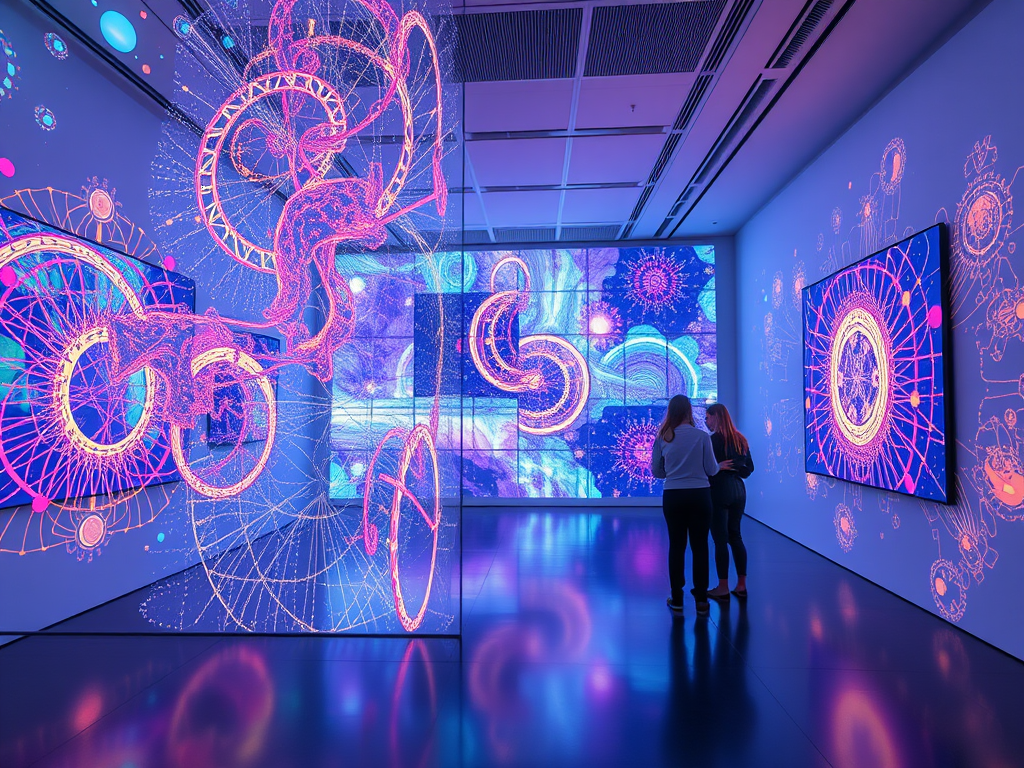
Imagine a setting in which a series of artworks adapt in real-time. Each piece emerges from algorithms that parse data streams, machine learning models that detect patterns, and computational logic that operates at scales too vast for direct human management. Visitors walk through a gallery that is not static. Displays shift in response to external inputs. Some react to environmental conditions, some transform based on interaction, some adapt according to complex variables embedded in code. These artworks are not fixed. They are always in a state of becoming, mirroring conditions that unfold both in and outside their encoded worlds.
In this thought experiment, the gallery’s installations reflect a broader phenomenon: the deep intertwinement of technology, society, and culture. Generative art stands as a mirror, showing how algorithms, data, and digital platforms define much of contemporary life. At the same time, it operates as a lens, focusing attention on the implications, questions, and dilemmas that arise from our increasingly technological environment. This mode of art-making is neither separate from the conditions that shape modern existence nor passively reflective. It engages actively with the tools, processes, and complexities that characterize the current era.
Generative art relies on systems and processes that run beneath the surface of our daily experience. It often involves complex rules that give rise to emergent patterns. These works can incorporate machine learning or other forms of artificial intelligence, thereby including elements not solely controlled by human authors. Over time, as the audience interacts and the parameters shift, the outputs continue to evolve. Viewed through the lens of contemporary technology, generative art does not simply depict a scene but performs a process analogous to those shaping communication networks, financial markets, online communities, and automated infrastructures. It shows that artistry can come from logic and code as much as from traditional human craftsmanship.
Yet generative art also encourages critical thought. As a commentary, it questions the nature of authorship in a time when software agents influence creative outcomes. It probes how data and algorithms shape our understanding of the world. It challenges assumptions about novelty, asking whether constant variation truly equates to meaningful innovation. By drawing attention to these concerns, generative art prompts reflection on society’s reliance on technology and the trade-offs between efficiency, complexity, and comprehension.
Generative Art as a Reflection of Technological Developments
Generative art mirrors the structures and tendencies of a rapidly transforming world. In this expanded exploration, we consider how its core attributes parallel the systems and dynamics that define contemporary technological culture.
Emphasis on Systems and Processes
Generative art is founded on systems and processes. It begins with code, parameters, and algorithms. The role of the artist is to design conditions that produce outputs rather than crafting each output directly. This shift from artifact to system has direct analogues in broader technological contexts. Much of modern life now depends on automated processes that shape social interactions, economies, governance, and personal decision-making. The rise of recommendation engines, data-driven logistics, and automated trading platforms exemplifies a world where underlying systems direct outcomes that individuals then navigate.
In the hypothetical gallery, each generative artwork’s nature is defined by code. It may draw on datasets for colors or shapes, or rely on sensor inputs for movement patterns. The observer sees not a single finished composition but a continuous flow of transformations. Similarly, daily life involves continuous engagement with shifting digital environments. Devices guide commute routes, online platforms refine user interfaces in real-time, and software optimizes responses to evolving conditions. Generative art thus holds a mirror up to these processes, underscoring that much of what we experience is orchestrated by systems we rarely see.
This emphasis on systems also resonates with the notion that software is not a neutral tool. In both art and daily life, software now operates as a medium that structures our possibilities. Just as generative art’s systems determine the visual or sonic outcomes, technological frameworks govern what users encounter online, how data is interpreted, and how actions are incentivized. The code underlying a generative piece parallels the logic running through countless applications and platforms. Both remind us that the world is increasingly experienced through the lens of carefully constructed processes.
Embracing Complexity and Emergence
The contemporary world is marked by complexity. Political, economic, and environmental systems intertwine in ways that resist simple explanations. High-speed trading algorithms, climate models, and social media dynamics create conditions where outcomes are emergent rather than predictable. Generative art engages with similar complexity. It often incorporates algorithms that produce patterns no single individual could predefine. Simple rules give rise to intricate forms. Initial conditions cascade into outcomes that cannot be known in advance.
Consider an artwork that uses particle systems, cellular automata, or machine learning models to generate evolving visuals. A slight change in input might spawn entirely different results. Over time, patterns emerge and subside, revealing complexity embedded in the generative system. This echoes how technology shapes global events. Data-driven decisions, subtle algorithmic nudges, and interlinked networks create feedback loops that can lead to unexpected consequences. The complexity of generative art thus parallels the complexity of contemporary systems, reminding us that we live in a world where outcomes are often products of emergent dynamics rather than linear cause-and-effect chains.
This reflection invites us to acknowledge that complexity is not simply a technical challenge but a cultural condition. As generative artworks highlight the beauty and unpredictability of emergent behavior, they also cast light on the limitations of attempts to control or fully comprehend these systems. Just as observers may find it hard to anticipate how a generative piece will evolve, decision-makers and citizens grapple with global networks that defy simplistic interpretation. The generative approach urges a mindset that accepts uncertainty and embraces ongoing inquiry rather than searching for final, static answers.
Blurring Boundaries Between Human and Machine
As technology advances, the line separating human creativity from machine processes becomes increasingly blurred. Generative art, particularly when it involves artificial intelligence, illustrates this shift. An artist sets the conditions, but algorithms may introduce variations that surprise even the creator. The outcome is a result of human intention and machine mediation. The machine’s logic, once a background tool, can now appear as a co-creator.
In the broader world, this blurring occurs as intelligent systems assist with tasks once seen as uniquely human. Recommendation engines influence cultural taste. Automated writing tools help produce text. Robotics aid in design and production. The hybridization of human and machine agency is a defining feature of modern life. Generative art directly engages with this condition. It shows that machine-driven processes can yield aesthetic results, and in doing so, challenges assumptions about what counts as authentic creativity.
By highlighting this hybrid authorship, generative art invites viewers to question their assumptions about originality, intention, and value. It also parallels a social environment where users collaborate with technology at every turn. In daily life, people rely on algorithms to curate what they see, and machines learn from human behavior to refine their outputs. Generative art lays bare these dynamics, making the once-invisible interplay between human input and machine response visually and conceptually evident.
Generative Art as a Commentary on Technological Culture
While generative art mirrors technology’s methods and structures, it also serves as a commentary. It is not only a reflection but a lens that focuses attention on the ethical, aesthetic, and conceptual questions that arise from the proliferation of digital systems. These artworks probe deeper issues about authorship, data, and novelty in a world where technology’s reach extends into every domain.
Questioning Authorship and Control
Generative art often unsettles the notion of a singular author. Traditional art rests on a sense of clear authorship: a painter’s brushstrokes or a sculptor’s chisel marks identify a unique creator. Generative art complicates this. The artist designs code that can produce innumerable outcomes. The algorithm, in executing rules, bears responsibility for the final form. Sometimes, external data sources or user interactions shape results as well. Authorship becomes distributed among the artist, the system, and the context.
This scenario parallels broader societal concerns. As algorithms manage financial transactions, shape political discourse, or curate information, questions arise about who is responsible for outcomes. When a decision is guided by machine logic or a predictive model, can a single individual be called the author of that decision? Generative art’s interrogation of authorship mirrors these dilemmas. By bringing issues of accountability and intention into the aesthetic realm, it reframes the debate and encourages viewers to consider how control and responsibility should be assigned in a world of algorithmic agency.
Within the thought experiment’s gallery, visitors encounter pieces that lack a single fixed creator. The artist initiated the code, but the displayed pattern might emerge from unpredictable interactions. This prompts reflection: if art no longer depends on one person’s hand, what does that say about cultural production at large? If technological infrastructures produce social outcomes with minimal direct human intervention, how do we assign credit, blame, or value? The generative artwork’s approach to authorship resonates with these broader questions, challenging conventional categories and prompting deeper thought about the conditions shaping contemporary existence.
Exploring the Aesthetics of Data and Code
Generative art treats data and code as materials. Traditional artists use paint, marble, or metal. Generative artists manipulate algorithms, datasets, and rules. In doing so, they reveal the aesthetic possibilities hidden in the abstractions that structure modern life. The data streams that govern traffic flow, financial transactions, social media trends, or environmental changes become subjects for artistic exploration.
This approach encourages the viewer to engage with data not just as information, but as a substance that can yield patterns and forms. By visualizing data creatively, generative art transforms numbers and code into accessible imagery, inviting the audience to consider what these abstractions represent. Data and code shape perceptions, decisions, and behaviors, yet they often remain invisible or intangible. Generative art makes them visible, prompting reflection on how these hidden substrates influence reality.
The gallery’s pieces might, for example, render a city’s traffic data as fluid generative patterns that shift throughout the day. Observers notice correlations and fluctuations previously hidden behind spreadsheets or database entries. Another piece might use temperature data to generate evolving color fields. Through these manifestations, viewers perceive technology’s underpinnings at a sensory level. This encourages questioning: what are we seeing when we look at algorithmic outputs? Are we witnessing distilled phenomena of our own world, or something else entirely? The artworks act as a lens, focusing attention on how data and code define the parameters of experience and knowledge.
Navigating the Allure of Novelty
Generative art can produce endless variations. With a change in input parameters, new forms appear. This capacity seems limitless. Yet an infinite supply of variation raises questions about novelty. Is each new iteration meaningful, or does the abundance risk diminishing its significance? The pursuit of novelty, a defining characteristic of technological culture, becomes a subject of inquiry.
The digital world provides constant streams of new content, products, and updates. Users scroll through feeds of information that never end. Innovation is valued, but it can also become superficial. Generative art reflects this tension. While it can always generate something different, not all variations carry depth. Some might be repetitive or trivial differences. This invites critical thinking about the cultural obsession with the new. Does novelty alone justify engagement? Is there a point where continuous variation becomes noise rather than insight?
Viewers in the thought experiment’s gallery might spend hours observing evolving patterns. Eventually, some may ask: what distinguishes one iteration from the next? Without criteria for understanding the underlying system, these variations may blur together. The artwork encourages viewers to consider whether the constant pursuit of the latest version, update, or aesthetic twist aligns with human values or understanding. By drawing attention to the potential emptiness of infinite novelty, generative art urges discernment about what truly matters, both in the art world and in broader technological culture.
Further Enrichment Through a Thought Experiment
To deepen these considerations, imagine a future environment influenced by generative processes on every level. The scenario extends beyond an art gallery into daily life. In this hypothetical world, public displays, architectural elements, music in common spaces, and educational materials all operate with generative logic. Sidewalk patterns shift based on pedestrian traffic data. Public announcements adapt their tone and frequency depending on environmental conditions. Even the layout of grocery stores is dynamically rearranged by algorithms seeking optimal flows. Everything that once seemed stable now reflects the adaptability and complexity of generative principles.
Against this backdrop, generative artworks occupy a central cultural role. They are displayed in civic centers, projected onto building facades, integrated into public transport hubs. Visitors are not just looking at art; they are interacting with it as a continuous aspect of their environment. This constant interplay between human activity and algorithmic processes becomes commonplace. In such a world, generative art no longer appears as a separate artistic discipline. Instead, it becomes a natural expression of how society functions.
In this scenario, questions about authorship intensify. If the city’s visual identity emerges from generative systems influenced by countless data points—weather, traffic, human presence—then who is shaping the city’s aesthetic soul? City planners might have initiated the code, but now the artwork evolves independently. Residents who pass by, unknowingly contributing data through their movements, become part of the creative process. This resembles how generative art functions in the gallery but now scaled up to the infrastructure of daily life. Authorship is plural and dynamic, mirroring how social and technological factors co-create cultural experiences.
Similarly, the aesthetics of data and code extend into all aspects of public life. Citizens learn to read patterns in the shifting facades of buildings, interpreting data visualizations as easily as they might read a news feed. The cityscape itself becomes an ongoing commentary on the flows and conditions affecting the population. Environmental data might appear as subtle color changes. Economic shifts could cause patterns to morph. This continuous aesthetic feedback loop encourages greater awareness of underlying systems. Data and code are no longer hidden. They become integral to the shared visual vocabulary.
Within such a technologically saturated environment, novelty no longer retains its previous allure. If everything is always changing, the distinction between innovation and mere variation becomes more important. Citizens learn to discern meaningful differences. When a public art display shifts patterns, they ask: does this reflect a new insight or just another trivial permutation? Over time, people might demand intentionality, transparency, and comprehension. They wish to see the logic behind changes, to connect transformations to underlying causes rather than treat them as endless novelty. The citizens become critical participants in a world shaped by generative principles, mirroring the questioning stance viewers adopt toward generative artworks in the gallery.
Implications for Understanding and Engagement
Generative art, viewed as both mirror and lens, has implications for how society approaches technology. Its reflection teaches that the complexity, algorithmic mediation, and fluid authorship in art closely resemble conditions experienced in other areas. Its commentary encourages deeper engagement. Rather than passively accepting technology as it is, generative art suggests that society can think critically about how these systems operate, how they distribute agency, and what values they embed.
In the gallery scenario, observers grapple with understanding a generative piece’s underlying logic. Similarly, in a technologically saturated world, citizens must learn to navigate complex systems responsibly. The skills involved are interpretive and analytical. They involve recognizing patterns, questioning intentions, and understanding that outputs are never neutral but shaped by parameters defined by developers, data sources, and automated processes.
Generative art’s questioning of authorship also resonates in discussions about accountability. If generative systems in art share the creative load with algorithms, how does one attribute artistic credit? Analogously, if algorithms determine significant societal outcomes, how do we assign accountability for bias, errors, or unintended consequences? By highlighting the difficulty of pinpointing authorship, generative art invites broader conversations about responsibility in technological governance.
In terms of aesthetics, generative art’s treatment of data offers a lesson: data can be understood as a malleable material, not a mere given. This perspective encourages critical evaluation of how data is collected, interpreted, and used. Just as generative art can make data visible, society can demand clarity about how data-driven systems function. Transparency and explainability become key values, ensuring that the generative logic shaping decisions and cultural expressions remains accessible rather than concealed.
The issue of novelty connects to broader cultural concerns about technological innovation. Society often prizes innovation for its own sake, celebrating new products, platforms, and apps. But generative art’s infinite potential for variation raises the question of whether all novelty is valuable. Perhaps meaning and understanding matter more than the sheer quantity of new outputs. The critical stance inspired by generative art may encourage a shift from seeking endless novelty to seeking depth, context, and long-term relevance.
Educational and Institutional Considerations
Generative art’s merging of aesthetics, technology, and commentary could influence educational approaches. Learning to engage with generative art trains individuals to interpret complex systems. Students might practice reading algorithmic patterns in the same way they learn to read texts or interpret historical data. This skill has broader applications. Understanding how generative systems operate becomes valuable in a world where technology affects most aspects of personal and professional life.
Institutions dedicated to art, culture, and education could incorporate generative artworks into their programs. By doing so, they acknowledge that art is not isolated from technological changes. Instead, art can help decode and clarify these changes. Museums and cultural centers might host interactive generative installations that allow visitors to experiment with parameters, observe consequences, and draw conclusions. This hands-on approach fosters a deeper appreciation for the complexity of both art and technology.
Over time, the presence of generative art in mainstream venues may normalize the idea that art can be a tool for understanding the systems shaping society. The gallery becomes a testing ground for interpretive skills. As citizens grow accustomed to reading generative artworks, they become better equipped to question the logic behind commercial algorithms, evaluate the outputs of automated systems, and seek transparency in data-driven governance.
Ethical and Social Dimensions
Generative art can also raise ethical questions. If artworks rely on data, what data is chosen and why? If algorithms shape aesthetics, whose values guide these choices? Similar questions apply to technological systems at large. Who decides which data points matter in decision-making processes? How do biases in training sets affect outcomes? By encountering these issues in an artistic context, viewers become more aware of parallel issues in their daily lives.
Art spaces can become forums for discussions about digital ethics, informed by what generative artworks reveal. Audiences can reflect on whether the algorithms producing art are open source, whether the data sources are representative, and whether certain methods of generating variation might inadvertently marginalize certain perspectives. These questions mirror those in the broader technology sphere, where biases in algorithms and data collection can have tangible social consequences.
In contemplating novelty, generative art also encourages ethical reflection on consumption. If infinite variations are easy to produce, does society risk becoming indifferent to quality or meaning? Will superficial differences overshadow more important considerations, such as environmental sustainability, social justice, or human well-being? Generative art’s commentary on novelty suggests that discerning viewers should distinguish between meaningful innovation and trivial iteration. This critical stance can inform how society adopts and evaluates new technologies, ensuring that progress aligns with collectively held values rather than pursuing novelty for its own sake.
A Continuing Conversation
Generative art’s dual role—as a mirror of technological developments and a lens for critical examination—is not static. As technology evolves, so do the questions generative art raises. The introduction of new machine learning models, more complex data sets, and immersive interfaces will alter how generative systems function. Future artworks may incorporate decentralized networks, quantum computing, or advanced sensors that merge the digital and physical worlds even more seamlessly.
This ongoing evolution ensures that generative art remains a living conversation about technology’s place in culture. As the world grapples with issues related to governance, privacy, regulation, and ethics in digital systems, generative art will continue to provide insights. By remaining responsive to changes, it can help track shifts in public sentiment, highlight emerging dilemmas, and propose new conceptual frameworks for understanding a technologically dependent era.
The thought experiment guiding this exploration—the gallery scenario and its extension into public life—serves to anchor these reflections. By visualizing possible futures in which generative principles become the norm rather than the exception, we gain a vantage point. From that vantage, we can consider how to navigate complexity, share authorship, interpret data, and evaluate novelty. Generative art thus becomes both an artifact of its time and a tool to imagine and influence what might come next.
Conclusion
Generative art stands as a mirror and a lens for our technological culture. As a mirror, it reflects the systems, complexity, and blurred boundaries that define modern life. Through its emphasis on processes, its engagement with emergence, and its exploration of hybrid human-machine creativity, generative art shows that what we consider distinct and stable may be contingent and evolving.
As a lens, it brings crucial questions into focus. It prompts examination of authorship, pushing beyond traditional notions of the solitary creator. It treats data and code as aesthetic materials, asking viewers to confront the fundamental substrates of the digital age. It questions the value of novelty, challenging the idea that endless variation is inherently meaningful. In doing so, generative art fosters critical thinking about how society embraces or resists technological change.
The envisioned scenarios—where generative systems pervade art galleries, public spaces, and civic infrastructures—underscore how deeply these issues resonate. They show that the same qualities that define generative art’s practice also shape how communities organize, communicate, and adapt. The reflexivity inherent in generative art—its ability to comment on the conditions that make it possible—ensures that as technology continues to advance, the dialogue remains open.
By engaging with generative art, individuals gain tools to navigate a world defined by complexity, data, and continuous innovation. They learn to question, interpret, and reassess the outputs of algorithms that influence culture, economy, and politics. In this sense, generative art does not merely entertain or decorate. It equips viewers with conceptual frameworks for understanding and participating in technological realities. As society continues to grapple with the implications of rapid technological change, generative art remains a vital practice that reveals, critiques, and ultimately enriches the cultural landscape.
 Visual Alchemist
Leave a comment