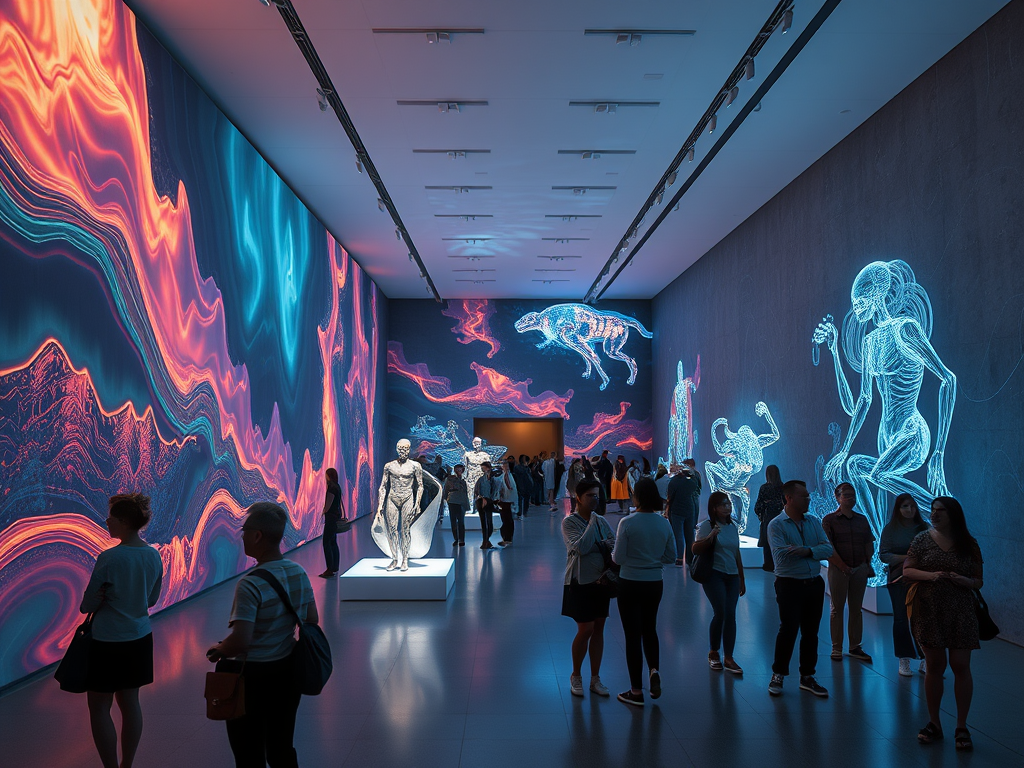
Imagine a future art museum unlike any traditional gallery you have ever visited. Instead of static paintings and sculptures, you encounter artworks that never seem to settle into a final form. The walls display projections that continuously shift, generated by complex algorithms pulling data from multiple sources. Sculptures alter their shapes subtly over time, influenced by sensors detecting changes in the environment. Soundscapes dynamically rearrange notes and rhythms as visitors move through the space, creating an immersive audiovisual experience that feels both alive and autonomous. Each artwork emerges from generative systems—computational frameworks that combine human-coded instructions, large datasets, artificial intelligence, and randomization to produce outputs that can surprise even their creators.
Yet, as you wander deeper into this futuristic museum, questions begin to surface. Who is truly behind these works of art? The artists who wrote the code, or the systems that execute it and produce the results? Are these works genuinely original creations, or do they borrow too heavily from the vast pool of existing imagery, music, or text that trained the algorithms? If the data used to inform these generative models contains biases or harmful stereotypes, does the resulting artwork reinforce them? Moreover, what happens to human creativity and labor when machines can generate infinite variations of aesthetically pleasing outputs with little effort? And beyond the museum, how does this emerging form of cultural production shape public perception, value systems, and social relations in a world increasingly mediated by AI?
These questions highlight the ethical entanglements surrounding generative art. While generative art offers unprecedented expressive potential, its growth also brings responsibilities that cannot be ignored. This article explores key ethical challenges: questions of authorship and control, the presence of bias, the impact on human creativity and labor, and the broader societal implications of art emerging from computational processes. Throughout, it emphasizes that addressing ethical concerns does not limit creativity. Instead, it can guide generative art toward a more thoughtful, inclusive, and responsible evolution.
Authorship and Control
One of the most fundamental shifts introduced by generative art lies in how we conceive authorship. Traditional understandings of art typically assume a human artist consciously shaping each element of a work. In generative art, the artist often sets the parameters—a code, a dataset, a machine learning model—and then steps back, allowing the system to produce outcomes beyond their full anticipation. The resulting artwork emerges from a complex interplay: human intention meets algorithmic execution, and chance elements or computational logic help determine the final form.
This interplay raises challenging questions. If the generative system produces something remarkable that the artist did not explicitly envision, can the artist still claim full authorship? Is the algorithm itself, or the underlying model, a kind of co-author? Some argue that the true creativity still lies in the initial design, the conceptual framework, and the parameters set by the human. Others suggest that the generative system is more than a tool, acting as an active collaborator contributing to the aesthetic result.
Matters grow more complicated when we consider appropriation and exploitation. Many generative systems rely on training data drawn from existing artworks—images of paintings, photographs, music samples, literary texts—often compiled without explicit permission from their creators. If a generative model learns a distinctive style from these data and reproduces it convincingly, where does that leave the original artist? Are we witnessing a subtle form of plagiarism masked by technological novelty? Some fear that generative art could become a mode of mass appropriation, where historical and contemporary creativity is mined for patterns without proper credit, consent, or compensation.
Additionally, we must grapple with the philosophical issue of whether art can exist outside human cultural practice. If a fully autonomous model, isolated from human feedback, generates outputs, do these works count as art if no human recognizes or interprets them? Proponents of strong AI-driven creativity argue that once we free ourselves from human-centric definitions, algorithmic production may represent a new kind of cultural artifact. Critics, however, maintain that human context—intention, interpretation, cultural value—is necessary for something to be considered art. The debate is not purely academic; it influences how we grant status, rights, and recognition within evolving artistic ecosystems.
The ethical implications revolve around intellectual property, fairness, and moral responsibility. If generative art thrives by absorbing the styles of countless human creators, should not those creators receive acknowledgment? Failure to address these questions risks reducing the human contributions that feed generative systems to raw, unpaid inputs. Striking a balance between innovation and respect for cultural heritage is vital. Ethical guidelines might involve clearly documenting data sources, seeking permission where possible, and inventing mechanisms to share value with original creators. Without these measures, authorship in generative art could become an unsettled territory ripe for exploitation.
Bias and Representation
Walk into another wing of the imagined museum. Here you find generative portraits of people who never existed. The system seamlessly combines facial features, producing an array of images that feel realistic, even intimate. At first glance, it seems like a celebration of diversity—faces of different ages, ethnicities, and genders appear in an endless carousel. Yet on closer examination, subtle skewing emerges. Certain racial or cultural features appear less frequently or are represented with stereotypical traits. Gender expressions may be flattened or caricatured. Beauty standards embedded in the dataset influence which features the system treats as “ideal.”
This is the issue of bias. Generative models, like other AI systems, inherit the values and blind spots of their training data. If the data reflect historical prejudices, inequalities, or skewed viewpoints, the resulting artworks do too. The aesthetic realm is not immune to social hierarchies; generative art can inadvertently replicate and reinforce them. Without careful curation and oversight, generative art risks becoming a new medium through which harmful stereotypes are perpetuated.
Consider also generative text-based artworks that produce narratives, poems, or dialogues. If the training text is riddled with bias—gendered language, racial slurs, cultural erasures—then the outputs can reflect these problematic elements. Music generation systems might privilege certain scales or tonalities associated with dominant cultures, while sidelining others. Visual generative models may systematically “underrepresent” certain communities, producing a distorted cultural mirror.
The ethical challenge lies in whether generative artists and developers have a responsibility to confront and correct such biases. Some argue that art has always reflected society’s flaws and should be free to do so. But when biases stem not from intentional critique but from unexamined datasets, the resulting stereotypes serve no creative purpose beyond ingraining harmful norms. Ethical generative art practice means scrutinizing data sources, acknowledging biases, and employing techniques to reduce them. It might involve diversifying training inputs, consulting with communities who have historically been misrepresented, or applying algorithmic fairness techniques.
Bias also connects to broader power dynamics. Who chooses the training sets, and based on what criteria? If generative art remains dominated by creators from certain backgrounds, their worldview may dominate the aesthetic outputs. Ethical responsibility suggests involving diverse curatorial voices and communities in the development process. Rather than uncritically embracing what the machine “decides” to produce, artists can intervene to ensure the generative process does not just mirror inequality but challenges it. By doing so, generative art could become a force for expanding cultural understanding instead of narrowing it.
Impact on Human Creativity and Labor
In another section of the museum, you encounter a generative audio installation. It composes intricate, pleasing music in real-time, responding to the gallery’s acoustics and the number of visitors present. The melodies shift seamlessly, blending influences from various traditions. A professional musician listens in wonder, but also with anxiety. If a generative system can produce endless, high-quality music at the press of a button, what does this mean for human composers who spend years refining their craft?
This scenario underscores a significant ethical concern: the impact of generative art on human creativity and labor. Tools that automate creative tasks raise questions about whether human artists will be displaced, undervalued, or reduced to data providers for algorithms that capitalize on their cultural heritage without adequate returns. While some herald generative art as a democratizing force, enabling anyone to produce complex works, others worry it might devalue the time, skill, and emotional labor that human artists invest.
These anxieties touch on the future of artistic professions. Visual artists, musicians, writers, and designers may find themselves competing with systems that can produce massive amounts of “fresh” content. If the market shifts to favor quick generative outputs at lower costs, human creators might struggle economically. The question of fair compensation arises: if generative models rely on datasets drawn from collective human creativity, should not original creators receive royalties or recognition when their stylistic contributions surface in new works?
Another aspect is the changing notion of creativity itself. Historically, creativity has implied a uniquely human capacity for invention, emotion, and subjective insight. Generative art challenges this notion, suggesting that novelty can emerge from computational processes. Some argue that machines have no internal experience, and thus cannot be truly creative. Others counter that creativity is defined by the outputs’ quality and originality, not by the subjective experience of the creator. Regardless of the stance, the debate forces us to re-examine what we value in artistic production. Is it the personal story behind the art, or the artifact itself?
To address these concerns ethically, stakeholders can develop frameworks that ensure fair compensation and acknowledgment. Artists who contribute works to training datasets might opt in through licensing arrangements, guaranteeing them a share of profits or at least recognition. Platforms and institutions can highlight the human artists who influenced generative outcomes, preserving a link between past creative labor and present automated innovation. By respecting and rewarding human creators, generative art can coexist with traditional artistry rather than undermining it.
Societal Implications
The museum’s final hall presents large-scale installations that remind viewers that generative art extends beyond pure aesthetics. One artwork simulates an evolving cityscape based on economic and demographic data, highlighting how algorithmic processes shape urban planning, housing distribution, and even law enforcement decisions. Another installation visualizes how machine vision classifies and tracks people, revealing the politics of surveillance and data-driven governance. A generative narrative work crafts speculative futures of climate change responses, blending factual data with imaginative leaps.
These pieces emphasize that generative art is not created in a cultural vacuum. The same technologies that enable these artworks also influence social systems, economies, and political structures. Machine learning models decide what content people see on social media, shape credit scores, inform hiring decisions, and filter news. By reflecting on these parallels, generative art can serve as a critical lens, prompting viewers to question not only the artworks themselves but the broader world powered by algorithms.
The ethical dimension here relates to how generative art engages with or comments on pressing societal issues. Art has long been a space for political critique and ethical reflection. Generative art, with its unique access to data-driven processes, can illuminate how AI and automation reshape power dynamics. Yet it can also risk normalizing these very systems if presented without critical context. If an artwork merely aestheticizes surveillance, for instance, it may inadvertently make intrusive monitoring appear benign or intriguing rather than alarming.
To ensure a positive societal role, generative artists and curators can anchor their works in critical discourse. They can provide context explaining how the underlying models work, what data they consume, and what biases they might contain. Galleries and museums can host discussions, panels, and workshops that link the aesthetic experience to broader political and ethical debates. By encouraging audiences to think beyond surface beauty, generative art can inspire awareness, empathy, and civic engagement.
Societal implications also include cultural domination. If generative art relies heavily on data from a handful of influential cultural centers, it may further entrench cultural imperialism. Lesser-known traditions or marginalized art forms might vanish into the algorithmic background. Ethical strategies could involve actively sourcing data from multiple cultures, collaborating with artists from different regions, and designing interfaces that let viewers see and appreciate the cultural provenance of certain aesthetic elements. In doing so, generative art can become a platform for cultural exchange rather than homogenization.
Mitigation, Responsibility, and Accountability
Awareness of these ethical entanglements is one thing; developing mechanisms to address them is another. Ethical generative art practice involves translating principles into concrete actions.
Transparency is a foundational step. Artists and developers can disclose where their training data came from, what methods they used, and how the system’s logic is structured. Such openness transforms a mysterious black-box process into something viewers can scrutinize and critique. When audiences understand the data sources and decisions behind a generative piece, they can question biases, challenge appropriations, and engage more deeply with the ethical dimensions.
Actively combating bias requires systematic efforts. Artists might audit their datasets, identifying underrepresented groups and deliberately adding more diverse sources. They can employ algorithmic fairness techniques or build interfaces that let viewers choose parameters influencing style and representation, thus making bias visible and giving the audience agency. Collaboration with social scientists, ethicists, and activists can offer guidance on identifying harmful patterns and implementing remedies.
Fair compensation and recognition models are critical. If generative art profits from remixing historical styles, then acknowledging those who contributed the source material is paramount. Possible solutions include licensing agreements allowing artists to include their works in training sets in exchange for royalties or attribution. Where direct compensation is difficult, curators and platform developers might develop tokenized forms of credit, digital provenance records, or agreements that ensure some form of shared benefit. The principle is simple: those whose creativity feeds the machine should not be erased by it.
Institutions—museums, galleries, online platforms—can also adopt ethical standards. They might refuse to exhibit works that violate basic fairness principles or that exploit data harvested without consent. They could reward artists who demonstrate ethical diligence, thereby incentivizing responsible behavior. Peer review and certification processes, similar to those in academic or environmental standards, might emerge to recognize artworks that meet certain ethical benchmarks.
Policy and regulation may eventually be part of the solution, although care is needed to avoid stifling creativity. Governments and cultural institutions could establish guidelines that protect original creators, limit certain exploitative practices, or require transparency in generative processes. As the cultural significance and commercial value of generative art grow, a balanced regulatory framework might help ensure that this new frontier develops in alignment with societal values.
A Collaborative Ethical Future
No single entity can address these ethical challenges alone. Artists, developers, audiences, cultural institutions, policymakers, and communities all have roles to play. Collaborative approaches can distribute responsibility and expertise across a network of stakeholders.
Artists can reach out to communities who appear in their training datasets, seeking feedback and partnership. They can engage ethicists or activists during the design phase of a project, co-creating works that highlight both aesthetic and moral complexities. Developers can design software features that allow artists to audit and adjust biases, credit sources, and insert explanatory metadata into their works.
Audiences can practice active critique. Instead of viewing generative art passively, they can question its provenance, challenge its assumptions, and support creators who uphold ethical standards. Critics, journalists, and scholars can analyze generative works not just formally but ethically, bringing these considerations into mainstream cultural discourse. Curators and museum directors can devote exhibition space to exploring how generative systems make decisions, thus educating the public about the interplay of technology, art, and ethics.
Such collaborations recognize that ethical constraints do not limit creativity. On the contrary, they open up new territories for experimentation. Artists might find inspiration in addressing ethical problems head-on, creating works that make biases visible or that experiment with fair compensation models. Developers might innovate by coding mechanisms for transparency and user feedback. Curators might develop entirely new exhibition formats that encourage audience participation in ethical decision-making. The result could be a richer, more engaged art ecosystem, in which ethics and aesthetics inform and elevate each other.
From Thought Experiment to Reality
While the museum scenario imagined at the outset is a projection into the future, generative art already populates online galleries, commercial platforms, and research labs worldwide. The speed at which AI art tools advance suggests that the questions raised here will become urgent sooner rather than later. Waiting until controversies erupt or legal battles ensue will not serve anyone’s best interests. Proactive reflection is necessary now.
Artists can begin by including short ethical statements alongside their works, outlining how and why they chose certain data. Developers can build user-friendly interfaces that let viewers investigate the generative process. Institutions can foster forums and educational programs that encourage visitors to think critically about what they see. Online platforms can adopt guidelines that reward transparency, fairness, and originality.
Viewers, too, can practice ethical literacy. When encountering a piece of generative art, they can ask: What cultural sources does this piece draw on? Are these sources acknowledged? Does the work challenge or reinforce stereotypes? Whose labor or creativity underpins this output, and how are they recognized? Such questions transform passive spectators into active participants in the ethical life of generative art.
Continuity with Artistic Traditions
It is useful to remember that art has always grappled with ethical issues. Historically, artists have faced accusations of appropriation, debates over originality, struggles over representation and inclusion, and questions about their social role. Generative art inherits these old debates and reframes them for an age of computational abundance. In doing so, it can learn from past movements.
Dadaists challenged authorial intention and embraced chance, prompting questions about what it means to create deliberately. Surrealists delved into the unconscious, hinting at forces beyond rational human control. Conceptual artists highlighted the idea over the artifact, paralleling generative art’s emphasis on systems rather than static outputs. Minimalists engaged with systems and structures, a practice not unlike algorithmic rules. Generative art now merges all these threads with advanced computation, scaling up the complexity and reach of their implications.
Recognizing this continuity can help generative artists see that ethical inquiry is not foreign to art. Far from stifling imagination, ethical considerations have historically driven artistic innovation and critique. By positioning themselves within a lineage of creators who questioned norms, generative artists can approach ethical issues as an intrinsic, generative part of their creative process rather than a nuisance.
Evolving Norms and Practices
As generative art matures, new norms and best practices will likely emerge. We might witness the development of artist collectives dedicated to maintaining ethical standards, sharing resources, and proposing community-driven guidelines. Online platforms might add metadata tags indicating the provenance of training data or the measures taken to avoid bias, allowing buyers, collectors, and audiences to factor ethics into their judgments.
Over time, educational institutions will integrate these discussions into art and design curricula, preparing students to think critically about technology’s cultural ramifications. Scholars may produce ethical frameworks specific to generative art, just as critics have developed theoretical lenses for analyzing other movements. Researchers might propose technical solutions—algorithms that can detect and mitigate certain types of biases, or protocols for ensuring consent in data collection.
The ultimate outcome could be a more mature, self-aware field. Instead of generative art sailing blindly into ethical storms, it navigates with a compass attuned to cultural values, human rights, and communal principles. Rather than each artist inventing ethical guidelines from scratch, they can build on collective wisdom and norms that evolve as the field grows.
Complexity and Responsibility
The ethical entanglements of generative art are intricate and multifaceted. From authorship and control to bias, labor, and societal implications, each challenge reveals that the leap into computational creation is not a simple advance. It opens new horizons but also forces us to reconsider what we value in art, how we acknowledge its sources, and what responsibilities accompany creative power.
Far from hindering creative freedom, ethical reflection can enrich generative art. By acknowledging the human labor, cultural histories, and societal contexts that feed into algorithmic outputs, generative artists show respect for the complexity of the worlds they draw from. By actively working against bias and exploitation, they make their art more inclusive, honest, and resonant. By engaging audiences in thoughtful reflection, they elevate art’s role as a catalyst for cultural dialogue rather than a passive commodity.
In essence, embracing ethical responsibility is not separate from pushing the boundaries of generative art—it is integral to doing so meaningfully. The future of generative art lies not in ignoring these entanglements, but in weaving them into the creative process. By doing so, artists, viewers, institutions, and communities can ensure that this emerging form of cultural expression does not just astonish the eye and ear, but also fosters empathy, fairness, and a deeper understanding of ourselves and our technologies.
 Visual Alchemist
Leave a comment