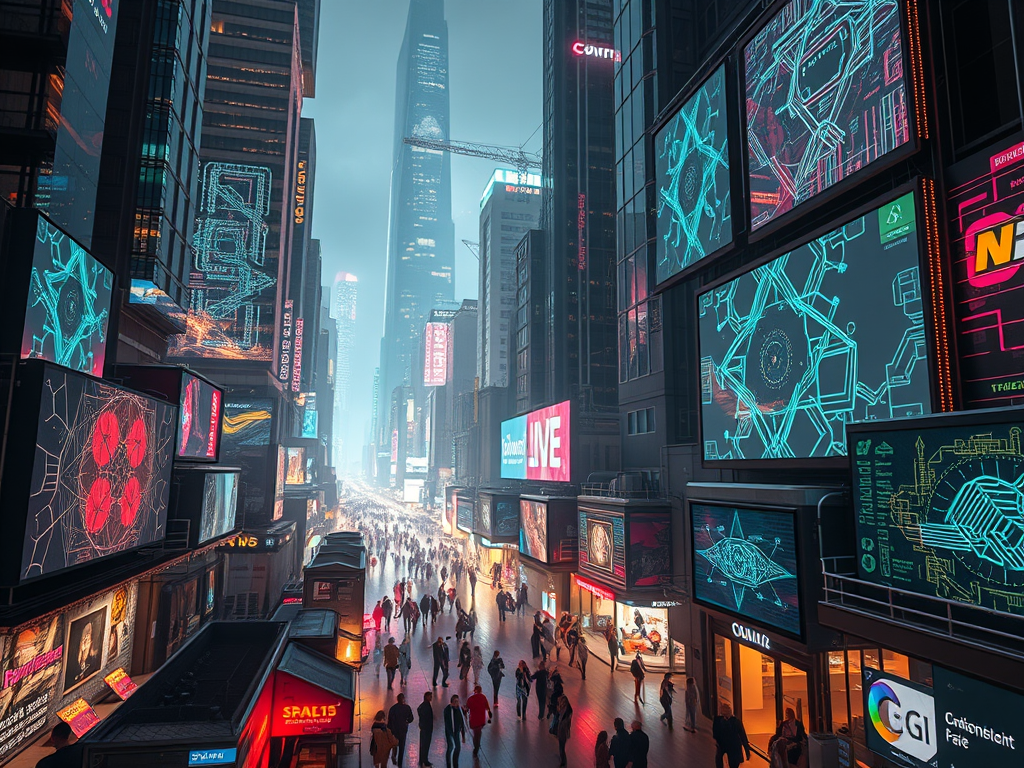
Imagine a sprawling metropolis in the near future where cultural production is no longer bound by conventional frameworks of authorship, craft, and taste. In this city, the lines between human and machine creativity are blurred. Across multiple venues, from grand museums to intimate neighborhood art hubs, generative artworks populate screens, projections, augmented reality layers, and sonic environments. Each piece emerges from algorithms, datasets, and interactive code, producing forms and patterns in real-time. Rather than fixed objects, these artworks are living, evolving entities—embodiments of computational processes that respond to viewers, contextual data, or networked feeds. They are shaped not solely by human hands, but also by artificial intelligence, chance operations, and collective participation.
In this imagined scenario, art no longer resides exclusively in the realm of the solitary genius or the fixed masterpiece. Instead, it manifests as a dynamic interplay between human intention, algorithmic logic, and emergent aesthetics. The generative approach to art-making invites a critical rethinking of deep-seated assumptions. It challenges the notion that an artwork’s value resides in a single creator’s vision. It questions traditional concepts of authenticity and originality when an artwork may have infinite variations. And it disrupts aesthetic hierarchies that have, for centuries, determined what is considered worthy of cultural esteem.
Yet this shifting creative landscape does not exist in isolation. Generative art emerges in a world fraught with social, political, and ethical complexities. The very algorithms that produce mesmerizing visuals and sounds are often trained on data sets riddled with cultural biases, economic inequities, and entrenched power structures. At the same time, generative artists explore these systemic conditions, using computational tools to reveal hidden assumptions and highlight social injustices. In doing so, generative art becomes a potent vehicle for critique—capable of exposing inequalities, challenging dominant narratives, and envisioning alternative futures that transcend the limitations of the present.
This article delves into how generative art can serve as a catalyst for critique, focusing on two broad areas. First, it examines how generative art subverts established artistic conventions, breaking down notions of singular authorship, originality, and stable aesthetics. Second, it explores how generative art offers a forceful means of social and political commentary, unraveling biases in algorithms and cultural systems, proposing new narratives, and empowering marginalized communities. Through these lenses, we can understand generative art not merely as a novel aesthetic form, but as a platform for radical thinking—a set of practices that spark dialogue, reflection, and transformation.
Subverting Artistic Conventions
In a bustling gallery district of our imagined metropolis, visitors encounter generative artworks that continually shift form—patterns fading and reemerging, colors evolving, entire compositions reinventing themselves. Here, the traditional figure of the solitary artist-genius, hunched over a canvas or sculpting clay, is replaced by collaborative networks of coders, designers, engineers, and sometimes even the audience itself. Algorithms, written by one person, might incorporate data sourced from another, combined with code libraries developed by a collective community. The final output belongs to no single author. This decentering of authorship alters fundamental assumptions about how art is created, attributed, and valued.
Challenging the Notion of the Artist as a Solitary Genius
For centuries, the dominant narrative in Western art has been one of singular genius—names like Leonardo da Vinci, Michelangelo, Picasso, or Duchamp evoke visions of individual creators whose personal vision defined entire epochs. The rise of generative art complicates this story. When an artwork is produced by algorithms that interpret code, data, and real-time inputs, the artist becomes more like a facilitator or orchestrator of a complex system. They set parameters, define constraints, and guide initial conditions, but do not wholly determine the outcome. The work’s final state emerges from the interaction between their instructions and the generative process itself.
This shift reflects a conceptual leap. The artist is no longer the lone heroic figure who imposes meaning onto matter. Instead, they share agency with computational entities and external influences. The artwork might incorporate audience data—gestures tracked by motion sensors or text snippets submitted by visitors—making viewers co-creators. It might respond to environmental cues, like humidity or city noise levels, embedding the work in a living ecosystem of inputs. In such a scenario, art-making becomes a collective event rather than a singular accomplishment.
This expanded sense of authorship invites a rethinking of creative labor. The coding of algorithms, the assembly of datasets, the design of interfaces, and the curation of sources all become integral to the creative process. Even the machines that run these algorithms—computers, servers, sensors—act as mediators, influencing the final aesthetic. By acknowledging the multiplicity of contributors, generative art dismantles the myth of the solitary genius and opens the door to more egalitarian models of creativity.
Questioning Traditional Concepts of Authorship and Originality
If authorship becomes diffuse, what happens to the idea of originality? Historically, art’s value often depended on the originality of a piece—a unique painting or sculpture that could never be perfectly replicated. Generative art, by contrast, thrives on iteration. An algorithm might produce an infinite series of variations on a theme, each distinct yet related. Traditional collectors or institutions might struggle to determine which iteration, if any, constitutes the “authentic” piece. When infinite variation is intrinsic, the entire notion of an authentic original falls apart.
This disruption of originality challenges the commodification of creativity. The art market, long predicated on rarity and uniqueness, faces a medium where scarcity can be artificially imposed but not naturally guaranteed. Some generative artists embrace this tension, releasing their code as open-source and encouraging others to generate their own instances of the work. By doing so, they question not only the concept of originality but also the value systems that treat art as an exclusive product.
Moreover, the blending of human and machine contributions complicates any simplistic notion of authenticity. Is a piece generated by a machine truly “authentic” art? Generative practice suggests that authenticity need not hinge on human intentionality alone. Perhaps authenticity resides in the conceptual framework established by the artist-programmer, or in the ongoing process that includes machine logic and audience interaction. By pushing us to acknowledge the complex interplay of human and non-human agency, generative art compels a reevaluation of authenticity in art’s digital future.
Disrupting Established Aesthetic Hierarchies
Throughout art history, aesthetic hierarchies have determined which styles are celebrated and which are marginalized. Certain forms—oil paintings on canvas, marble sculptures—attained canonical status, while others struggled for recognition. Generative art arrives as a fundamentally different practice, often employing procedural complexity and computational aesthetics that defy easy categorization. Instead of replicating known styles, generative systems might produce forms that elude established taxonomies—organic patterns reminiscent of biological growth, geometric abstractions that never settle into stable compositions, or soundscapes emerging from algorithmic randomness.
In a world accustomed to certain art forms being “high” and others “low,” generative art’s fluidity shakes up these distinctions. It can incorporate photography, sculpture, sound, architecture, graphic design, and interactive media into one integrated experience. Traditional gatekeepers may find their aesthetic criteria inadequate. What does “mastery” mean when an artwork self-generates complexity beyond a human’s direct control? By transcending medium specificity and bridging digital tools with conceptual depth, generative art invites viewers to question long-held hierarchies and become more open to new aesthetic possibilities.
The disruptive potential of generative art lies in its capacity to unsettle comfort zones. Viewers used to admiring brush strokes on canvas must now appreciate evolving pixel arrays. Critics trained to assess composition and technique face artworks that shift under their gaze, never settling into a final form. The critical language itself must evolve to engage with generative aesthetics. This linguistic and conceptual shift paves the way for more inclusive dialogues about what counts as meaningful, beautiful, or important in art.
A Force for Social and Political Critique
In another part of our imagined city, a public plaza hosts generative installations that engage openly with contemporary issues—inequality, climate change, surveillance, and social justice. These artworks are not neutral decorations; they serve as windows onto complex systems of power. By making visible what is often hidden, generative art can reveal biases in datasets, highlight the fragility of ecological systems, or confront narratives imposed by dominant ideologies. Rather than merely reflecting social conditions, generative artworks can challenge them, offering critiques and alternative visions.
Exposing and Challenging Societal Biases
Algorithms and machine learning systems do not arise from a vacuum. They are trained on data reflecting past human decisions, cultural values, and historical injustices. When generative artists incorporate these algorithms into their work, they inherit the biases embedded in the source materials. In other words, the “raw material” for generative art—images, texts, sounds, statistics—may carry hidden assumptions about race, gender, class, ability, and nationality. By carefully examining their datasets and revealing the patterns encoded within them, generative artists can unmask societal biases that viewers might otherwise overlook.
For example, a generative collage might draw from a massive image database that, by historical accident, overrepresents Western cultural icons and underrepresents non-Western traditions. By highlighting this imbalance, the artwork questions why certain cultures dominate visual archives and prompts viewers to consider the colonial legacies embedded in media production. Another piece might manipulate linguistic data, showing how language models perpetuate sexist stereotypes or reinforce particular political ideologies. The artwork becomes a diagnostic tool, surfacing what is usually hidden in the complexity of big data and automated decision-making.
By making the invisible visible, generative art encourages critical media literacy. It alerts audiences to the fact that technology is not neutral and that the systems shaping our digital world reflect human prejudices and blind spots. In doing so, generative art can catalyze social debate and motivate individuals, communities, and policymakers to demand more equitable, transparent, and accountable technology.
Creating Alternative Narratives and Visions of the World
If one power of generative art lies in revealing biases, another lies in envisioning alternatives. Just as it can expose what is wrong, generative art can also imagine what could be. By reconfiguring data and patterns, it can construct speculative futures, re-assemble cultural fragments into new narratives, or propose solutions to pressing problems. When artists use generative systems to model the impact of climate interventions, for instance, they transform environmental data into dynamic visuals that make abstract scenarios tangible. In this way, generative art fosters engagement with complexity, translating scientific or political debates into accessible experiences.
Alternative narratives also emerge from pushing creative boundaries. A generative artwork might merge documentary footage with algorithmically generated landscapes, suggesting hybrid realities where communities marginalized in mainstream media take center stage. Another piece might remix historical archives with contemporary social media feeds, creating juxtapositions that challenge linear, hegemonic versions of history. By weaving together disparate elements, generative artists can craft poetic commentaries on globalization, cultural exchange, migration, and resilience.
These imagined futures and reassembled pasts are not mere aesthetic exercises. They function as critical interventions, suggesting that the world’s stories need not be told by the most powerful voices. Generative art democratizes narrative construction, allowing multiple, overlapping perspectives to emerge. This multiplicity can counter monolithic cultural narratives, encouraging audiences to embrace complexity, ambiguity, and the possibility of change.
Empowering Marginalized Voices and Communities
The transformative potential of generative art extends beyond top-down commentary. It can also empower marginalized communities by providing tools, platforms, and visibility. Historically, the art world’s elitism, economic barriers, and institutional gatekeeping have limited who can produce and display meaningful work. The availability of generative tools—many of which are open-source or relatively inexpensive—enables creators from diverse backgrounds to experiment with computational aesthetics. This can foster a more pluralistic art ecosystem where individuals and groups previously excluded from traditional galleries find their footing.
Community-oriented generative projects might involve workshops in neighborhoods where participants learn to code simple generative algorithms, integrating local stories and aesthetics into artworks displayed in public spaces. By engaging residents as co-creators, these projects disrupt the top-down model of cultural production and allow communities to represent themselves rather than be represented by outsiders. As participants gain digital literacy and creative confidence, they can articulate their perspectives, celebrating their cultural identity in new forms.
Moreover, generative art can highlight solidarity networks. Artists might form collectives that share code repositories, data sets, or best practices, bypassing restrictive art markets and fostering a digital commons. These cooperative models challenge the competitive, individualistic ethos of the traditional art world. They align with social and political movements that seek greater equity, transparency, and justice. By making generative art creation accessible, communities seize the means of cultural production, reclaiming narratives and aesthetics that commercial or institutional frameworks often ignore or exploit.
A Thought Experiment: A Generative Art Biennial for Critique and Change
To deepen these insights, imagine a large-scale generative art biennial in our future city. This event unfolds across multiple zones—some are prestigious museums, others are repurposed warehouses in formerly neglected neighborhoods, and still others are entirely virtual environments accessed through augmented reality headsets. The biennial’s thematic focus is “Algorithmic Disruption: Art as a Catalyst for Critique.”
In one gallery, visitors encounter an installation that uses a facial recognition model trained on skewed datasets. The resulting projections show distorted portraits, revealing how the algorithm struggles to represent certain communities accurately. A textual interface allows viewers to see the dataset composition, prompting them to question why some faces appear more frequently, which historical conditions led to these imbalances, and how image-based AI reinforces racial or ethnic stereotypes. The curatorial notes encourage debate: Should we regulate dataset composition? Should artists and coders be accountable for the biases their systems reveal?
In another venue, there is a participatory artwork where visitors submit short text inputs—reflections on their personal experiences, political statements, or hopes for the future. The generative algorithm takes these textual fragments and fuses them with poetic lines from global literatures historically marginalized in institutional curricula. The evolving textual tapestry scrolls across multiple screens, weaving audience contributions with archival sources. This ongoing narrative resists authoritative interpretations; instead, it suggests that collective meaning is emergent, contested, and fluid. Over time, patterns appear—recurring motifs about longing, injustice, resilience. The installation becomes a living manifesto that critiques uniform, hegemonic narratives and celebrates pluralism.
A third space houses an immersive data-driven environment tracking local environmental indicators—air pollution, water quality, biodiversity measures. The algorithm translates these metrics into evolving landscapes of color and sound. When pollution levels spike, the visuals become erratic and discordant; when community-led green initiatives improve conditions, calmer patterns emerge. In linking environmental conditions to generative aesthetics, the piece critiques our complacency and encourages proactive stewardship. Visitors leave contemplating their role in shaping ecological health, having witnessed how algorithmic systems can reflect and respond to collective action.
This hypothetical biennial demonstrates how generative art can be curated and contextualized to spur critical reflection. The event includes public forums and panel discussions where artists, technologists, activists, and audiences converse about what they’ve experienced. City officials attend sessions discussing how the cultural insights generated here might inform urban policy. Students engage with workshop facilitators, learning how to code generative routines and incorporate their communities’ stories. Over the course of the biennial, a new cultural ecosystem emerges—one where generative art is not passive entertainment but a locus of collective inquiry, debate, and imagination.
Navigating Ethical Dimensions and Responsibilities
The power of generative art to catalyze critique does not absolve artists, institutions, or audiences of ethical responsibility. Instead, it magnifies it. When artists choose training data, they implicitly decide which cultural voices to foreground and which to exclude. When they release code without context, they risk enabling malicious uses or reinforcing stereotypes. Institutions hosting generative exhibitions must consider accessibility, fairness, and the implications of showcasing biased outputs. Audiences, too, cannot remain passive consumers; they must develop media literacy to understand the nuances of computational aesthetics.
Ethical engagement involves transparency. Artists might disclose their data sources and document their decision-making process. Curators can provide explanatory materials that detail how algorithms shape the artwork and its potential cultural impact. Critics and scholars can develop evaluative frameworks that incorporate ethical considerations into aesthetic judgments. Instead of separating form and content, ethics and aesthetics merge: a beautiful generative image carries less value if it perpetuates harmful biases, while a less visually striking piece might gain significance if it illuminates urgent social problems.
There are no simple solutions. Generative art’s disruptive potential lies partly in its ability to raise questions that resist easy answers. Instead of definitive resolutions, what emerges is a culture of vigilance and continuous learning. As the medium evolves, so too should our ethical frameworks. Over time, artists may craft code practices that prioritize inclusive datasets, or partner with communities to co-create generative systems that represent them fairly. Institutions could adopt guidelines that encourage critical reflection on the social implications of the artworks they exhibit.
This ethical dimension also intersects with broader policy debates. Regulators might look to the insights generated by critical generative art projects to inform guidelines on AI transparency, data governance, or intellectual property. Public discourse sparked by generative artworks could shape opinions on whether corporate tech giants should have unfettered access to cultural data. In this sense, generative art not only critiques existing power structures but also contributes to forging new social contracts around technology, art, and accountability.
Fostering Transdisciplinary Dialogues and Education
Generative art’s complex interplay of technology, creativity, and critique calls for transdisciplinary dialogues. Artists collaborating with computer scientists, data ethicists, historians, environmental scientists, and activists produce richer and more nuanced artworks. Such cross-pollination can deepen the critique embedded in generative pieces. A project examining climate injustice might integrate datasets from environmental researchers and oral histories collected by anthropologists, ensuring that the generative output does not oversimplify complex issues.
Educational initiatives can prepare future generations to engage thoughtfully with generative art. Art schools, which once focused on painting, sculpture, or printmaking, now include coding and data literacy in their curricula. Students learn not only the technical skills of programming but also critical thinking, cultural studies, and ethics. They study case examples of generative artworks that have effectively exposed biases or inspired social change, analyzing why these pieces succeeded and how they might be improved. By producing informed creators and audiences, education ensures that the disruptive potentials of generative art can be harnessed responsibly.
Public programs—talks, workshops, hackathons—further bridge divides. At a community center, a workshop might teach residents how to create simple generative patterns from local oral traditions. Participants learn to code while discussing the cultural significance of their chosen narratives. They leave not only with new technical skills but also a heightened awareness of how algorithms can either erase or celebrate their stories. In this way, generative art becomes a participatory medium for cultural resilience and empowerment.
From Critique to Transformation: Scaling Impact
One might ask: is critique enough? Generative art reveals biases, imagines alternatives, and empowers voices, but can it drive tangible change beyond the cultural sphere? While art alone cannot overhaul political and economic systems, it can influence public opinion, inspire activism, and provide conceptual frameworks for rethinking norms. Generative artworks that highlight algorithmic unfairness might prompt technology companies to re-examine their data pipelines. Pieces that model sustainable futures can support environmental advocacy, helping the public visualize the stakes of policy decisions. Art does not replace legislation or social movements, but it can strengthen them by altering the collective imagination.
Over time, a network of generative artists dedicated to critique could emerge, forming alliances with journalists, educators, and NGOs. They might publish open-source toolkits enabling activists to visualize social data dynamically, making abstract injustices more comprehensible. Media platforms might feature generative pieces that reflect on current events, turning data streams into evolving commentaries that shape collective understanding. Such integrated efforts can scale the impact of generative art far beyond gallery walls.
To maintain momentum, generative art communities must remain adaptable. As technology evolves, new biases arise, and old narratives persist. Artists must continuously update their methodologies, revisiting assumptions and refining datasets. Curators and critics should recognize emerging forms of generative expression, ensuring that vital critiques do not become stale. Just as generative art thrives on iteration and continuous production, its critical dimension demands perpetual reinvention, resisting complacency and embracing the uncertain future.
Embracing Complexity and Ambiguity
The potency of generative art as a catalyst for critique lies partially in its complexity. Traditional artworks often offer a static statement, a singular perspective captured in paint or stone. Generative artworks, by their nature, refuse to settle into a single interpretation. They embrace complexity, fluidity, and ambiguity. These qualities are not limitations but strengths. They reflect the complexity of the societal issues the art aims to address.
When exploring questions of authorship, authenticity, and aesthetic norms, generative art acknowledges that no simple formula can answer them. Instead, it presents viewers with processes that invite reflection and debate. Similarly, when critiquing social and political structures, generative art rejects neat solutions. The visible biases or injustices that artworks expose do not vanish overnight. Instead, viewers leave with a heightened consciousness of ongoing struggles, understanding that transformations must be collective and continuous.
This embrace of complexity resonates with the nature of the world we inhabit—an interconnected, rapidly changing environment shaped by competing interests and infinite data flows. Generative art, as a practice and a form of critique, mirrors this reality. It challenges simplistic narratives and encourages viewers, creators, and institutions to engage in ongoing critical inquiry.
Reimagining the Role of the Viewer
In this transformative landscape, the viewer’s role also changes. Instead of passive spectators, viewers become active participants who complete the generative artwork’s meaning. When confronted with an installation that reveals cultural biases in algorithmic image recognition, the viewer can choose to investigate further—reading about the sources of these biases, comparing the piece’s visuals to their lived experiences, or discussing its implications with others. The viewer’s interpretation is not a final verdict but part of an evolving discourse. The meaning of generative art emerges in the interplay between artwork, artist, context, and audience.
Generative art that integrates interactive elements intensifies this participatory dimension. If viewers can manipulate parameters, choose datasets, or contribute input streams, they shape the artwork’s trajectory. In this sense, the viewer becomes a co-creator, directly influencing the critique embedded in the piece. For instance, a work might ask viewers to select which historical archives to incorporate into the generative process. The final aesthetic then reflects their collective decisions, making the critique both conceptual and experiential.
This co-creative engagement extends to digital platforms. Online exhibitions or social media platforms hosting generative art encourage global dialogues. Viewers from different cultural backgrounds can leave comments, remix code, or upload their data samples. The artwork’s critique evolves as a mosaic of perspectives. By involving viewers in the critical process, generative art democratizes cultural production and interpretation, reducing reliance on authoritative critical voices and empowering distributed, grassroots understandings.
Sustaining Momentum and Shaping the Future
The potential for generative art to catalyze critique will depend on sustained efforts by all stakeholders. Artists must continue refining their craft, exploring new algorithms, and remaining conscious of the socio-political contexts in which they operate. Curators and institutions must support challenging works that provoke reflection rather than merely entertain or conform to market trends. Educators and scholars can integrate generative art into broader intellectual traditions, ensuring it converses with disciplines like philosophy, sociology, environmental science, and critical theory.
Collective action is key. Networks of practitioners who share techniques, data sets, and conceptual frameworks can push the field forward. Online repositories of code and documentation enable newcomers to learn and contribute. Conferences, symposiums, and research residencies dedicated to generative art and critique foster global exchange. Through these collective infrastructures, generative art’s critical dimension becomes a shared endeavor rather than a series of isolated experiments.
We must acknowledge that there are risks. The very systems generative art critiques—surveillance apparatuses, biased algorithms, corporate monopolies—may co-opt or neutralize critical impulses. The challenge lies in maintaining a critical edge that resists easy commodification. Some projects might be watered down into decorative novelties, their radical potential lost. Vigilance and principled practice are necessary to ensure that generative art remains a site of meaningful critique rather than another trend.
Conclusion: Generative Art as an Ongoing Negotiation
Generative art’s disruptive capacity does not arise from technology alone. It emerges from the human desire to question norms, confront injustices, and imagine better futures. By leveraging algorithms and computational processes, generative artists can expose the limitations of traditional art practices, challenge entrenched social and political structures, and propose new modes of cultural engagement. The shift from the solitary genius to collaborative networks, from static masterpieces to evolving aesthetics, and from reified hierarchies to inclusive complexity reflects a profound reorientation of what art can be and do.
This reorientation is not a final state but an ongoing negotiation. Generative art and its associated critiques will evolve as society grapples with new technologies and emerging crises. Old biases will be replaced by new ones, requiring perpetual reevaluation. Established institutions may adapt or attempt to contain generative art’s radical potentials, and the global community of artists and audiences must remain active in shaping the trajectory.
In this continuous process, generative art stands as both a mirror and a lens: a mirror that shows us the assumptions underpinning our cultural and technological systems, and a lens that helps us envision alternative paths forward. Its capacity to unsettle established frameworks, inspire dialogue, and amplify marginalized voices ensures that generative art’s role as a catalyst for critique will remain indispensable. As we move further into an era defined by algorithms and complexity, the creative and critical energies unleashed by generative art will contribute to building a more just, reflective, and imaginative world.
 Visual Alchemist
Leave a comment