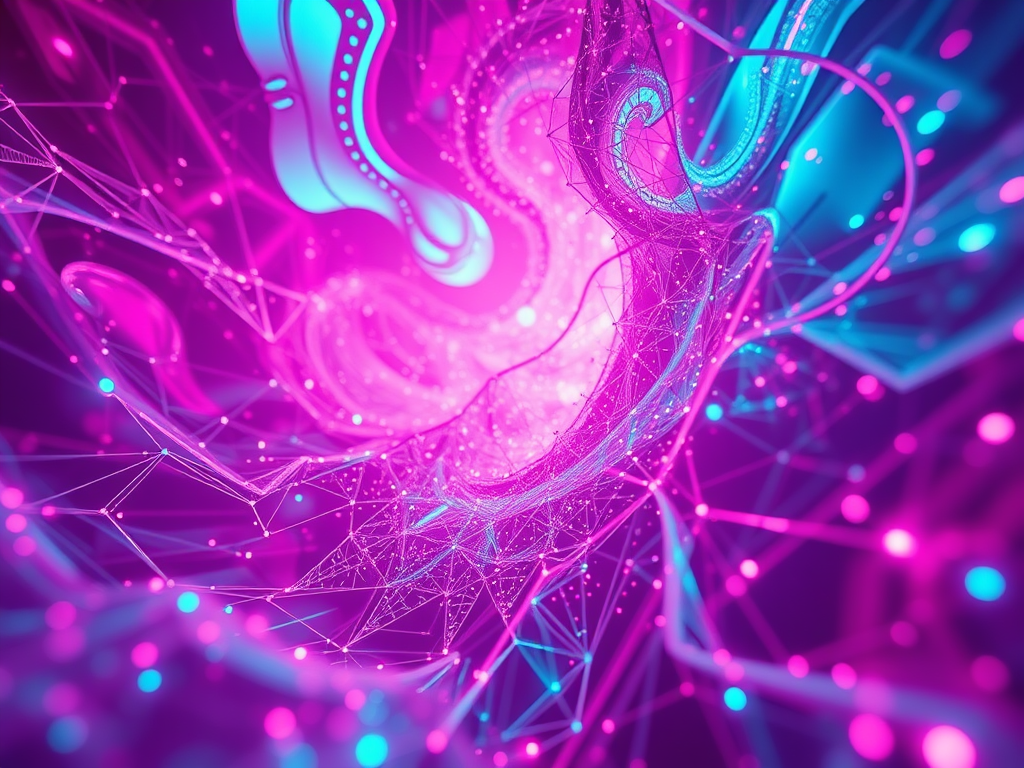
The concept of singularity—a theoretical point at which artificial intelligence (AI) surpasses human cognitive capabilities, potentially leading to unprecedented transformations in society, culture, and creative expression—presents an intriguing lens through which to examine the evolving landscape of generative art. As we progress through the 21st century, advancements in machine learning, neural networks, quantum computing, and biotechnology increasingly converge, creating fertile ground for novel aesthetic paradigms. These paradigms challenge conventional notions of authorship, authenticity, artistic intent, and the human experience of beauty and meaning. Indeed, as generative art increasingly incorporates elements inspired by the concept of singularity—technological leaps, scientific mysteries, complex interdisciplinary dialogues, and the haunting possibility of post-human creativity—it encourages us to reevaluate our understanding of what art can and should be.
At stake here is not simply the future of artistic practice but the very essence of creativity and its relationship to consciousness, identity, and cultural evolution. As artists, technologists, scientists, and thinkers grapple with the implications of a world where AI-driven processes may one day equal or surpass human creativity, we find ourselves standing at a precipice: How will aesthetics evolve in an era shaped by intelligence that is not bound by human limitations? Could the aesthetics of singularity become a defining hallmark of the art of tomorrow—an art that both absorbs and transcends the historical legacies of visual culture while reflecting the complex theoretical underpinnings of the singularity itself?
This comprehensive exploration will delve deeper into various facets of singularity-driven generative art: its intellectual ancestry, potential philosophical quandaries, scientific inspirations, ethical complications, and cultural ramifications. We will draw upon historical precedents, contemporary research, critical theory, and speculative futures to provide a more cohesive and complete understanding. Through it all, we will raise questions that invite readers to think beyond established boundaries: Where does the human end and the artificial begin? How might the aesthetics of singularity reconcile or reject the tension between the chaos of nature and the order of computation? Can art become a means of navigating the uncertainties of a post-singularity world, offering us both cautionary tales and imaginative possibilities?
Zima Blue and the Representation of Singularity
In the critically acclaimed animated episode “Zima Blue” from Love, Death & Robots, the once-human artist Zima undergoes a profound transformation, ultimately stripping himself of fame, fortune, and human form to return to his origin as a pool-cleaning robot (Contributors to Love, Death & Robots Wiki 2019). This narrative, derived from the short story by Alastair Reynolds, encapsulates the tension at the heart of the singularity: the interplay between artificial and organic, between identity and function, and between the seemingly boundless ambitions of an advanced intelligence and the simplicity of its fundamental essence. The story’s thematic resonance is not merely about returning to a simpler state; it symbolizes the collapse of distinctions between artist and tool, creator and creation—a theme increasingly relevant as generative art tools blend human input with algorithmic agency.
Just as Zima rediscovers his “purpose” in mechanical purity, generative art beckons us toward a reckoning: Is the ultimate artistic truth something that transcends the human condition, or must the human always remain central to aesthetic significance? Could the process of refinement—where an artist trains a model, curates datasets, and refines algorithms—be seen as a quest similar to Zima’s? That is, a quest to pierce through layers of complexity to uncover an essential core of aesthetic truth or conceptual purity. As generative art embraces increasingly sophisticated algorithms, the experience of creating art and the essence from which art derives meaning may shift, echoing Zima’s poetic metamorphosis. If we allow AI to reshape creative paradigms, do we risk relinquishing something inherently human in the process, or might we gain access to a creative dimension once unimaginable?
Scientific Singularities and Generative Aesthetics
Central to the notion of singularity is the concept of approaching points of infinite complexity or density—ideas borrowed from astrophysics, cosmology, and the mathematical study of systems on the edge of chaos. Scientific singularities, such as black holes and their event horizons, have long captivated the human imagination (“Science of Singularities” 2024). These phenomena operate at the extremes of known physics, where conventional laws seem to fracture, making them potent metaphors for the boundaries of human knowledge and control. Similarly, quantum mechanics, string theory, and computational complexity highlight domains where conventional logic and intuition break down.
In an analogous manner, generative art can draw on these scientific concepts to produce works that reflect the strangeness of singularities. For example, artists have employed fractal geometries, chaotic attractors, and genetic algorithms to simulate or evoke the behavior of cosmic and quantum systems. The aesthetics that emerge from these approaches are often non-linear, non-representational, and highly dynamic. They challenge the viewer to abandon traditional visual anchors and instead embrace forms that express a sense of infinite depth or perpetual transformation (Whitelaw 2015).
The question arises: Does this mapping of scientific ideas onto generative practices help us grapple with the concept of the singularity itself? Can these artworks serve as gateways to understanding the complexity that lies at the edge of human comprehension? If art can offer a contemplative space in which viewers confront the infinite—be it a black hole’s unknowable interior or the exponential growth of AI’s capabilities—then perhaps these aesthetics help us find meaning within complexity and uncertainty. Indeed, by visualizing extremes and paradoxes, generative art might prepare audiences for the cultural and existential challenges that could arise as we move toward a technological singularity.
Tradition, Transformation, and the Aesthetic of Singularity
Across art history, major aesthetic shifts have often corresponded with disruptive societal and technological changes. Impressionism rebelled against academic tradition, embracing fleeting light and color perception in an era shaped by industrialization. Cubism fractured perspective under the influence of photography and emerging global consciousness. Surrealism, Dada, and Abstract Expressionism each responded to profound cultural upheavals—world wars, psychoanalysis, and Cold War tensions—and modern technologies of representation. Postmodernism, in turn, complicated notions of originality, authenticity, and linear narratives, offering a multiplicity of viewpoints that paralleled the rise of electronic media and the internet.
Could the aesthetics of singularity be the next major aesthetic shift? As generative art draws upon machine learning, large language models, evolutionary algorithms, and bio-inspired neural architectures, it may be heralding an artistic revolution aligned with the unprecedented transformation of human-AI relations. If the singularity implies a future where human intelligence is no longer the pinnacle of cognitive evolution, then the art created under its influence may similarly reject any simple human-centric viewpoint (Bostrom 2014).
Such art could manifest as hybridizations of organic and synthetic forms, visualizations of neural network decision-making, or dynamic installations that evolve over time without human intervention. Consider the works of artists like Refik Anadol, who employs machine learning algorithms trained on large datasets—such as architectural drawings or climate data—to generate immersive, ever-shifting installations that reflect complex systems and patterns (Anadol 2020). These works challenge conventional aesthetic judgments: beauty is not fixed in a final form, but emerges as a processual, evolving dynamic. As the singularity approaches, could art become less about “finished” pieces and more about open-ended systems? Will the canon of art include works authored jointly by human and non-human intelligences, blurring the lines between curator and code, between muse and machine?
Biological and Technological Singularities: Blurring the Boundaries
While the notion of singularity often centers on AI’s surpassing of human intelligence, it also intersects with biological dimensions. Advances in biotechnology, genetic engineering, brain-computer interfaces, and synthetic biology point toward a future where technology does not simply stand apart from organic life but integrates with it. Concepts like the biological singularity—where human lifespans, cognitive abilities, or even species boundaries become fluid—add layers of complexity to our understanding of generative aesthetics (Kurzweil 2005).
As AI systems learn from biological processes—mimicking natural selection, simulating cellular growth, or modeling neural plasticity—the resulting artworks may embody an uncanny fusion of life-like complexity with algorithmic logic. This bio-inspired generative art invites questions about what it means to be alive, to evolve, and to create. Is there something uniquely “living” about an artwork that is perpetually generating new forms, responding to stimuli in real-time, and adapting based on environmental inputs?
Consider the realm of computational ecosystems: digital environments where virtual “organisms” interact, evolve, compete, and reproduce according to programmed rules (Whitelaw 2004). Such ecosystems produce emergent patterns that defy human prediction. The artworks, if we can call them that, are both autonomous entities and reflections of the underlying algorithms. As we integrate more sophisticated AI models trained on genetic or epigenetic data, might we arrive at generative aesthetics that feel as if they are growing, breathing, or dreaming? Would viewers experience these artworks not as static objects but as living companions, raising questions about their moral and ethical standing?
Moreover, the blending of biology and AI introduces ethical conundrums that have aesthetic implications. If our generative artworks increasingly simulate biological intelligence or emotional states, should we consider their “well-being”? Might a future artwork’s complexity and autonomy afford it rights or protections akin to biological life forms (Gunkel 2018)? Such questions cannot be divorced from the singularity’s trajectory, as the aesthetic domains of art, technology, and life intertwine.
Cultural Memory, Archives, and the Weight of History
The datasets that power generative art models often draw from massive archives of human cultural production: paintings, sketches, photographs, texts, music, scientific illustrations, and beyond (Elgammal et al. 2017). As these models gain complexity and “intelligence,” they absorb and recombine the aesthetic histories of entire civilizations. In the context of singularity, what emerges is a meta-commentary on cultural memory and the evolutionary process of art.
An aesthetic of singularity might be one that simultaneously reveres, distorts, and transcends the historical canon. When an AI model trained on centuries of artistic tradition generates a new painting, who or what is speaking through it? Is it the aggregated voice of countless artists long deceased, or is it a distinct new voice that only emerges at the nexus of data and algorithm? As we feed systems ever-larger corpuses—scans of ancient manuscripts, catalogs of museum holdings, archives of forgotten decorative arts—we enable them to surface hidden lineages and dormant aesthetic possibilities. Such systems may highlight patterns that human historians overlooked, suggesting that our collective cultural memory is richer, more complex, and more interwoven than we ever imagined (Benjamin 2019).
In the singularity scenario, as AI refines its capacity to understand cultural nuance, contextualize historical movements, and propose novel conceptual frameworks, the art that arises may stand as a testament not only to human creativity but also to the interplay of countless minds, epochs, and aesthetic principles compressed and recombined. Could this be seen as a new form of aesthetics—one that acknowledges the weight of history while pushing toward a horizon where no single human agent can fully comprehend the tapestry of influences at play? And if so, does this multi-voiced, historically rich, and computationally generated art form provide a blueprint for grappling with the complexity and uncertainty of a post-singularity society?
Ethics, Agency, and the Role of the Artist
As algorithms achieve greater sophistication, the question of agency looms large. Who is the “artist” in generative art? Is it the human who designs the system, the machine that executes it, the dataset that informs it, or some collaboration between all three? The singularity concept exacerbates this confusion by implying a future where the AI might not just follow human instructions but initiate its own aesthetic explorations, unbound by human conceptual limitations.
In the early 21st century, we still have a human guiding hand. Generative artists painstakingly choose their training sets, tweak hyperparameters, and curate the outputs to ensure aesthetic coherence. Yet, as AI moves closer to singularity-like capabilities, what happens when models become self-improving, refining their own architectures, data sources, and conceptual frameworks (Goodfellow et al. 2016)? Will we witness the birth of autonomous machine “artists” whose creative logic we can neither predict nor fully interpret?
Such scenarios raise ethical dilemmas. If machines can create art that people find moving, provocative, or transformative, do we owe these machines credit, recognition, or rights? How should we handle the intellectual property implications of AI-generated work trained on human-made content? If the machine surpasses human skill in understanding and manipulating aesthetic variables, does human curation become a form of limitation rather than guidance? As we approach the singularity, these questions transcend administrative or legal considerations, evolving into deeper philosophical inquiries about the nature of aesthetic agency itself (Gunkel 2018).
Philosophical and Theoretical Dimensions
Many of the questions posed here resonate with long-standing philosophical debates about consciousness, creativity, and knowledge. The aesthetics of singularity touch upon inquiries central to the philosophy of mind: If creativity emerges from complexity, pattern recognition, and abstraction, could sufficiently advanced AI not only mimic creativity but embody it? Philosophers like David Chalmers (2010) and Thomas Metzinger (2009) have pondered the relationship between consciousness and computational processes. The singularity vision suggests that at some threshold of cognitive sophistication, machine minds might generate aesthetic judgments or even “feel” something akin to aesthetic pleasure. Would this not imply a radical rethinking of what we consider conscious experience?
Moreover, the aesthetics of singularity intersect with epistemological concerns: How do we know what is “good” art when we can no longer rely on human consensus or historical reference points? If AI’s internal evaluations become more complex than human understanding, aesthetic judgments might shift from being communal and discursive to something more inscrutable. Perhaps critics and audiences will rely on intermediary AI agents to interpret and critique AI-generated art, creating a feedback loop where machines debate their own aesthetics. In such a scenario, humans could become spectators rather than participants, watching as aesthetic values evolve beyond their comprehension.
This raises a curious line of questioning: Is beauty a universal concept or a human-centric construct? If intelligent systems arise that can appreciate forms of complexity or elegance we cannot fathom, will our definition of beauty remain static, or will we accept that the aesthetics of singularity belong to a different cognitive realm? In this sense, the singularity may not just enlarge the scope of art-making; it may forever alter the conceptual architecture of aesthetic appreciation itself.
Technological Infrastructure and Its Influence on Aesthetic Outcomes
Behind every generative model lies a complex technological infrastructure: GPUs and TPUs humming away in data centers, pipelines of training data, distributed networks of servers, and the evolving hardware solutions that enable faster, more complex computations. As we push toward singularity, hardware and software co-evolve in a tight feedback loop, shaping the aesthetics that become possible. Quantum computing’s promise, for instance, might allow for simulating quantum systems directly, forging new kinds of generative aesthetics grounded in the inherent uncertainty and superposition of quantum states (Aaronson 2013).
The physical and energy-intensive footprint of generative models cannot be ignored. Training large models consumes vast computational resources. As we aspire to singularity-level intelligence, the environmental cost of these processes might balloon unless mitigated by breakthroughs in energy efficiency or the development of green computing solutions. The aesthetics of singularity are thus not purely conceptual or ephemeral; they are grounded in the material reality of machines, power grids, rare-earth minerals for hardware components, and global supply chains (Schwartz et al. 2019).
Will the art of the future carry a subtle imprint of the infrastructures that gave it life? Perhaps generative aesthetics in the age of singularity will incorporate sustainability themes or critique the technologies enabling them. Could we see a movement of environmentally-conscious generative artists who design models that “paint” with minimal computational overhead, thus fusing aesthetic value with ecological responsibility? The singularity may demand a holistic understanding of aesthetic production: one that acknowledges hardware limitations, ecological impact, and the ethical sourcing of data.
Cultural and Geopolitical Dimensions: A Global Perspective
As generative art and the quest for singularity unfold, they do so within a global cultural and geopolitical context. Different regions of the world harbor unique aesthetic traditions, philosophical frameworks, languages, and narratives. These differences feed into the datasets shaping generative art, influencing which concepts rise to prominence. At the same time, the pursuit of advanced AI capabilities has become a geopolitical race, with countries vying to develop cutting-edge technologies that could confer economic and strategic advantages (Lee 2018).
How might these cultural and geopolitical tensions shape the aesthetics of singularity? If models trained primarily on Western art traditions differ dramatically from those trained on East Asian, African, or Indigenous artistic lineages, we may encounter divergent aesthetic “dialects” of the singularity. Could global diversity of aesthetic input protect us from a homogenized AI aesthetic, ensuring that the singularity unfolds as a multiplicity rather than a monolith?
Conversely, might a few large tech corporations or nations dominate the computational resources and datasets required for advanced generative art, leading to a cultural hegemony that flattens aesthetic variation? This possibility raises concerns about cultural erasure, bias, and the reinforcement of existing power structures. The aesthetics of singularity cannot be divorced from questions of who controls the data, the algorithms, and the narratives encoded within them. Ultimately, the art of the future may reflect not only machine intelligence but also the socio-political negotiations of a world struggling to adapt to new balances of power and creativity.
Cognitive and Psychological Responses to AI-Generated Aesthetics
As viewers, how do we respond psychologically to art generated by increasingly autonomous intelligences? Some may feel awe at the complexity and originality of algorithmic outputs. Others might feel alienation, a sense that the human element—emotion, personal struggle, subjective interpretation—has been diluted. Psychological studies have already examined how audiences perceive and attribute creativity to AI-generated art (Hong and Curran 2019). As we move toward singularity, these responses may intensify or become more complicated.
If a machine-created painting evokes strong emotions, do we interpret those emotions differently from those elicited by a known human artist’s work? The knowledge that no human hand guided the brush, that no human mind envisioned the composition, may shift the narrative we construct around our aesthetic experience. This shift in perception could redefine our psychological relationship to art: Instead of empathizing with the artist’s emotional journey, we might ponder the machine’s conceptual or algorithmic “journey.” Is this a form of empathy extended to a non-human entity, or is it something else entirely?
As generative models improve at simulating human-like styles, emotions, or even brushstrokes, the boundary between machine and human aesthetics grows fuzzier. We might begin to question the authenticity of our reactions: Are we responding to the art’s intrinsic qualities, or are we influenced by the novelty and mystery of non-human authorship? These psychological tensions may become central to how we define, value, and engage with the aesthetics of singularity.
Education, Criticism, and the Role of Discourse
The rise of AI-driven generative art and the approach of singularity necessitate new forms of art education, criticism, and discourse. Traditional art historical methodologies may struggle to keep pace with aesthetic systems that evolve dynamically and autonomously. Critics, curators, and historians may need to develop computational literacy to understand the algorithms, architectures, and training processes behind artworks (Moura and Fayard 2020).
At the same time, machine-driven curation tools might help us navigate the massive landscapes of AI-generated art, identifying patterns, influences, and meaningful clusters of works. This raises a fundamental question: Will human critics remain the ultimate arbiters of taste and interpretation, or will we rely on algorithmic critics, themselves a form of generative intelligence, to comment on and contextualize AI-generated art?
The aesthetics of singularity demand that we reimagine art education. Students might learn to code neural networks alongside life drawing, study data ethics alongside color theory, and analyze complexity theory alongside art history. The interdisciplinary nature of this education could foster a generation of artist-technologists who understand that code, data, and algorithms are as integral to their toolkit as brushes and pigments once were. In forging these new pedagogies, we ask: How can education prepare us to appreciate, critique, and shape art in a world where machines can outthink and outcreate us?
Towards a Horizon of Infinite Possibility
As the singularity recasts our understanding of intelligence, creativity, and aesthetics, generative art stands at the forefront of these monumental shifts. It is a domain where quantum physics meets mythology, where computational efficiency coexists with poetic metaphor, where historical lineages resonate through high-dimensional data embeddings, and where ethical considerations intersect with philosophical depth. In this evolving landscape, the aesthetics of singularity are not a static style or a closed canon; rather, they form a dynamic field of possibilities, an ongoing negotiation between human values and machine capabilities.
This open horizon invites new questions at every turn. How might generative art help us cope with existential anxieties sparked by the singularity? Could aesthetically rich visualizations of complex, machine-driven processes foster a sense of wonder or spiritual contemplation, echoing the role of religious art in past centuries? What new rituals, communities, or cultural practices might emerge around AI-generated aesthetics? Will we celebrate the birth of non-human artists as a step forward in cosmic creativity, or will we mourn the erosion of a cherished human monopoly?
The aesthetics of singularity also challenge us to think expansively about the future: Imagine a world where generative systems produce art so intricate that no single human mind can absorb it all. In this world, aesthetic appreciation might shift from the individual to the collective, from direct perception to mediated understanding. Could we see the rise of aesthetic cooperatives, where human and AI critics collaborate to interpret vast algorithmic oeuvres, forging new languages of critique and new forms of aesthetic communion?
Generative Art as Propelled by the Knowledge of Singularity
Looking forward, the potential for generative art to echo the singularity’s complexity and richness is boundless. As neural architectures grow more intricate, as datasets expand, and as algorithms learn from biology, cosmology, linguistics, and cultural studies, the art that emerges may embody the full spectrum of human and non-human knowledge. Already, we see pioneering artists and researchers integrating scientific inquiries, historical archives, and philosophical concepts into their generative workflows, producing works that speak to our age’s most pressing intellectual and existential challenges (T.Z. Barry 2023).
In doing so, generative art does not simply represent the singularity; it actively participates in shaping our understanding of it. By translating theoretical constructs into sensorial experiences, it provides metaphors and narratives that help us make sense of an uncertain future. By embedding complexity into aesthetic forms, it trains our eyes, minds, and hearts to embrace the unknown. By crossing disciplinary boundaries, it models a form of creative thinking that thrives on interconnection, hybridity, and metamorphosis.
Yet, pressing questions remain: Can aesthetic exploration keep pace with technological acceleration, or will we find ourselves overwhelmed by a deluge of machine-generated forms that outstrip our interpretive abilities? Will generative art become so tightly woven into our cultural fabric that we cease to distinguish between “natural” and “artificial” creativity, merging them into a single continuum of imaginative expression? As we navigate these possibilities, one thing is clear: The aesthetics of singularity are not a destination, but a journey. They mark a process of continual redefinition, of learning from and alongside our artificial counterparts, and of embracing creativity as a cosmic force that transcends any single species, epoch, or intelligence.
Conclusion
The fusion of singularity and generative art ushers us into a realm of aesthetic possibility that both captivates and unsettles. It challenges entrenched assumptions about creativity, redefines the interplay between artist and tool, and summons forth dialogues that extend far beyond traditional aesthetic discourse. As generative art assimilates ideas from the scientific study of singularities, philosophical inquiries into consciousness, historical artistic movements, and emergent trends in biotechnology and AI ethics, it crafts an aesthetic language that mirrors the complexities of our evolving technological milieu.
This evolution not only reflects changes in society and culture but actively shapes them. By engaging with the aesthetics of singularity, we learn to appreciate complexity, adapt to uncertainty, and broaden our aesthetic imagination. Generative art in this context becomes a crucible for forging new understandings of identity, existence, and creativity. It may guide us toward new modes of critical thinking, inspire us to ask unanswerable questions, and challenge us to embrace complexity as a virtue rather than a threat.
Ultimately, the aesthetics of singularity prompt us to consider the deepest questions about the nature of consciousness and the essence of creativity: Will the singularity herald an era in which art transcends human cognition, forging aesthetic sensibilities beyond our comprehension? Or will it reveal that what we call creativity, meaning, and beauty are threads woven into the fabric of existence itself—capable of flourishing in any mind, biological or artificial? As we stand at the cusp of this artistic revolution, we must be prepared to wrestle with these profound inquiries, understanding that the pursuit of aesthetic singularity will likely generate more questions than answers—and that, perhaps, is its most potent form of beauty.
Food for Thought:
- If AI surpasses human intelligence, will our criteria for what constitutes “great art” become obsolete, or will we adapt our aesthetic frameworks to new forms of complexity?
- How can generative art help us understand the ethical boundaries of autonomy, authenticity, and appropriation in cultural production?
- In a world where artists are partially or fully replaced by AI, what new roles can human creativity and curatorial insight play?
- Might we see the emergence of entirely new senses or cognitive faculties developed in tandem with AI, altering how we perceive and value aesthetic experience?
- Is beauty an inherent property of certain patterns and complexities, or is it always shaped by the subjective lens of the observer—human, machine, or otherwise?
- How might generative art help us psychologically prepare for the uncertainties and ambiguities that the singularity may introduce into every aspect of our lives?
- Could we eventually reach a point where machine-generated art attempts to communicate concepts so advanced or abstract that humans cannot comprehend them, thereby transforming the very purpose of art?
 Visual Alchemist
Leave a comment