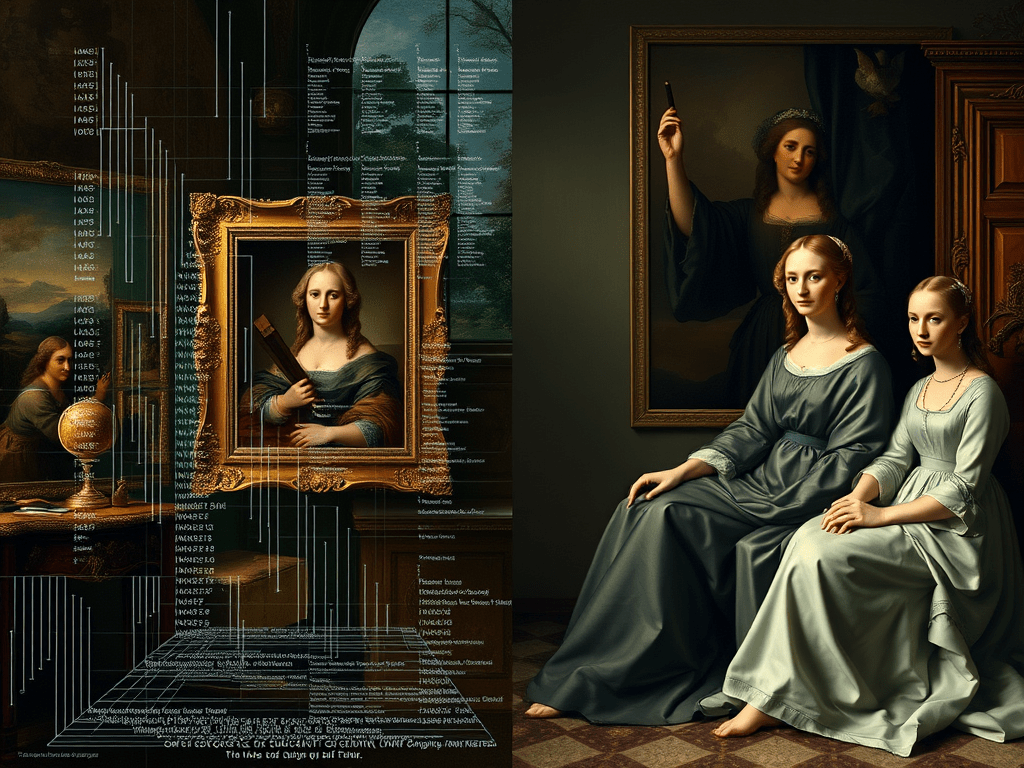
Art history as a discipline has long wrestled with the challenge of describing, classifying, interpreting, and understanding art objects. Traditional methodologies have involved connoisseurship, iconographic analysis, social history, anthropological perspectives, and critical theories. Scholars examined artworks within cultural, historical, and material contexts, emphasizing the importance of nuanced interpretation. Over time, new approaches emerged: formalism, structuralism, semiotics, and various theoretical frameworks. Each had strengths and limitations. In recent years, the rise of computational tools, computer vision technologies, and large-scale digital archives has opened a new path for art historical research. Under the banner of computational formalism, art historians and data scientists use algorithms, pattern recognition, and quantitative methods to analyze vast corpora of images and related metadata. These methods promise efficiency, objectivity, and the discovery of patterns invisible to the naked eye.
On the surface, computational formalism appears to solve certain persistent problems in art history. Traditional methods relied on subjective judgment, partial access to images, and limited exposure to large corpora. By contrast, computational approaches promise large-scale surveys, quantitative measures, and algorithmic classification. This promise appeals to those seeking a more empirically grounded and reproducible scholarship. Some have hoped that computational methods would allow art historians to confirm or challenge established theories with robust data analysis. Others see it as a way to unveil new connections and stylistic evolutions over time.
Yet these computational approaches have limits. The assumptions encoded in algorithms, the biases in datasets, the complexity of style, the importance of context, and the irreducible subjectivity of interpretation raise serious concerns. Many of these concerns mirror problems known from earlier methodological debates in art history. Formalism, focusing on form over context, was once celebrated for its clarity but later critiqued for ignoring social and cultural factors. Now, computational formalism risks resurrecting some of these old limitations. It focuses heavily on visual features at the expense of meaning, and it treats style and categorization as stable entities rather than contested interpretations.
This critical analysis examines the limits of computational formalism in art history. It draws attention to data bias, the problem of style, the neglect of context, the limits of quantification, the opacity of algorithmic “thinking,” the indispensable role of human judgment, the fallacy of the “artificial art historian,” and the potential return to problematic formalist doctrines. The goal is not to reject computational methods outright. Instead, it is to acknowledge what they can and cannot do, and to argue for a balanced integration that preserves the irreplaceable contributions of human scholarship. Recognizing these limitations ensures that computational techniques serve as tools rather than replacements for the nuanced, context-sensitive insights that art historians bring to their work.
The Appeal and Promise of Computational Formalism
Computational formalism builds on the idea that digital tools can process and analyze enormous amounts of visual data efficiently. Rather than relying on a scholar’s memory, library visits, or partial image sets, automated image recognition can process thousands or even millions of artworks in a fraction of the time. This efficiency appeals to researchers who see value in large-scale pattern detection, cross-cultural comparison, and broad historical sweeps. The prospect of analyzing entire collections from multiple museums to identify trends or confirm stylistic theories presents an alluring vision of systematic and comprehensive art historical scholarship.
The promise of objectivity draws many to computational methods. Traditional art history often involves subjective judgments influenced by training, taste, cultural background, and scholarly fashion. Quantitative methods suggest a more neutral stance. Instead of relying on personal interpretation, one can measure certain formal features—color distributions, line orientations, compositional patterns—and produce data-driven classifications. By generating statistical evidence, it might seem possible to ground art historical claims in something beyond personal preference or scholarly consensus.
Another promise lies in the potential discovery of patterns invisible to the human eye. Machine learning algorithms, especially unsupervised methods, can cluster images into groups based on subtle visual cues. They may reveal connections among artworks that do not share obvious iconographic or geographical links. Such computational techniques might show how certain compositional strategies spread across regions or periods, or might identify unrecognized influences. These insights appeal to art historians who hope to expand their understanding of artistic production beyond established narratives.
Computational formalism might also confirm existing theories. Formalist theories, such as those advanced by Heinrich Wölfflin, proposed systematic principles of style and visual form. Until recently, testing these theories at scale was difficult. Now, computational methods allow researchers to apply image analysis to large sets of works and check whether patterns align with Wölfflin’s categories. This empirical approach might give new life to older formalist frameworks, providing a form of validation or, conversely, revealing their limitations.
These appeals explain the enthusiasm for computational formalism. Yet they also highlight a danger: the seduction of large-scale analysis and quantitative neatness can overshadow the complexities and contextual richness that define art historical inquiry. As we delve into the limitations, it becomes evident that these promises, though valuable, must be taken with caution.
1. Data Bias and the Problem of Representativeness
Computational methods depend on data, and data in art history are never neutral. Existing databases, museum collections, and image repositories reflect historical biases. Western art dominates many canonical collections and scholarly narratives, marginalizing non-Western or Indigenous art. Selecting data that are easily available online often means relying on collections that have been digitized and are maintained by well-funded institutions. These institutions tend to center on artworks considered “canonical” in Western art history. As a result, training computational models on such datasets perpetuates existing biases and blind spots.
Labeling practices in supervised learning exacerbate these problems. When training a system to recognize specific artistic styles or genres, researchers rely on labels assigned by prior scholars or curators. These labels assume that categories correspond neatly to formal characteristics. But style categories often emerged from historical contexts, Eurocentric frameworks, or older historiographic assumptions. Treating these categories as objective ground truth imposes a rigid taxonomy onto what should be a contested field of meaning. Instead of discovering patterns free from bias, computational methods inherit and amplify pre-existing biases.
Unsupervised methods might seem to offer a remedy, since they cluster images based on internal similarities rather than pre-assigned labels. Yet these methods still rely on input data that skew representation. The patterns the algorithm “discovers” reflect the dataset’s composition. If the dataset excludes entire traditions, the algorithm cannot “discover” something it does not see. Data cleaning and selection processes introduce subtle biases at every step. Even the decision about which images to digitize involves institutional and cultural biases. Thus, the outputs of computational formalism always rest on partial and potentially skewed foundations.
This data bias problem demands critical awareness. Art historians must question what datasets represent, who shaped them, and which traditions they exclude. Without addressing data bias, computational formalism risks reinforcing a narrow canon, ignoring entire artistic traditions, and presenting results as neutral when they reflect historical and institutional biases. Such limitations are not minor technical issues; they speak to the very heart of understanding art in global and inclusive terms.
2. The Complexity of Style and the Inadequacy of Fixed Categories
Style is central to art history, yet it remains one of the most contested concepts. Scholars have debated what defines a style, how it emerges, and how it changes over time. Style categories are not stable entities with clear borders. They represent interpretive constructs shaped by historical contexts, critical debates, and cultural assumptions. Wölfflin’s formalist approach once promised a universal set of stylistic principles, but many scholars now see these categories as historically contingent and flexible.
Computational methods that identify style usually assume stable categories. An algorithm might classify artworks into “Impressionist,” “Baroque,” or “Cubist” clusters based on certain formal features. But what does it mean to label an artwork as “Impressionist” without considering the historical debates about which artists counted as Impressionists, how Impressionism related to the broader social conditions of late 19th-century France, or the evolving reception of these works over time? Blindly applying style labels treats them as objective facts rather than scholarly constructs that require interpretation and debate.
Moreover, styles overlap, mutate, and interact with each other. Many artworks defy neat classification. Terms like “Mannerism” or “Post-Impressionism” serve as catch-all categories. They gather artworks that share some features but differ in others. Their boundaries are porous and context-dependent. A computational system that tries to assign artworks to neat clusters overlooks these complexities. It might succeed at grouping certain visual patterns, but it cannot explain why these patterns emerged, how artists responded to cultural conditions, or how viewers interpreted them. It also cannot capture the multiplicity of viewpoints on style that exist in scholarship.
In practice, style recognition algorithms may return results that confirm known categories. The risk is that researchers interpret these confirmations as objective proof of stylistic boundaries rather than as an artifact of how the dataset and algorithm were structured. Without a critical understanding of the history and theory of style, computational formalism reduces a contested and dynamic concept to a static label. This flattening of complexity hinders rather than enhances art historical understanding.
3. Neglect of Context and the Reduction of Art to Visual Features
Context matters deeply in art history. Understanding an artwork involves situating it within its historical moment, geographical location, cultural environment, and material conditions. It requires knowledge of the artist’s background, patronage, intended function, and the social and political climate in which it was produced. Iconography, symbolism, theological meaning, and market conditions can shape how a painting is read. Formal analysis contributes one dimension, but art history depends on a synthesis of multiple factors.
Computational formalism, by design, focuses on formal properties—lines, shapes, colors, compositions—extracted from digital images. Algorithms can measure and compare these features on a large scale, but they do not capture the non-visual dimensions of an artwork. They do not register the tactile quality of brushstrokes, the significance of materials, the environmental context of a site-specific installation, or the cultural values that inform the reception of the work.
By ignoring these contextual factors, computational formalism risks producing a fundamentally incomplete understanding of art. At best, it can offer a partial perspective that complements contextual analysis. At worst, it can mislead by suggesting that visual patterns alone suffice to interpret art. This neglect resembles old formalist approaches that were criticized for ignoring content, meaning, and context. If the goal of art history is to understand artworks as cultural artifacts with multiple layers of meaning, then reducing them to sets of visual features misses the point.
Context includes the human experience of viewing art. Artworks evoke emotional responses, engage with political debates, and reflect or challenge social norms. These human dimensions are difficult to quantify. A computational system cannot easily register irony, subversion, humor, or spiritual significance. It cannot interpret complex references or evaluate the cultural relevance of certain motifs. Human interpretation remains essential to uncovering these meanings and integrating them into art historical narratives.
4. The Limits of Quantification and the Nature of Art
Quantification appeals to many researchers because it promises clarity and replicability. In fields like economics or the natural sciences, quantification has proven essential. Art, however, poses unique challenges. Much of what matters in art resists quantification. Symbolic content, emotional impact, aesthetic judgment, and cultural resonance do not yield easily to numerical measures. Attempting to quantify these qualities risks distorting or trivializing them.
Even seemingly straightforward measures can be misleading. Counting the occurrence of a certain motif might show a pattern, but what does that pattern mean? Without interpretive context, a frequency count does not explain why artists used that motif, how viewers responded to it, or what cultural significance it held. Similarly, measuring the similarity between images in feature-space might tell us which works share certain visual properties, but it says nothing about why those properties mattered or how they shaped the artwork’s reception.
Recommender systems, borrowed from e-commerce, might try to gauge the reception or impact of artworks by tracking user preferences. This approach raises philosophical questions about what it means to “recommend” art. Does popularity equate to importance? Does algorithmic recommendation alter the understanding of art’s cultural role? Relying on quantitative metrics to assess quality or significance shifts the ground of interpretation. Instead of asking what art means or does, we might start asking how it scores on certain metrics. This changes the nature of art historical inquiry, narrowing it to what can be counted.
Quantification also introduces a risk of false precision. Numbers may suggest certainty where none exists. Because art is always open to multiple interpretations, reducing it to quantifiable elements can give an illusion of objectivity. But this objectivity is shallow if it ignores the fundamental complexity of meaning-making. Art historians must remain aware that the quantitative lens is one tool among many, not a neutral arbiter of truth.
5. Algorithmic Opacity and the “Black Box” Problem
Computational models, especially complex machine learning architectures, are often opaque. It is difficult to understand why an algorithm classified certain images together or how it reached a conclusion about stylistic similarity. This opacity poses a methodological challenge. Traditional humanistic scholarship values transparency, the ability to explain methods and reasoning. Scholars strive to show their evidence, lay out their interpretive steps, and remain self-critical about their assumptions.
When art historians rely on “black box” models, they outsource interpretation to opaque processes. If a convolutional neural network groups works into clusters, the historian sees the output but not a clear reasoning process. Unlike a human scholar who can explain their criteria, the algorithm’s internal logic might be too complex or inaccessible. This undermines the methodological self-criticality that is crucial in the humanities. Without understanding how the model works, one cannot fully trust its insights or critique its biases.
Algorithmic opacity also limits reflexivity about perceptual biases. Humans bring their own preconceptions to art interpretation, but they can reflect on them, debate them, and revise their methods. An algorithm has no inherent capacity for self-criticism. If the input data are biased or the model’s architecture encodes certain assumptions, the output will reflect these issues without any internal safeguard. The historian can attempt to probe the model, test edge cases, or modify parameters, but the underlying logic may remain elusive.
This situation demands that art historians using computational tools cultivate technical literacy. Understanding the basics of machine learning, feature extraction, and model design can help researchers recognize when the algorithm’s logic is questionable. But even with technical knowledge, the complexity of some models exceeds human interpretability. This barrier introduces a layer of uncertainty and highlights the difference between human interpretative reasoning and algorithmic classification.
6. The Essential Role of Human Judgment and Expertise
Art historical interpretation depends on human insight. Scholars spend years studying historical contexts, primary sources, languages, cultural traditions, materials, and critical theories. They learn to read subtle cues in artworks, to understand how images relate to texts, how patronage systems influenced production, or how religious and political ideologies shaped aesthetics. This accumulated knowledge and interpretive skill cannot be replaced by automated processes.
Computational methods can handle large datasets, but they lack the depth of human expertise. A human scholar can notice when a certain motif contradicts the supposed style category, recognize when a painting’s iconography aligns with a specific theological interpretation, or understand that an artwork’s meaning changed drastically over time. Scholars can navigate the complexity of influence, dialogue with primary documents, and challenge received categories. They can also acknowledge and adjust for their own biases, engaging in self-reflection and methodological debate.
In matters of authenticity, for example, art historians rely on connoisseurship, provenance research, technical analysis of materials, and a deep familiarity with the artist’s oeuvre. Machine learning tools might detect inconsistencies, but they cannot explain them historically or argue convincingly about the significance of a discovery. Human judgment remains crucial in evaluating the meaning of anomalies and incorporating them into a narrative that makes historical sense.
Subjective judgment is not a flaw but a feature of art historical research. Interpretation thrives on multiple perspectives, debates, and revisions. The absence of a single “correct” reading is not a failure but a recognition of art’s complexity. Computational formalism cannot eliminate subjectivity; it can only conceal it behind a facade of objectivity. True understanding emerges when scholars integrate computational findings with their own interpretive frameworks, using data as a starting point for deeper inquiry rather than a final answer.
7. The Artificial Art Historian Fallacy
Some proponents of computational formalism suggest that machine learning models or other automated systems might one day replace human art historians. This claim misunderstands the nature of art historical practice. Art historians do not just classify artworks or identify patterns; they formulate research questions, contextualize objects, engage with theoretical debates, and relate art to broader cultural and intellectual histories. They do not simply discover patterns but interpret them, argue about them, and connect them to human experiences.
The idea that computational tools can stand in for human scholars rests on the assumption that art history is primarily about formal classification. But as discussed, art history encompasses social, political, religious, economic, and cultural dimensions. It involves negotiating contested interpretations, engaging with source materials, and acknowledging uncertainties. Art historians also study reception: how artworks were understood in their own time and how meanings shift as contexts change. These tasks require understanding human culture in ways algorithms do not replicate.
Moreover, human scholars approach artworks with the capacity for empathy, moral judgment, and ethical reflection. They consider how art relates to historical injustices, how it has been used to uphold certain ideologies, or how it might challenge prevailing norms. Algorithms, as tools, have no stance on these matters unless humans guide them. The “artificial art historian” would be at best an assistant, helping to sift through large datasets, but never replacing the complexity of human thought. Believing otherwise reduces art history to a mechanical process rather than a humanistic inquiry.
8. Resurrecting Problematic Formalism
Formalism as an art historical method has a long history. Early formalists sought to classify artworks according to visual elements, treating form as the primary guide to understanding art. This approach was criticized for its neglect of context. Scholars argued that form cannot be separated from meaning, content, cultural significance, and the conditions of artistic production. Formalism had its uses—careful observation of form is a valuable skill—but it was seen as incomplete.
Computational formalism risks reviving these old debates. By focusing on formal properties extracted from images, it returns to a form-centered view of art. Even if the method is more sophisticated and involves advanced machine learning, the underlying principle remains similar: try to understand art by analyzing its visual features in isolation. The risk is that we forget why formalism fell out of favor. We risk repeating the same mistakes: overlooking historical context, political significance, or the role of the viewer’s interpretation.
This is not to say that computational analysis must be purely formalist. Researchers can integrate computational findings with contextual scholarship. They can treat computational results as one piece of evidence among many, subject to interpretation and debate. The problem arises when computational formalism becomes an end in itself rather than a tool. If scholars embrace computational methods without acknowledging their limits, they risk sliding back into a narrow formalist paradigm that previous generations of art historians labored to move beyond.
Integrating Computational Methods with Humanistic Scholarship
The limitations outlined so far do not imply that computational methods have no place in art history. On the contrary, these tools can be valuable when used thoughtfully and in combination with traditional approaches. Efficiency and pattern detection can help researchers notice large-scale trends. When integrated with careful contextual analysis and historical understanding, computational insights can enrich art historical narratives rather than reduce them.
A balanced approach might involve the following strategies:
- Critical Data Selection and Annotation:
Art historians should be involved in selecting datasets and determining the categories or labels used. They must reflect on what biases might be introduced at these stages and attempt to include a diverse range of artworks. Documentation of selection criteria, sampling methods, and limitations should accompany the computational work. - Transparent Methodology and Interpretability:
Researchers should strive for models and techniques that enhance interpretability. Explaining how an algorithm arrived at certain classifications is important. Even if some complexity remains opaque, documenting methods, parameters, and known biases fosters trust and encourages critical scrutiny. - Contextual Integration:
Computational findings should serve as prompts for deeper inquiry rather than as final statements. If algorithms identify certain clusters of artworks that share visual features, human scholars should investigate why these clusters emerged. They must reintroduce context, historical data, and cultural factors to interpret meaning. The computational results become a map pointing to areas worth exploring, not a definitive interpretation. - Reflexive Use of Style Categories:
Instead of treating style labels as fixed truths, researchers can use computational tools to test the stability of these categories. Unexpected groupings might reveal that what we considered a coherent style is more diverse than assumed. Scholars can use these insights to refine or question existing taxonomies rather than confirm them unquestioningly. - Combining Qualitative and Quantitative Evidence:
Art history should continue to embrace qualitative scholarship. Primary documents, historical records, material analysis, and theoretical perspectives remain essential. Computational analyses can add a quantitative dimension, but it must be woven together with qualitative reasoning to achieve a richer understanding. - Ongoing Dialogue with the Humanities and Data Science:
Interdisciplinary collaboration can prevent oversimplification. Art historians, data scientists, and digital humanists working together can design models that respect the complexity of the subject matter. Such collaborations foster mutual learning, as data scientists learn about art historical nuance and art historians gain a better understanding of computational methods.
Lessons from Other Contexts
The concerns raised by computational formalism in art history echo broader debates in the digital humanities. In literary studies, text mining tools have been both celebrated and critiqued for their capacity to reveal patterns in large corpora. Some researchers worry that focusing on word frequencies and co-occurrences neglects the interpretive richness of literature. In historical research, big data projects have run into questions about the meaning of patterns and correlations that lack historical explanation. These parallels suggest that the challenge is not unique to art history but reflects a broader tension between computational methods and humanistic interpretation.
Previous contexts—such as the analysis of generative art or discussions about identity in digital spaces—have shown that computational processes can reveal patterns but cannot fully capture the meaning, purpose, or cultural significance of creative acts. Generative art analysis might identify recurring motifs, but it does not explain the artist’s intent or the viewer’s experience. Similarly, digital identity studies can use data analytics to track behavior but cannot fully interpret the subjective sense of self. In all these cases, computational methods illuminate certain aspects while leaving others in shadow.
This recognition calls for a methodological pluralism that values multiple modes of inquiry. Art historians should not reject computational tools but neither should they accept them at face value. Instead, they must engage critically, always asking how these tools influence the questions asked and the answers produced. The best outcomes emerge when computational analysis is one step in a larger interpretive process rather than an endpoint.
Training and Methodological Self-Awareness
For art historians who wish to use computational methods, some degree of technical literacy is important. Understanding the basics of algorithmic processes, data preprocessing, and model selection helps in identifying pitfalls and biases. Just as art historians have learned to read archival documents critically, they must learn to read computational outputs critically.
This does not mean every art historian must become a programmer. Interdisciplinary collaboration can ensure that there is enough technical expertise in a research team. But even collaborations require art historians to understand the limits and potentials of computational methods. Failing to grasp these aspects leaves them vulnerable to accepting misleading results at face value.
Methodological self-awareness also matters. Art historians should reflect on their reasons for using computational tools. Are they seeking confirmation of a theory, looking for new patterns, or hoping to test a certain hypothesis? Clarifying these goals can prevent blind trust in computational outputs. Scholars must remain vigilant about how quantification shapes the framing of research questions and interpretive tasks.
Towards a more Integrated Approach
As digitization continues, more artworks will become accessible as high-quality images along with metadata, textual sources, and material analyses. Computational tools will likely improve, becoming more sophisticated in handling contextual data. Machine learning models might incorporate metadata beyond pixel analysis, perhaps learning from textual descriptions or archival documents. This integration could help reduce the gap between form and context, allowing for richer computational interpretations.
Yet no technological advance will eliminate the need for human interpretation. The complexity of art’s meaning, rooted in human culture, historical events, and subjective experiences, cannot be fully modeled algorithmically. Instead, computational methods will always serve as tools that augment human capacities. They might highlight patterns or raise new questions, but human scholars will interpret those patterns, connect them to cultural contexts, and decide what they mean. This synergy acknowledges each method’s strengths and corrects for their respective weaknesses.
The ideal future is one in which art historians and computational tools work together. Instead of aiming to create an “artificial art historian,” we could create a set of digital resources and analytical techniques that assist in exploring large datasets, while the human scholar guides interpretation, sets research agendas, and ensures contextual depth. This balanced approach respects the complexity of art and acknowledges the limits of computational formalism.
Preserving the Human Element in Art Historical Inquiry
Computational formalism offers ways to process large amounts of visual data efficiently, to identify patterns, and to test certain formalist theories at scale. However, its limitations are significant. Data bias challenges the neutrality of results. The complexity and contested nature of style categories resist algorithmic simplification. Neglecting context reduces art to isolated visual features. The limits of quantification distort the nature of interpretive inquiry. Algorithmic opacity undermines transparency and reflexivity. Most importantly, human judgment, subjective interpretation, and deep contextual knowledge remain indispensable.
Art history is a humanistic discipline. It seeks to understand artworks as expressions of human culture, creativity, and meaning. While computational tools can assist in handling complexity, they cannot replace the nuanced thinking that art historians bring to the table. The risk of resurrecting problematic formalist approaches should alert scholars to the need for caution and critical integration. Rather than celebrating computational formalism as a cure-all, researchers should use it as one instrument among many.
The final takeaway is that a comprehensive approach to art history will always combine methods. Traditional interpretive scholarship, archival work, material analysis, theoretical framing, and cultural contextualization remain foundational. Computational methods can enhance this work by revealing patterns and suggesting new lines of inquiry. The challenge for current and future scholars is to maintain a balance that leverages computational advantages without compromising the essential human element. By recognizing the limits of computational formalism and preserving space for subjective judgment and contextual awareness, art historians ensure that their interpretations remain rich, meaningful, and aligned with the complexity of art itself.
 Visual Alchemist
Leave a comment