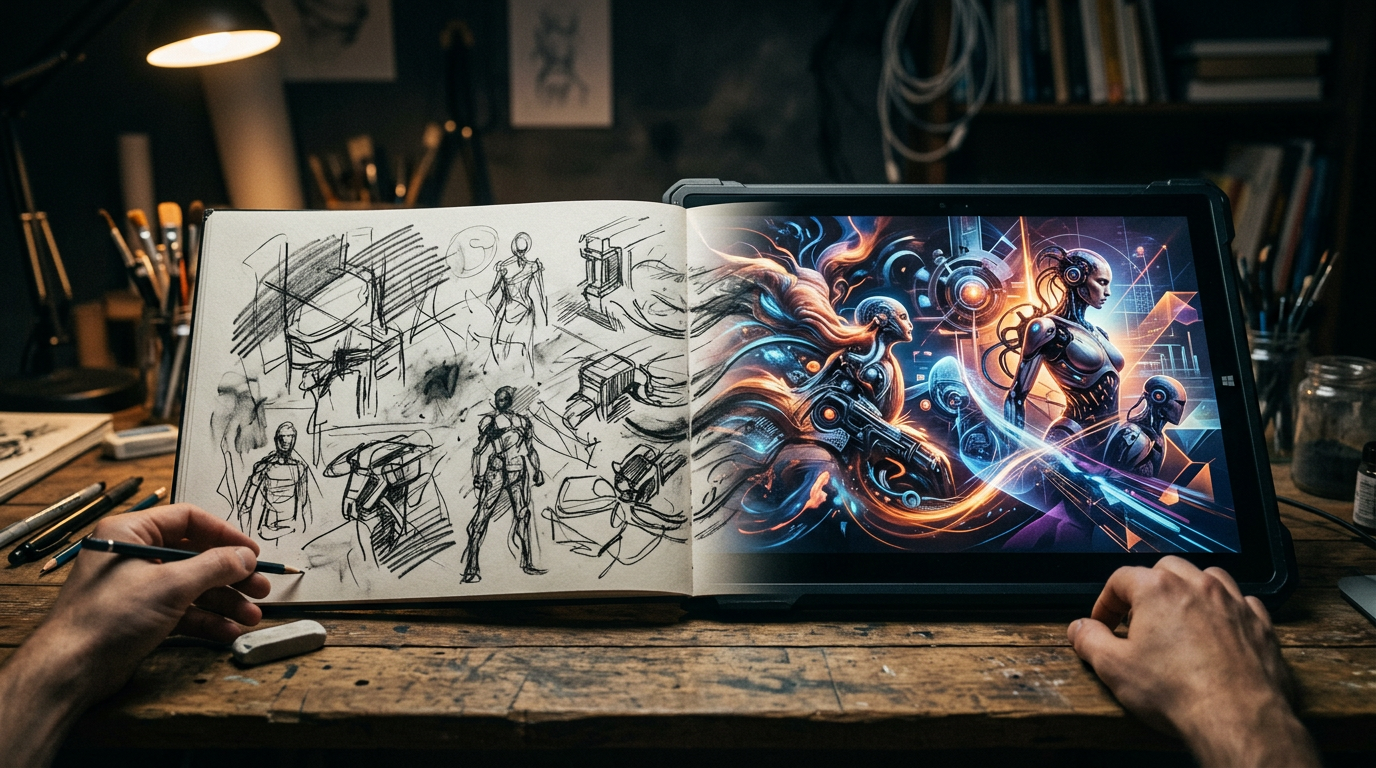
The relationship between AI image systems and traditional design methods is often framed as a competition — a zero-sum struggle in which one approach will eventually displace the other. This framing obscures a more nuanced and productive reality. Understanding AI image systems vs traditional design requires examining their respective strengths, limitations, and appropriate applications across different creative contexts. The most sophisticated practitioners recognize that the question is not which approach is superior but how they can be combined most effectively.
Subscribe to the Visual Alchemist Newsletter
The Historical Context
Traditional design methods have evolved over centuries, with each generation building on the knowledge and techniques of its predecessors. The tools have changed — from brush to pencil to pen to tablet — but the fundamental creative process has remained remarkably consistent: an iterative cycle of conception, execution, evaluation, and refinement driven by human judgment, skill, and intentionality.
AI image systems represent a fundamentally different paradigm. Rather than tools that extend the physical capabilities of the creator, these systems introduce a computational intermediary that participates actively in the creative process. The creator specifies intent through prompts and parameters, the system generates outputs, and the creator evaluates and selects. This shift from direct manipulation to generative collaboration has profound implications for how creative work is conceived and executed.
The comparison between these paradigms is not simply technical but philosophical, touching on questions of authorship, creativity, and the nature of artistic skill. Understanding both perspectives is essential for informed creative practice.
Speed and Scale
The most obvious advantage of AI image systems over traditional design methods is speed. A task that might take a human designer hours or days — producing a photorealistic product visualization, generating multiple variations of a composition, exploring different stylistic treatments — can be accomplished by AI in seconds or minutes.
This speed advantage enables workflows that are qualitatively different from traditional practice. Designers can explore hundreds of options before committing to a direction, rather than investing in a single approach and hoping it works. Teams can iterate through multiple rounds of revision in the time that traditional methods would require for a single round. Content production can scale to meet demand that would be impossible to satisfy through traditional means.
The scale advantage extends to variation and personalization. An e-commerce brand might need thousands of product images showing every item in every available color and configuration. Through traditional methods, this would require a massive production operation. Through AI image systems, it can be accomplished by a small team with appropriate generative workflows.
However, speed and scale are not always the primary considerations. For certain types of creative work — particularly work where the process itself carries meaning, where the hand of the maker is valued, or where the uniqueness of a bespoke creation is part of its value — the efficiency of AI generation may be irrelevant or even counterproductive.
Precision and Control
Traditional design methods offer a level of precision and control that AI image systems currently cannot match. When a designer places an element at specific coordinates, selects an exact color value, or draws a precise curve, the result is deterministic and repeatable. The designer’s intent is directly translated into output without an interpretive intermediary.
AI image systems operate differently. The prompt specifies intent, but the model interprets that intent through its training. The result may be beautiful and appropriate, but it is not precisely controllable at the pixel level. The designer specifies direction, and the system navigates within that direction. This lack of deterministic precision is a limitation for applications that require exact specification.
However, the control landscape is evolving rapidly. ControlNet, regional prompting, and layout conditioning are progressively giving creators more precise influence over generated outputs. The gap between the control offered by traditional methods and AI systems is narrowing, though it has not closed entirely.
The appropriate approach depends on the precision requirements of the task. For applications where pixel-level accuracy is essential — typography, logo design, technical illustration — traditional methods remain superior. For applications where general visual quality and aesthetic impact are the primary considerations, AI systems may be entirely adequate or even superior.
Creative Exploration and Serendipity
AI image systems excel at creative exploration in ways that traditional methods cannot replicate. The ability to generate diverse interpretations of a concept rapidly, to explore stylistic variations without manual execution, and to discover unexpected visual directions through the model’s creative interpretations opens possibilities that traditional workflows do not offer.
The serendipity of AI generation — the unexpected but valuable results that emerge from the interaction between prompt and model — is one of the technology’s most distinctive creative contributions. Experienced practitioners learn to work with this serendipity, treating unexpected outputs not as failures but as gifts that may open new creative directions.
Traditional methods also have their own form of creative exploration, but it operates differently. The physical engagement with materials, the time required for execution, and the constraints of manual techniques all shape the creative process in ways that influence outcomes. The exploration is slower but often deeper, with each iteration carrying more intentional weight.
The most productive approach combines both forms of exploration. AI systems can rapidly survey the possibility space, identifying promising directions. Traditional methods can then develop those directions with the depth, precision, and intentionality that manual techniques enable.
Cost and Accessibility
The economic comparison between AI image systems and traditional design is complex and context-dependent. For high-volume content production, AI generation is dramatically less expensive. A single product image that might cost hundreds of dollars through traditional photography can be generated for pennies through AI systems. The cost advantage compounds with volume.
For bespoke, high-value creative work, the cost comparison is less straightforward. While AI systems can reduce the time and therefore cost of certain production stages, the value of human creative direction, strategic thinking, and aesthetic judgment remains significant. The cost of a creative campaign directed by an experienced professional using AI tools may not be substantially less than a traditionally executed campaign, though it may enable different creative possibilities.
Accessibility is another dimension where the comparison favors AI image systems for democratization. Traditional design skills require years of training and practice to develop. AI systems lower the barrier to visual creation, enabling individuals and organizations without design training to produce professional-quality visual content.
This democratization has complex implications. It expands access to visual communication, which is broadly positive. It also disrupts the economic models that support professional designers, which has negative consequences for those whose livelihoods depend on traditional skills.
Quality Considerations
The quality comparison between AI image systems and traditional design is perhaps the most debated aspect of the relationship. Quality is multidimensional, and different quality criteria favor different approaches.
Technical quality — resolution, consistency, freedom from artifacts — has improved dramatically in AI systems and now matches or exceeds traditional methods for many applications. The remaining technical limitations are increasingly subtle and continue to diminish with each model iteration.
Aesthetic quality is more subjective. AI systems can produce images that are visually stunning by conventional aesthetic standards. However, they operate from statistical patterns learned from training data rather than from intentional aesthetic choices. The result may lack the distinctive point of view, the conceptual depth, or the emotional resonance that characterizes the best human-created work.
Conceptual quality — the relationship between the visual output and the ideas it is intended to communicate — remains an area where human creators maintain advantage. AI systems generate images based on textual descriptions but do not understand the concepts those descriptions reference. The most effective visual communication requires conceptual understanding that AI currently lacks.
Workflow Integration
The most sophisticated practitioners do not choose between AI image systems and traditional design but rather integrate both approaches within unified workflows that leverage the strengths of each.
A typical integrated workflow begins with AI generation for rapid exploration and ideation. The creative team generates hundreds of variations on a concept, identifying promising directions that warrant further development. Selected concepts are developed further, with AI handling variation production while human designers provide creative direction and quality evaluation.
For final production, the approach may vary. Some elements may be generated entirely by AI with human quality approval. Others may be created through traditional methods where precision or intentionality is paramount. Many final assets combine AI-generated and human-created elements through compositing and finishing.
This integrated approach requires practitioners who are skilled in both paradigms — who understand how to direct AI systems effectively and who have the traditional design skills to refine and finish AI-generated outputs. The most valuable creative professionals in the current environment are those who bridge both worlds.
The Future of the Relationship
The relationship between AI image systems and traditional design will continue to evolve as both the technology and the creative practices around it mature. Several trajectories are likely.
The capabilities of AI systems will continue to expand, narrowing the gaps in precision, control, and conceptual understanding. However, complete convergence is unlikely, as some aspects of human creative practice — intentionality, embodied knowledge, contextual understanding — may remain beyond the reach of current AI paradigms.
Traditional design skills will not become obsolete, but their role will shift. Skills that are purely about technical execution may diminish in value as AI handles routine production. Skills involving creative direction, aesthetic judgment, strategic thinking, and conceptual development will become more valuable.
New hybrid practices will emerge that are neither purely traditional nor purely AI-driven. These practices will develop their own aesthetics, standards, and communities, creating a new category of creative work that is native to the human-AI collaboration.
FAQ
Q: Will AI replace traditional designers? A: AI will transform rather than replace design practice. Roles focused purely on technical execution face disruption, while roles involving creative direction, strategy, and judgment are evolving. Designers who develop AI skills alongside traditional abilities will be best positioned.
Q: When should I use AI image systems versus traditional design? A: Use AI for exploration, variation, ideation, and high-volume production. Use traditional methods for precision work, bespoke creations, and applications where the creative process itself is valued. Most professional work benefits from combining both approaches.
Q: Is AI-generated design as good as human-created design? A: The answer depends on the quality criteria applied. AI matches or exceeds human capability in technical quality and speed. Human creators maintain advantages in conceptual depth, intentionality, and distinctive creative voice. The best work often combines both.
Q: How should design education adapt to AI? A: Design education should teach both traditional fundamentals and AI capabilities. Understanding visual principles, design thinking, and creative process remains essential. Skills in directing AI systems, integrating generative outputs, and hybrid workflows are increasingly important.
Conclusion
The comparison between AI image systems and traditional design reveals not a competition but a complementarity. Each approach has distinctive strengths that make it appropriate for different aspects of creative work. The most effective practitioners are those who understand both paradigms, can select the appropriate approach for each task, and can integrate AI and traditional methods within unified creative workflows. The future of design belongs not to AI or to traditional methods but to those who can work effectively across both.
Stay at the intersection of AI and traditional design. Subscribe to our newsletter for insights on hybrid workflows, creative strategy, and the future of visual communication.
Leave a Reply