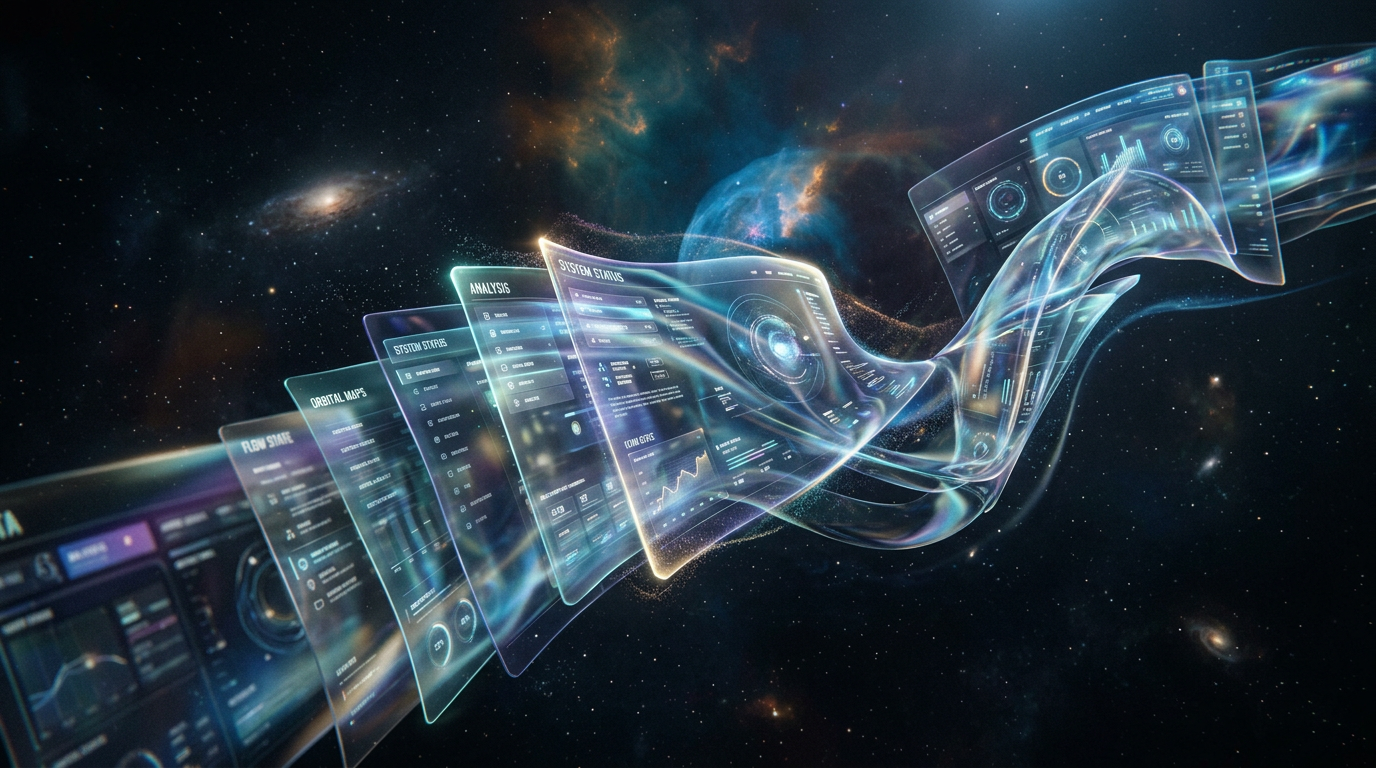
The interface paradigms through which practitioners interact with AI toolchains are in their infancy. Current interfaces — node-based visual editors, conversational chat, template galleries — represent the first generation of toolchain interaction design. The future of toolchain interfaces will be shaped by the same forces that are transforming human-computer interaction more broadly: spatial computing, natural language, gesture, and direct manipulation. This analysis explores the emerging interface paradigms for AI toolchain operation and their implications for creative practice.
The Current Interface Landscape
Today’s AI toolchain interfaces fall into several categories, each with characteristic strengths and limitations.
Node-based visual editors (ElevenLabs Flows, Scenario, ComfyUI) provide explicit visibility into workflow structure. Practitioners can see every component and connection. The strength is transparency and control. The limitation is complexity — large workflows become visually dense and difficult to navigate.
Conversational interfaces (Adobe Firefly AI Assistant, Luma AI chat) use natural language for toolchain interaction. Practitioners describe what they want; the system executes. The strength is accessibility and low learning curve. The limitation is precision — natural language is ambiguous, and complex specifications are difficult to communicate conversationally.
Template-driven interfaces (Vyndra.ai, XainFlow) present pre-configured workflows that practitioners select and customize. The strength is speed — practitioners can go from brief to output quickly. The limitation is flexibility — the available templates constrain what practitioners can achieve.
Direct manipulation interfaces (Luma boards, standard creative tools) let practitioners interact with content directly rather than through workflow representations. The strength is intuitive interaction. The limitation is that direct manipulation becomes impractical as workflow complexity increases.
The Spatial Interface
Spatial computing — augmented and virtual reality — offers new possibilities for AI toolchain interaction.
Spatial workflow visualization represents the toolchain as a three-dimensional space that practitioners can navigate, inspect, and manipulate. Workflow nodes are arranged in space, with data flow visualized as connections between them. The practitioner moves through the workflow space, examining nodes, adjusting parameters, and observing outputs in their spatial context.
Spatial context management situates creative context in the physical environment. Brand guidelines, reference materials, and creative direction are displayed as spatial elements that the practitioner can reference while working. The context is not hidden in menus or panels but present in the workspace.
Collaborative spatial work enables multiple practitioners to share a toolchain workspace, each contributing from their physical location. Team members see each other’s presence, observe toolchain operations in progress, and collaborate on workflow design and output evaluation within a shared spatial environment.
The Conversational Interface Matured
Natural language interfaces will evolve beyond current chat-based interactions to support richer, more precise communication.
Multi-turn specification enables practitioners to refine creative direction through extended conversation, with the system maintaining context across the interaction and building increasingly precise understanding of the practitioner’s intent.
Multi-modal conversation combines natural language with gesture, reference images, spatial pointing, and direct manipulation. The practitioner might say “make this image feel warmer” while pointing at a specific area of the output, combining linguistic and spatial reference.
Collaborative conversation involves the toolchain agent as an active participant in creative discussion, not just an executor of instructions. The agent can suggest directions, raise considerations, and propose alternatives, engaging in genuine creative dialogue.
The Adaptive Interface
Future toolchain interfaces will adapt to the practitioner’s skill level, working style, and current task context.
Progressive complexity surfaces simple controls for novice practitioners and reveals sophisticated capabilities as proficiency develops. The interface grows with the practitioner, always matching their current capability.
Context-adaptive presentation adjusts the interface based on what the practitioner is doing. During creative direction, the interface emphasizes reference materials and parameter controls. During quality evaluation, it emphasizes comparison tools and assessment frameworks. During production monitoring, it emphasizes throughput metrics and status indicators.
Personalization through learning enables the interface to learn the practitioner’s preferences, habits, and patterns, adapting its behavior to match their working style. The interface becomes more effective the more it is used.
The Generative Interface
The most radical future direction is the generative interface — toolchains that generate their own interfaces in response to practitioner needs.
Rather than a fixed interface designed by the platform developer, the toolchain generates an interface optimized for the specific task, practitioner, and context. A complex multi-modal campaign might generate a different interface than a simple single-image task. An experienced workflow architect might see a different interface than a novice operator.
The generative interface uses AI to determine: what controls to surface, how to arrange them, what information to display, and what interactions to support. The interface is not designed once but generated for each interaction.
The Embodied Interface
Beyond screen-based interaction, embodied interfaces connect toolchain operation to physical action.
Gesture-controlled workflows let practitioners manipulate toolchain parameters through physical gestures — adjusting model weights by hand position, controlling generation parameters through body movement. This is particularly relevant for live performance contexts where the practitioner is already in motion.
Haptic feedback provides physical sensation that communicates toolchain state. A subtle vibration might indicate generation completion. A resistance pattern might communicate quality assessment results. Haptic feedback adds a sensory channel that reduces visual monitoring burden.
Voice-controlled operation enables hands-free toolchain interaction, particularly valuable in studio environments where practitioners are simultaneously engaged in other activities.
The Implications for Creative Practice
The evolution of toolchain interfaces has implications beyond convenience. Interface design shapes how practitioners think about their work.
An interface that makes workflow structure visible encourages systematic thinking about creative production. An interface that enables fluid switching between specification and evaluation encourages iterative practice. An interface that supports collaborative interaction encourages team-based creative work.
The practitioner’s choice of interface paradigm is not neutral — it shapes their creative practice in ways that are not always apparent. Practitioners who understand this influence can make deliberate choices about which interface paradigms support their creative goals.
Platform Implications
Toolchain platform developers face significant interface design challenges as they evolve beyond current paradigms.
The tension between power and simplicity is the central interface design challenge. Interfaces that support sophisticated toolchain operation are inherently more complex than interfaces designed for casual use. Platform developers must decide which segment to serve and design accordingly.
The tension between consistency and adaptability is equally significant. A consistent interface is easier to learn and support. An adaptive interface is more efficient for experienced users. The right balance depends on the platform’s target users and use cases.
The tension between visibility and abstraction — how much of the toolchain’s internal operation to show — affects how practitioners understand and trust the system. Greater visibility supports understanding and debugging but can overwhelm and confuse. Greater abstraction simplifies interaction but can mystify the system’s behavior.
The Practitioner’s Preparation
Practitioners preparing for the evolution of toolchain interfaces should focus on transferable skills rather than platform-specific interaction patterns.
Conceptual understanding of toolchain architecture — context, routing, quality, workflow — transfers across interface paradigms. A practitioner who understands these concepts can work with any interface that expresses them.
Adaptive learning capability — the ability to rapidly learn new interfaces as they emerge — is more valuable than deep expertise in any current interface.
Interface literacy — understanding how interface design shapes creative practice — enables practitioners to make informed choices about which tools and paradigms to adopt.
Multimodal Interaction Design
Future toolchain interfaces will support multiple simultaneous interaction modalities, enabling practitioners to work in whatever mode best suits their current task.
Voice and gesture combinations allow practitioners to direct the toolchain through natural speech while using hand gestures to specify spatial relationships. “Make this image warmer” spoken while gesturing at a specific area of the output combines linguistic precision with spatial reference.
Direct manipulation with AI assistance lets practitioners interact with generated content directly — dragging, resizing, adjusting — while the AI completes the intent behind the manipulation. The practitioner roughs out a composition; the AI refines it. The practitioner adjusts a color; the AI harmonizes the adjustment across the entire palette.
Collaborative multimodal interaction enables multiple practitioners to interact with the same toolchain through different modalities simultaneously. One practitioner directs through voice while another adjusts parameters through direct manipulation. The toolchain integrates input from all participants, maintaining a coherent understanding of collective intent.
Cognitive Load & Interface Complexity
The evolution of toolchain interfaces must account for the cognitive load that different interaction paradigms impose.
Recognition over recall — interfaces that present options for selection rather than requiring the practitioner to remember and specify parameters — reduce cognitive load. The practitioner recognizes the desired configuration rather than recalling its specification.
Progressive disclosure — revealing complexity only when the practitioner needs it — prevents information overload while making advanced capabilities available on demand. The interface adapts to the practitioner’s current depth of engagement.
Consistent mental models — maintaining a consistent conceptual framework across different interaction modes — prevents the cognitive friction that occurs when the practitioner must switch between different ways of thinking about the same toolchain.
Feedback clarity — providing clear, immediate feedback about the effects of interactions — helps practitioners maintain understanding of the toolchain’s state and the relationship between their actions and the system’s responses.
The interface designer’s goal is not to minimize complexity but to manage it — making the toolchain’s sophisticated capabilities accessible without overwhelming the practitioner with the full complexity all at once.
The Human Connection
As toolchain interfaces become more sophisticated and automated, maintaining the human connection to creative work becomes both more important and more challenging.
Interfaces that distance the practitioner from the creative process — that make the work feel like it is happening somewhere else, directed by someone else — can reduce creative satisfaction and sense of ownership. Interfaces that maintain a sense of direct connection — that make the practitioner feel like they are creating, not just specifying — preserve the intrinsic motivation that sustains creative practice.
The best future interfaces will not hide the toolchain’s operation but will make it visible in ways that enhance the practitioner’s sense of creative agency. The practitioner will see their creative intent flowing through the system, recognize their decisions shaping the output, and feel that the toolchain is an extension of their creative will rather than an independent agent.
This human connection is not a luxury but a necessity for sustainable creative practice. The toolchain must serve human creativity, not supplant it.
Leave a Reply