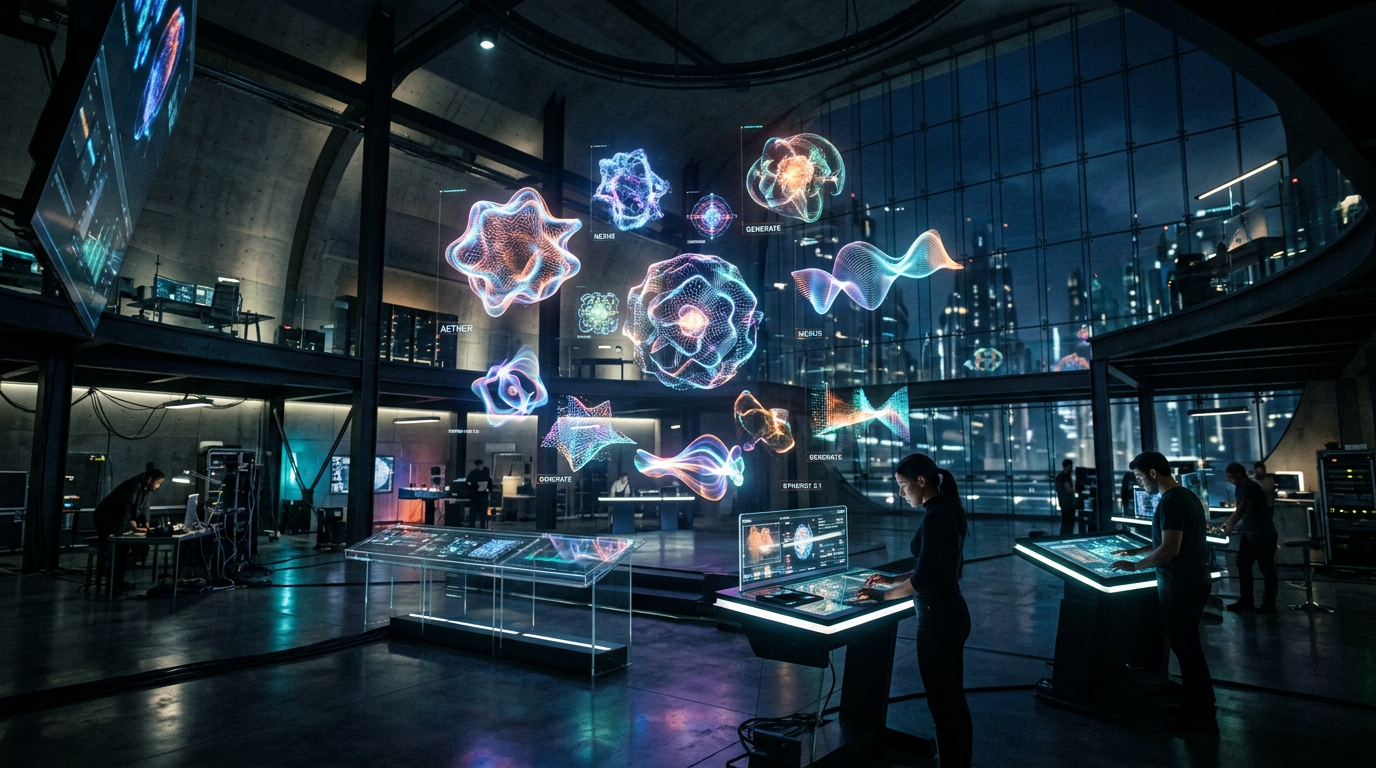
AI aesthetics trends for 2026 reveal a field that is simultaneously maturing and diversifying. The early phase of AI aesthetics, characterized by exploration of basic text-to-image capabilities and the novelty of machine-generated visuals, has given way to a more sophisticated landscape defined by specialized applications, refined techniques, and deeper integration into professional practice. This article maps the key trends shaping AI aesthetics in 2026, analyzing their technical foundations, aesthetic implications, and likely trajectories.
Trend One: The Rise of Fine-Tuned Domain Models
The most significant trend in AI aesthetics for 2026 is the shift from general-purpose base models to fine-tuned domain-specific models. While the major foundation models—Stable Diffusion, Flux, DALL-E, Midjourney—continue to improve their general capabilities, the most interesting aesthetic developments are happening in specialized models fine-tuned for specific visual domains.
Architectural Aesthetics Models
Fine-tuned models trained exclusively on architectural photography, drawings, and renders are producing imagery with a distinctive architectural sensibility. These models understand structural logic, material behavior, and spatial relationships in ways that general models do not. An architect can generate conceptual imagery that accurately represents structural possibilities rather than plausible-looking but structurally impossible configurations.
Fashion-Specific Models
Similarly, models fine-tuned on fashion photography, runway footage, and garment construction details produce outputs that respect the specific visual language of fashion: the way fabric drapes, the precision of tailoring, the specific lighting conventions of fashion photography. These models are becoming integral tools for fashion designers and brands.
The Implications
The proliferation of domain-specific models means that AI aesthetics is becoming less about what a general model can do and more about what a specialized model trained for a specific visual domain can achieve. This trend toward specialization is likely to accelerate, with models emerging for increasingly narrow aesthetic domains. [Internal Link: How Brands Use AI Aesthetics]
Trend Two: Agentic Generative Workflows
A transformative trend in AI aesthetics for 2026 is the emergence of agentic workflows—multi-step generative processes orchestrated by AI agents that make autonomous decisions about tool selection, parameter adjustment, and output refinement.
From Tool to Agent
In conventional AI aesthetics workflows, the practitioner makes every decision: which model to use, what settings to apply, which outputs to refine. Agentic workflows introduce AI agents that can make some of these decisions autonomously, freeing the practitioner to focus on higher-level creative direction.
An agentic workflow might work as follows: the practitioner specifies a creative brief; an agent determines the appropriate model and parameters; the agent generates multiple variations; the agent evaluates outputs against the brief criteria; the agent selects the best outputs and performs initial refinement; the practitioner reviews and provides feedback for further iteration.
Creative Implications
Agentic workflows raise important questions about creative agency and authorship. If an AI agent makes significant decisions about visual output, who is the author of the resulting work? The answer is not clear, and the art world is only beginning to grapple with these questions.
What is clear is that agentic workflows will significantly accelerate production velocity. Practitioners who master agentic workflows will produce more work, explore more variations, and iterate faster than those who make every decision manually.
Trend Three: Real-Time Generative Interaction
Latent consistency models and other acceleration techniques have made real-time generative interaction a practical reality in 2026. This represents a fundamental shift in the creative experience of AI aesthetics.
The Experience of Real-Time Generation
When generation happens in milliseconds rather than seconds, the creative process fundamentally changes. Practitioners can explore the latent space as a continuous, responsive environment rather than a discrete set of samples. Adjusting a prompt parameter produces an immediate visual response, enabling a fluid, conversational interaction with the model.
This real-time capability is particularly significant for interactive installations, live performance visuals, and collaborative creative sessions where immediate visual feedback is essential.
Implications for Creative Process
Real-time generation encourages a more exploratory, playful approach to AI aesthetics. The friction of waiting for generation discouraged experimentation—practitioners tended to be more conservative when each generation cost time. With real-time generation, experimentation becomes free, leading to more diverse outputs and more serendipitous discoveries.
Trend Four: Ethical and Transparent Workflows
As AI aesthetics has matured, so has the conversation about ethics and transparency. A significant trend in 2026 is the adoption of ethical and transparent workflows by serious practitioners.
Provenance Tracking
Practitioners are increasingly adopting provenance tracking systems that document the complete creative process: which model was used, what training data it was trained on, what prompts and parameters were used, and what post-processing was applied. This transparency allows viewers and clients to understand exactly how an image was produced.
Dataset-Conscious Practice
A growing number of practitioners are choosing to work with models trained on ethically sourced datasets—datasets where the training images were licensed or commissioned rather than scraped without consent. This is particularly important for commercial work where copyright questions are most acute.
Attribution Frameworks
New frameworks for attribution in AI aesthetics are emerging. These frameworks recognize the distributed nature of authorship in generative work and provide guidelines for crediting the various contributors: the model developers, the dataset curators, the prompt engineer, and the creative director.
CTA: Access our ethical AI aesthetics practice guide in the Visual Alchemist Resource Library.
Trend Five: Hybrid Human-AI Creation
The most artistically significant trend in AI aesthetics for 2026 is the move beyond pure AI generation toward hybrid human-AI creation—workflows that combine AI generation with traditional creative skills in seamless integration.
AI-Assisted Traditional Practice
Many traditional artists and designers are incorporating AI into their existing practices not as a replacement but as an assistant. An illustrator might use AI to generate texture maps, lighting studies, or compositional variations while maintaining control over the core creative decisions. A photographer might use AI to generate backgrounds or props that would be impractical to produce physically.
The Integrated Workflow
The most sophisticated hybrid workflows move fluidly between AI and traditional methods within a single creative process. A typical workflow might begin with AI-generated concept exploration, move to traditional sketching for refinement, use AI for rendering and texturing, apply traditional compositing and color grading, and finish with AI variation generation for output series.
This integrated approach leverages the strengths of both methods: the speed and variety of AI generation combined with the precision and intentionality of traditional craft.
Trend Six: AI Aesthetics in Three Dimensions
While AI aesthetics has been primarily concerned with 2D image generation, 2026 is seeing a significant expansion into three-dimensional output.
AI-Generated 3D Models
New models capable of generating 3D geometry from text prompts or 2D references are becoming practical tools. These models produce textured 3D models that can be imported into standard 3D software for further refinement. While the quality is not yet comparable to manually created 3D models for production use, the technology is advancing rapidly.
AI-Enhanced 3D Workflows
More immediately practical is the use of AI to enhance existing 3D workflows. AI tools can generate texture maps, lighting setups, and background environments for 3D scenes, significantly reducing the time required to produce finished 3D renders.
Implications for Spatial Computing
The expansion of AI aesthetics into 3D has particular significance for spatial computing. As AR and VR platforms mature, the ability to generate 3D content quickly and efficiently becomes increasingly valuable. AI aesthetics may become the primary method for populating virtual environments with visual content.
Trend Seven: The Aesthetics of AI Video
Video generation has been one of the most rapidly advancing areas of AI aesthetics. In 2026, AI-generated video is transitioning from a novelty to a practical tool for content production.
Short-Form and Social Video
The most immediate application is short-form video for social media and advertising. AI video generation enables brands to produce animated content at a fraction of the cost of traditional animation or live-action production. The aesthetic quality of AI-generated video is approaching broadcast standards for certain applications.
Temporal Aesthetics
AI-generated video has its own distinctive temporal aesthetic. The way models handle motion, transition, and temporal coherence produces a visual quality that is different from both live-action and traditional animation. Practitioners are learning to work with this temporal aesthetic rather than against it, embracing the distinctive visual character of AI-generated motion.
Looking Ahead
The AI aesthetics trends for 2026 point toward a field that is becoming more specialized, more integrated, and more sophisticated. The era of “AI can make images” is giving way to an era of “AI can make specific kinds of images for specific purposes with specific aesthetic qualities.” This specialization is a sign of maturity—a field developing its own techniques, standards, and critical discourse.
Frequently Asked Questions
What is the most important AI aesthetics trend to watch in 2026? The rise of fine-tuned domain models will have the most significant impact on professional practice, enabling AI aesthetics to serve specialized visual domains with unprecedented quality.
How will agentic workflows change creative practice? Agentic workflows will accelerate production velocity and enable practitioners to focus on higher-level creative direction rather than technical implementation details.
Is real-time generation ready for professional use? Yes. Latent consistency models and acceleration techniques have made real-time generation practical for professional workflows, particularly in interactive and exploratory contexts.
Leave a Reply