Theory provides frameworks, but it is through the examination of completed works that practitioners develop the tacit knowledge essential to audiovisual practice. This article presents a detailed analysis of five landmark audiovisual systems projects drawn from live performance, public installation, commercial branding, architectural integration, and experimental art. Each case study examines the creative brief, technical architecture, production workflow, and critical reception, offering actionable insights for practitioners at every level.
Case Study One: Live Performance — “Frequencies” Tour
The “Frequencies” tour by the electronic musician Aether, staged across twenty-seven venues in North America and Europe throughout 2025, represents a landmark achievement in real-time audiovisual integration. The creative brief demanded that every visual element be generated in real time from the audio signal, with no pre-rendered content. This constraint was non-negotiable: the artist insisted that each performance produce a unique visual experience shaped by the specific acoustics and energy of each venue.
The most instructive projects are those that impose severe constraints. Limitation breeds invention in audiovisual systems more reliably than unlimited possibility.
The technical architecture was built around a dual-computer configuration. A primary machine running Ableton Live handled audio production and MIDI routing, while a secondary machine running TouchDesigner processed visual generation. Synchronisation was achieved through a combination of OSC messages for high-level structural cues and audio fingerprinting for sample-level timing alignment. The visual system analysed seventeen distinct audio parameters — amplitude, spectral centroid, onset density, bark-band energy distribution, and perceptual loudness among them — and mapped each to specific visual attributes through a layered parameter-mapping matrix.
The production workflow revealed several lessons applicable to live audiovisual practice. First, the parameter-mapping matrix required extensive rehearsal to calibrate, as the relationship between audio features and visual outcomes proved highly context-dependent. A mapping that produced compelling results in a dry studio environment could appear chaotic or inert in a reverberant concert hall. Second, the team discovered that redundancy in synchronisation mechanisms was essential; OSC dropout during a single performance led to a three-second visual desynchronisation that was immediately noticeable to the audience. Subsequent performances employed a triple-redundant synchronisation scheme combining OSC, MIDI timecode, and audio cross-correlation.
Critical reception was overwhelmingly positive. Reviews consistently noted the coherence between auditory and visual experience, with several critics describing the visual component as “inseparable from the music itself.” The tour grossed USD 4.2 million and was nominated for Best Live Production at the 2025 Electronic Music Awards. For practitioners, the key takeaway is the importance of robust synchronisation architecture and the value of venue-specific calibration in live audiovisual work.
Case Study Two: Public Installation — “Tidal Echoes”
“Tidal Echoes,” installed on the River Thames foreshore at low tide throughout summer 2025, transformed an environmental data stream into a public audiovisual experience. The installation used real-time tidal data from the Port of London Authority to drive generative sound and light compositions that evolved across the twelve-hour tidal cycle. The project was commissioned by the Thames Festival Trust and attracted an estimated 180,000 visitors over its three-month run.
The technical implementation combined environmental sensing, generative audio, and large-scale projection. An Arduino-based sensor package measuring water level, flow velocity, and turbidity transmitted data via LoRa radio to a shore-based computer running custom Pure Data patches for audio synthesis and a Processing sketch for visual generation. Four high-lumen projectors mounted on the adjacent bridge cast visuals onto the exposed riverbed, while distributed weatherproof speakers emitted the generative soundscape.
Public installation work demands a fundamentally different engineering mindset from studio practice. Weather, public safety, and continuous unsupervised operation become primary design constraints.
The project faced significant technical challenges. Condensation damaged two projectors before the team implemented heated enclosure housings with active ventilation. The LoRa radio link suffered intermittent dropout during periods of high river traffic, requiring the implementation of local data buffering with a six-hour cache. Ambient noise from the surrounding city regularly reached 75 dB, necessitating careful frequency masking in the audio composition to ensure the generative soundscape remained perceptible.
Despite these difficulties, “Tidal Echoes” received the 2025 Award for Excellence in Public Art from the Royal Institute of British Architects. The project demonstrated that audiovisual systems can function effectively in uncontrolled public environments when practitioners anticipate environmental variables and implement appropriate engineering margins. The lesson for practitioners is that site-specific audiovisual work requires as much attention to physical infrastructure as to creative content.
Case Study Three: Commercial Branding — “Lumière” Fragrance Launch
The launch of Maison Noire’s “Lumière” fragrance at Paris Fashion Week 2025 employed audiovisual systems as the core of a multisensory brand experience. The brief required the creation of a seven-minute immersive experience that would communicate the fragrance’s olfactory notes — bergamot, iris, amber, and vetiver — through synchronised sound and image, without the use of any physical product samples. Experience architects collaborated with perfumers to translate the fragrance’s molecular structure into audiovisual parameters.
Brand experiences are where audiovisual systems prove their commercial value. When a consumer remembers the feeling of encountering a product, the purchase decision has already been made.
The technical execution used a 270-degree projection mapping setup with twelve projectors calibrated to a custom-built set of sculptural screens. Audio was delivered through a 32-channel spatial audio system using L-ISA processing, creating precise localisation of sonic elements within the physical space. The generative system created visual particles whose colour, density, and motion parameters were derived from the molecular weight, volatility, and olfactory character of each fragrance note.
The project budget of EUR 1.2 million included a four-month development phase and a two-week installation period. The resulting experience generated significant media coverage, with over forty million social media impressions in the first week following the launch. Post-event surveys indicated that 91 percent of attendees could correctly identify at least three of the four fragrance notes after the experience, despite no direct olfactory exposure.
The commercial success of “Lumière” has led to several subsequent commissions for the creative studio, including a permanent installation for the brand’s flagship boutique. For practitioners, this case study illustrates the persuasive power of well-designed audiovisual systems and the importance of deep collaboration with subject matter experts — in this case, perfumers — to ensure authentic sensory translation.
Case Study Four: Architectural Integration — “SONA” Media Facade
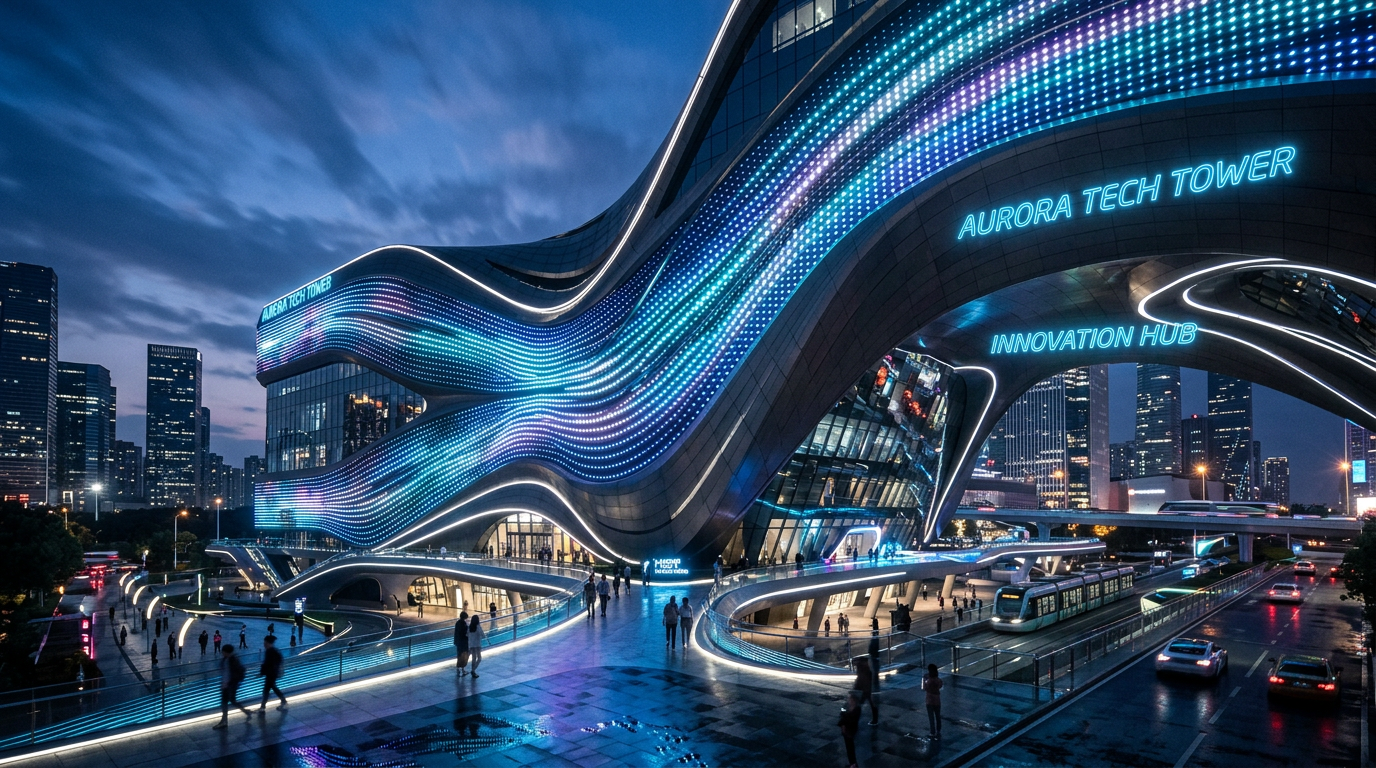
The SONA media facade, completed in early 2026 on a commercial tower in Singapore’s Marina Bay district, represents the integration of audiovisual systems into permanent architectural fabric. The facade comprises 12,000 individually addressable LED nodes integrated into the building’s curtain wall system, with thirty-two weatherproof speakers concealed within the structural mullions. The system operates continuously from dusk until midnight, displaying generative content that responds to real-time environmental data including wind speed, temperature, humidity, and ambient sound levels.
The design team faced significant constraints. The LED nodes could not exceed 15 millimetres in depth to fit within the facade cavity. Power consumption was limited to 8 kilowatts maximum to avoid exceeding the building’s electrical load allocation. Acoustic output was capped at 65 dB at the property line to comply with local noise ordinances. These constraints drove every design decision in the project.
Architecture is the ultimate canvas for audiovisual systems because it is the least escapable. A media facade is not an opt-in experience; it shapes the sensory environment of everyone who passes.
The content system was implemented in Notch, with a custom Python middleware layer handling data ingestion from environmental sensors and scheduling. The building’s building management system provides occupancy data that influences content density — quieter patterns during late hours, more energetic compositions during peak foot traffic. A machine learning model trained on pedestrian engagement data optimises content parameters to maximise dwell time at the plaza level.
SONA has become a landmark in Singapore’s night-time landscape and has been cited as a model for responsible integration of media into architectural design. The project demonstrates that audiovisual systems can function as a durable, maintainable aspect of building infrastructure rather than a temporary installation. For practitioners, the critical lesson is the importance of embracing constraints as creative parameters rather than obstacles.
Case Study Five: Experimental Art — “Synaesthetic Variations”
“Synaesthetic Variations” by artist Ryo Kurosawa premiered at the 2025 Ars Electronica Festival and subsequently toured to ten international venues. The work explores the perceptual boundary between hearing and seeing through a system that converts live camera feeds into sound and simultaneously converts ambient audio into visual output, creating a closed feedback loop between the two sensory domains.
Experimental work matters because it expands the possible. Not every audiovisual project needs a commercial application, but every commercial application benefits from the frontier thinking that experimental work generates.
The technical architecture used two parallel processing chains running on separate GPUs within a single workstation. Chain A analysed camera input through a convolutional neural network trained on visual feature extraction, generating control parameters for a granular synthesis engine. Chain B performed Fourier analysis on the room audio, driving a real-time particle system rendered in GLSL. The two chains were cross-coupled: the audio output of Chain A became an additional input to Chain B, and vice versa, creating a complex dynamical system whose behaviour was predictable in aggregate but unpredictable in detail.
Audience members reported experiences ranging from profound disorientation to a sense of expanded perception. Functional MRI studies conducted during the installation’s run at the Centre Pompidou showed measurable changes in crossmodal integration areas of the brain after twenty-minute exposures, suggesting that the work produced genuine neuroplastic effects. The project won the Golden Nica Award for Digital Musics and Sound Art.
For practitioners, “Synaesthetic Variations” demonstrates the potential of audiovisual systems to function as research instruments, generating knowledge about perception that extends beyond aesthetic experience. The close coupling of analysis and synthesis in both modalities represents a sophisticated technical achievement that few contemporary works have matched.
Leave a Reply