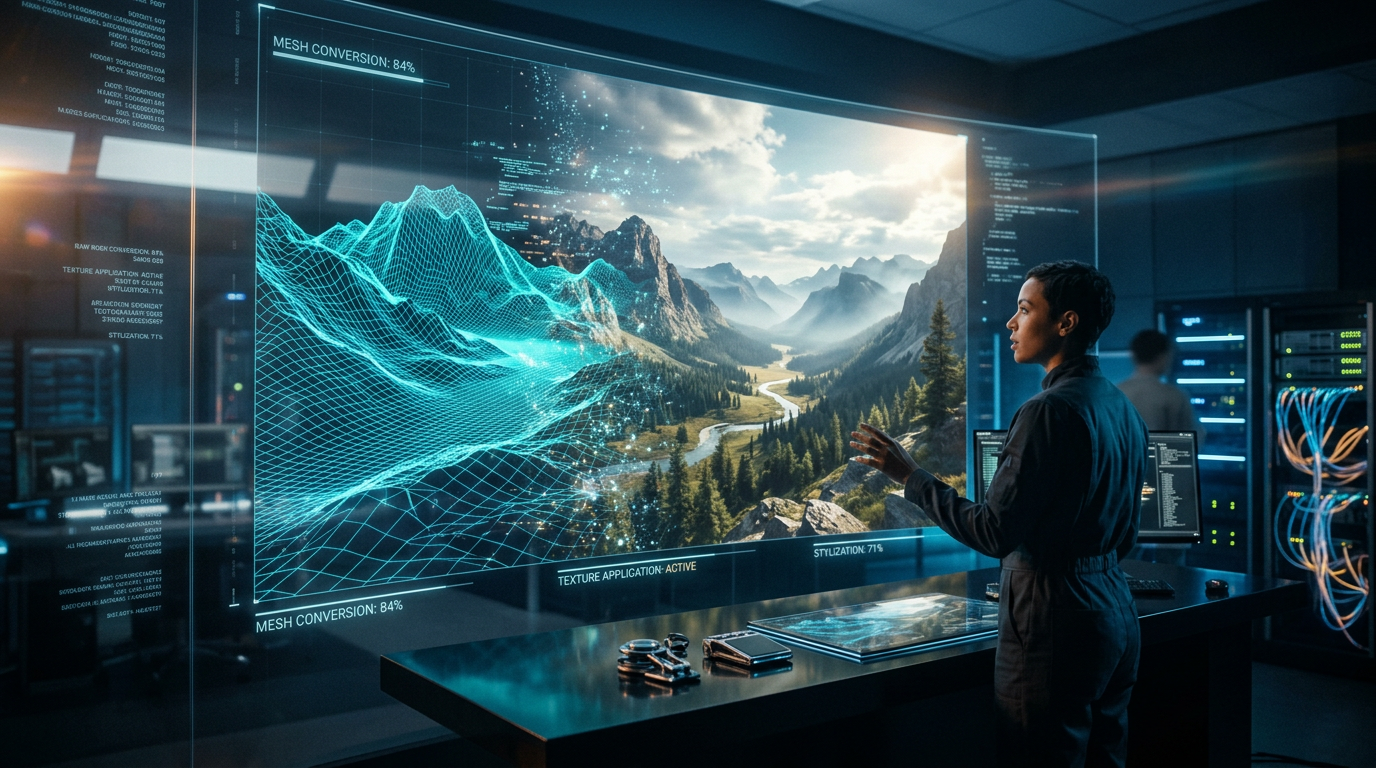
AI aesthetics and spatial computing represent a convergence that promises to transform how we experience digital content in physical space. Spatial computing—augmented reality, virtual reality, and mixed reality—places digital content in spatial relation to the physical world. AI aesthetics can generate this content dynamically, adapting to the specific characteristics of each physical environment.
This article examines the technical integration, aesthetic possibilities, and practical applications of combining AI aesthetics with spatial computing.
The Spatial Computing Context
Spatial computing encompasses technologies that enable digital content to exist in spatial relationship with the physical world.
Current Capabilities
Contemporary spatial computing platforms (Apple Vision Pro, Meta Quest, Microsoft HoloLens) can display 3D content that appears to occupy physical space. Users can view digital objects from different angles, walk around them, and interact with them through gestures and gaze.
The Content Challenge
Spatial computing faces a fundamental content challenge: creating 3D content for every possible physical environment and use case is prohibitively expensive. Traditional 3D modeling cannot scale to meet the demand for spatially aware digital content.
The AI Solution
AI aesthetics offers a solution: generate spatial content dynamically, adapting to the specific physical environment and user context. Instead of pre-creating all possible content, the system generates appropriate content on demand.
Technical Integration
Integrating AI aesthetics with spatial computing requires addressing several technical challenges.
3D Content Generation
The primary challenge is generating 3D content rather than 2D images. Current AI models for 3D generation are less mature than 2D models but advancing rapidly. Approaches include: – Text-to-3D generation from neural radiance fields – Single-image to 3D reconstruction – Generative 3D model creation – 2D-to-3D projection with depth estimation
Spatial Understanding
The system must understand the physical environment to generate appropriate content. This requires: – Room scanning and 3D reconstruction – Surface detection and classification – Lighting estimation – Spatial mapping for object placement
Real-Time Generation
Spatial computing requires real-time generation. Users expect content to appear immediately as they move through space or interact with the system. Generation latency must be minimal.
Environmental Consistency
Generated content must be consistent with the physical environment: correct scale, appropriate lighting, proper occlusion, and physical plausibility. Inconsistent content breaks the illusion of spatial presence.
Aesthetic Approaches
Several aesthetic approaches are emerging for AI content in spatial computing.
Responsive Environments
AI generates environmental content that responds to the physical space. Virtual vegetation grows along physical walls. Digital textures flow over real surfaces. Abstract forms orbit around physical objects.
The aesthetic is one of augmentation: the physical environment is enhanced rather than replaced by digital content.
Spatial Narratives
AI generates narrative content that unfolds through physical space. Different locations in the environment reveal different parts of a story. User movement through space advances the narrative.
The aesthetic is one of discovery: the user explores both physical and narrative space simultaneously.
Generative Objects
AI generates 3D objects that respond to user interaction. Objects might change form, color, or behavior based on user gaze, gesture, or proximity.
The aesthetic is one of liveness: objects that appear alive and responsive rather than static and pre-authored.
Environmental Art
AI generates large-scale environmental art that transforms the user’s perception of physical space. The generated content might create impossible architectures, surreal landscapes, or abstract visual fields that overlay the physical environment.
Applications
Architectural Visualization
Spatial computing with AI aesthetics enables architects and clients to experience proposed buildings at full scale in physical space. The AI generates interior finishes, furniture, and environmental context dynamically, creating a realistic experience of the unbuilt space.
Architects can modify the design and see changes reflected immediately, with AI generating updated visual content that responds to the modified design.
Retail and Commerce
Spatial retail environments can use AI aesthetics to generate product visualizations, virtual try-on experiences, and personalized shopping environments. A customer looking at a piece of furniture could see it generated in their own home at actual size, with AI-generated styling that matches their taste.
Entertainment and Gaming
Spatial gaming experiences can use AI aesthetics to generate unique environments for each player and each play session. The game world is not a fixed creation but a generative system that produces content in response to player behavior and environmental context.
Education and Training
Educational spatial computing experiences use AI aesthetics to generate visualizations of concepts, historical environments, or scientific phenomena. The generated content adapts to the learner’s level and learning context.
Aesthetic Qualities
AI-generated spatial content has distinctive aesthetic qualities.
Adaptive Realism
AI-generated spatial content can adapt its level of realism to the context. In some applications, photorealistic content is appropriate. In others, stylized or abstract content better serves the experience.
Environmental Responsiveness
AI aesthetics enables content that responds to the specific physical environment rather than being generic. This responsiveness creates a stronger sense of integration between digital and physical.
Temporal Evolution
AI-generated spatial content can evolve over time, changing with the time of day, user activity, or random variation. This temporal quality creates spaces that feel alive rather than static.
Challenges and Limitations
Computational Requirements
Real-time 3D AI generation is computationally demanding. Current hardware limits the complexity of what can be generated in real time.
Quality Gap
AI-generated 3D content is not yet comparable in quality to manually created 3D models for close inspection. The quality gap is closing but remains significant.
Interaction Design
Designing interactions for AI-generated spatial content requires new approaches. Traditional interaction design assumes fixed content; adaptive content requires adaptive interaction design.
The Future
The trajectory of AI aesthetics and spatial computing points toward increasingly seamless integration. Future systems will generate 3D content at quality levels comparable to authored content, at real-time speeds, and with sophisticated understanding of physical environments.
The most profound development will be generative environments that are indistinguishable from physical environments: AI-generated spatial experiences that are as rich, detailed, and convincing as the physical world.
Interaction Design for Spatial AI
Designing interactions for AI-generated spatial content requires new approaches that differ from traditional interface design.
Gaze-Based Interaction
Gaze tracking enables interaction without physical gesture. Users can direct AI generation by looking at specific locations in space. The system interprets gaze as an implicit selection mechanism, generating content in the region the user is viewing.
Gaze-based interaction feels natural because it aligns with how humans already explore spatial environments. The challenge is distinguishing between casual looking and intentional selection.
Gestural Navigation
Hand and body gestures provide intuitive control over generative parameters. Sweeping gestures can change the environment’s color palette. Pinching and expanding can scale generated objects. Pointing can specify generation locations.
The mapping between gesture and generative response must be learnable and consistent. Users should develop reliable expectations about how their gestures will affect the generated content.
Voice and Language Commands
Voice commands enable high-level direction of generative systems. Users can describe what they want to see, and the system generates appropriate content. Voice interaction is particularly valuable when hands are occupied or when precise gestural control is difficult.
Voice commands for spatial AI should support spatial language: “put a blue sphere there,” “make the lighting warmer,” “generate trees along that wall.”
Technical Architecture for Spatial AI
Building spatial AI systems requires specific technical architecture decisions.
Scene Understanding Pipeline
Before generating content, the system must understand the physical environment. This requires: room scanning and 3D reconstruction, surface classification (wall, floor, ceiling, furniture), lighting estimation, and spatial mapping for persistent content placement.
The quality of scene understanding directly affects the quality of generated content. Poor environmental understanding produces content that does not integrate properly with the physical space.
Content Persistence
Users expect AI-generated spatial content to persist consistently across sessions. Content placed at a specific location should remain there when the user returns. Persistence requires spatial anchors that survive application restarts and device changes.
Multi-User Consistency
When multiple users share a spatial experience, they should see consistent AI-generated content. This requires synchronization mechanisms that ensure all participants view the same generated environment.
Practical Implementation
Implementing spatial AI aesthetics requires specific technical skills and tools.
Development Platforms
AI Integration
Performance Optimization
Frequently Asked Questions
What hardware is needed for AI aesthetics in spatial computing? Current spatial computing devices (Apple Vision Pro, Meta Quest 3) have limited capability for on-device AI generation. Cloud-based generation with network transmission is the current practical approach.
Can AI generate 3D content for spatial computing? Yes, but the quality is not yet comparable to manually created 3D models. Text-to-3D and image-to-3D generation are rapidly improving and are already useful for conceptual and background content.
How do users interact with AI-generated spatial content? Interaction methods include gaze, gesture, voice, and controller input. The most natural interactions use multiple methods in combination.
Leave a Reply