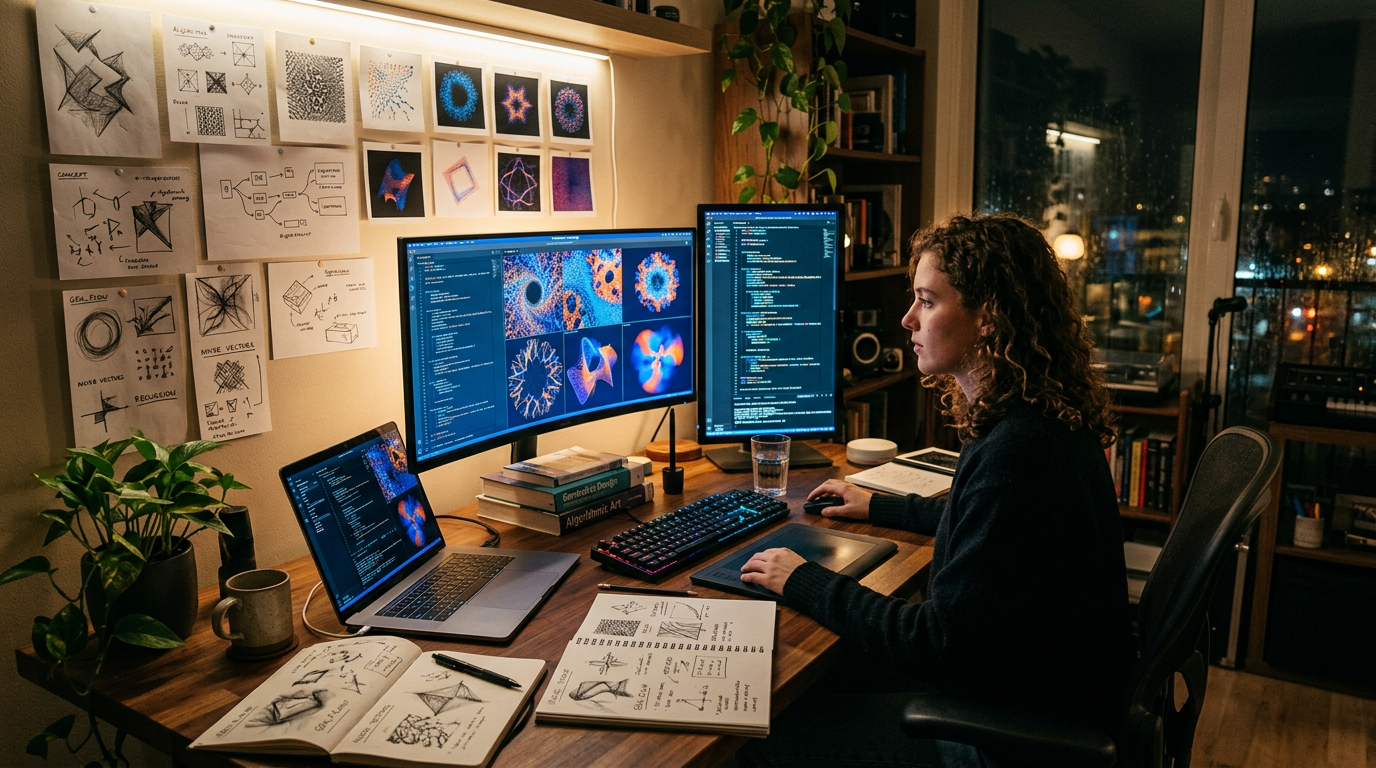
The relationship between AI aesthetics and generative AI is symbiotic and often misunderstood. Generative AI provides the technological foundation for AI aesthetics; AI aesthetics provides the creative direction, critical framework, and human context that give generative AI cultural meaning. Neither fully exists without the other.
This article examines the symbiotic relationship between AI aesthetics and generative AI, exploring how each field shapes and is shaped by the other.
Defining the Relationship
Generative AI as Technology
Generative AI encompasses the machine learning models and systems that can produce new content—images, text, audio, video, 3D models—based on patterns learned from training data. It is a technological domain concerned with model architectures, training methods, and inference optimization.
AI Aesthetics as Practice
AI aesthetics is the creative and critical practice of working with generative systems to produce meaningful visual work. It is concerned with beauty, meaning, expression, and communication—humanistic concerns that technology alone does not address.
The Symbiosis
Generative AI without AI aesthetics produces technically capable but culturally empty outputs. AI aesthetics without generative AI has no medium to work with. Each field needs the other for full expression.
How Generative AI Enables AI Aesthetics
Generative AI provides the substrate on which AI aesthetics operates.
The Capability Foundation
Every technique in AI aesthetics rests on generative AI capabilities. Latent space navigation requires models that have learned a structured latent space. Text conditioning requires models that can interpret text. ControlNet requires models that accept spatial conditioning inputs.
As generative AI capabilities advance, the possibilities for AI aesthetics expand. Better models enable better creative work.
The Quality Trajectory
The improving quality of generative models directly benefits AI aesthetics. Higher resolution, better coherence, and fewer artifacts raise the ceiling on what practitioners can achieve.
The relationship is not one-to-one: better models do not automatically produce better creative work. But they enable better work by providing a higher quality substrate.
New Capabilities
Generative AI research creates entirely new capabilities for AI aesthetics. Video generation, 3D generation, real-time generation, and multi-modal generation each open new creative territories.
How AI Aesthetics Shapes Generative AI
The influence of AI aesthetics on generative AI development is less obvious but equally important.
Use Case Definition
AI aesthetics practitioners define use cases that drive model development. The demand for better text conditioning, finer control, and higher quality comes from creative practitioners who need these capabilities for their work.
Model developers who understand AI aesthetics practice build better creative tools than those who only understand the technology.
Quality Standards
AI aesthetics establishes the quality standards that generative AI must meet. The difference between “technically functional” and “aesthetically excellent” is defined by creative practice, not by technical metrics.
Practitioners who articulate what they need from models—better composition, more consistent style, finer control—shape the development priorities of model builders.
Critical Feedback
AI aesthetics practitioners provide critical feedback that improves generative models. They identify failure modes that matter creatively, not just technically. They articulate what makes a model useful for creative work beyond benchmark scores.
Key Intersection Points
Several domains exemplify the symbiotic relationship between AI aesthetics and generative AI.
Controllability
The demand for controllability comes from creative practice. Practitioners need to direct generative outputs with precision. This demand drives research into conditioning techniques, fine-tuning methods, and parameter controls.
Each advance in controllability—ControlNet, IP-Adapter, regional prompting—enables new creative possibilities. The cycle of practitioner demand and technical response drives progress in both fields.
Aesthetic Quality
Technical quality (resolution, artifacts, coherence) is necessary but not sufficient for aesthetic quality. The aesthetic evaluation of generative outputs requires human judgment that technical metrics cannot replace.
Practitioners who understand both the technical and aesthetic dimensions can evaluate generative outputs on the dimensions that matter for creative work, providing feedback that improves both models and creative practice.
Creative Workflows
The development of creative workflows for AI aesthetics shapes how generative AI is used. Workflow innovations—multi-model pipelines, iterative refinement, feedback loops—emerge from creative practice and influence how models are developed and deployed.
The Co-Evolution of Models and Practice
The history of AI aesthetics reveals a pattern of co-evolution between models and creative practice.
The GAN Era
In the GAN era, creative practice was constrained by limited text conditioning and domain-specific models. Practitioners worked within these constraints, developing techniques for latent space navigation and style mixing. These techniques influenced the development of subsequent models.
The Diffusion Era
The diffusion era dramatically expanded creative possibilities. The open release of Stable Diffusion catalyzed an explosion of creative practice. Practitioners developed conditioning techniques that model developers had not anticipated—ControlNet, LoRA, attention control—which in turn shaped the development of subsequent model architectures.
The Current Era
Current creative practice is characterized by sophisticated multi-model workflows, fine-tuned domain models, and integrated pipelines. Model development is responding with multi-modal capabilities, real-time generation, and improved controllability.
This pattern of co-evolution will continue. Each advance in generative AI enables new creative possibilities. Each creative innovation reveals new requirements for generative AI.
Tensions in the Relationship
The symbiotic relationship also involves productive tensions.
Speed vs. Quality
Generative AI research prioritizes speed and efficiency. Creative practice prioritizes quality and control. These priorities sometimes conflict: fast generation may sacrifice quality; high-quality generation may be too slow for interactive applications.
Resolving this tension requires both technical innovation (more efficient architectures) and practical accommodation (pre-generation for interactive applications).
Automation vs. Craft
Generative AI tends toward automation—doing more with less human input. Creative practice values craft—the human contribution to the work. Too much automation reduces the scope for craft; too little makes the technology inefficient.
The productive balance lies in automating what can be automated while preserving human creative agency where it matters most.
Generalization vs. Specialization
Generative AI research pursues general models that handle many tasks. Creative practice often benefits from specialized models optimized for specific domains. The tension between generality and specialization shapes model development and creative application. [Internal Link: The Evolution of AI Aesthetics]
The Evaluation Gap
One of the most significant challenges in the AI aesthetics and generative AI relationship is the evaluation gap.
Technical Metrics vs. Aesthetic Quality
Generative AI research evaluates models using technical metrics: FID (Fréchet Inception Distance) measures distribution similarity, CLIP score measures text-image alignment, and IS (Inception Score) measures image quality. These metrics are useful for comparing models but do not capture aesthetic quality.
A model with excellent technical metrics may produce images that are technically competent but aesthetically uninteresting. Conversely, a model with modest technical metrics may produce aesthetically compelling work when directed by a skilled practitioner.
Closing the Gap
Closing the evaluation gap requires new evaluation frameworks that incorporate aesthetic dimensions. Some researchers are developing human evaluation protocols that capture aesthetic qualities. AI aesthetics practitioners can contribute to this effort by articulating the aesthetic dimensions that matter in their work.
Implications for Model Selection
Practitioners must evaluate models based on aesthetic criteria relevant to their work rather than technical metrics alone. Testing models through direct creative use, comparing outputs across aesthetic dimensions, and sharing findings with the community helps the field develop better evaluation practices.
The Knowledge Asymmetry Challenge
A structural challenge in the symbiotic relationship is knowledge asymmetry between technical and creative communities.
Technical Community Understanding of Aesthetics
Many generative AI researchers and developers have limited understanding of aesthetic principles, creative workflows, and artistic practice. This knowledge gap leads to models and tools that are technically sophisticated but poorly designed for creative use.
Bridging this gap requires closer collaboration between technical and creative communities. AI aesthetics practitioners who can communicate their needs in technical terms are particularly valuable.
Creative Community Understanding of Technology
Conversely, many AI aesthetics practitioners have limited understanding of the technical foundations of generative AI. This knowledge gap limits what practitioners can achieve and makes them dependent on tool developers.
Practitioners who invest in technical understanding gain significant advantage: they can work more effectively with current tools, anticipate future developments, and contribute to tool development.
Structural Solutions
Addressing knowledge asymmetry requires structural solutions: interdisciplinary education programs, collaborative research projects, and platforms that facilitate knowledge exchange between technical and creative communities. The most successful AI ecosystems are those that bridge this gap effectively.
Implications for Practitioners
Understanding the symbiotic relationship between AI aesthetics and generative AI has practical implications.
Stay Connected to Both Communities
Practitioners benefit from engaging with both the AI aesthetics community and the generative AI research community. Each provides valuable perspectives and capabilities.
Contribute Feedback
Practitioners who provide thoughtful feedback to model developers shape the development of better creative tools. Your experience as a practitioner is valuable data for model improvement.
Anticipate Developments
Understanding the trajectory of generative AI research helps practitioners anticipate future capabilities and prepare for them. Following research publications and model releases provides strategic foresight.
Ethical Dimensions of the Relationship
The symbiotic relationship carries ethical responsibilities for both communities.
Responsible Development
Generative AI developers have responsibility for how their models are trained, what data is used, and how models are released. These decisions have profound effects on AI aesthetics practice. Models trained on ethically sourced data, with appropriate attribution and compensation mechanisms, provide a more sustainable foundation for creative practice.
Responsible Practice
AI aesthetics practitioners have responsibility for how they use generative systems. Transparent disclosure, respect for intellectual property, and consideration of labor impact are ethical obligations that practitioners should integrate into their practice.
Shared Responsibility
The most important ethical questions cannot be addressed by either community alone. Questions about ownership, attribution, cultural impact, and the future of creative work require collaboration between technical developers and creative practitioners. [Internal Link: The Ethics of AI Aesthetics]
Building Bridges Between Communities
Strengthening the symbiotic relationship requires intentional bridge-building.
Cross-Disciplinary Events
Hackathons, residencies, and workshops that bring together technical developers and creative practitioners create opportunities for mutual learning. These events produce both better tools and better creative work.
Collaborative Research
Research projects that include both technical and creative perspectives produce more relevant outcomes than purely technical research. AI aesthetics practitioners should seek opportunities to participate in research collaborations.
Knowledge Sharing Platforms
Platforms that facilitate knowledge sharing between technical and creative communities—shared tutorials, documentation, and case studies—reduce knowledge asymmetry and strengthen the symbiotic relationship.
The Future of the Relationship
The symbiotic relationship between AI aesthetics and generative AI will intensify. Future generative AI systems will be designed with creative practice in mind. Future AI aesthetics will leverage increasingly capable generative systems.
The boundary between the two fields will blur. Practitioners will need understanding of both technology and creative practice. Model developers will need understanding of aesthetic values and creative workflows.
The most important developments will emerge from the intersection: capabilities that neither field would develop independently but that arise from their combination.
Frequently Asked Questions
Does generative AI need AI aesthetics? Generative AI technology produces technically capable outputs, but AI aesthetics provides the creative direction, quality standards, and human meaning that make those outputs culturally valuable.
How can I contribute to both fields? Practice AI aesthetics while engaging with generative AI research. Provide feedback to model developers. Share your creative insights with the technical community and technical insights with the creative community.
What developments in generative AI should AI aesthetics practitioners watch? Key developments include video generation, 3D generation, real-time generation, multi-modal models, and improved controllability techniques.
Leave a Reply